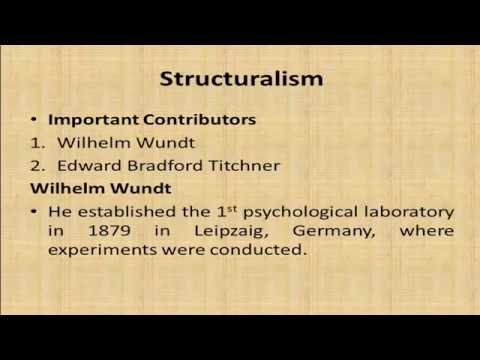
Structuralism School of Psychology | Wilhelm Wundt | English
Keywords
Summary
168 words
Critical Evaluation
Value of the Information & Strength of the Argument
The video provides value as an introductory resource for learners new to structuralism. It explains the core concepts—school of thought, consciousness, introspection—in a straightforward manner, using relatable examples. The argumentation is logical: it defines a school of thought, then applies that framework to structuralism, explains Wundt’s contributions, and contrasts Titchener’s refinements. However, the argumentation is simplistic and does not engage with alternative interpretations or criticisms. No evidence beyond textbook-level claims is provided, and the speaker’s language is informal and occasionally ambiguous. The strength of the argumentation lies in its clarity and step-by-step approach, but it lacks rigorous justification and depth.
Scientific Rigor, Source Quality, Title Accuracy
The video does not cite any external sources or provide references, limiting its scientific rigor. The content relies on well-known historical facts (e.g., Wundt’s laboratory in 1879) but is presented without citations. The information is generally accurate but simplified to the point of potential distortion (e.g., the list of consciousness components). The title adequately matches the content, as it directly addresses structuralism and Wundt. The video is purely educational and does not aim for advanced analysis; thus, the absence of sources is consistent with its introductory nature.
202 words
Title / Content Match
The title accurately reflects the content: the video explains structuralism, highlights Wilhelm Wundt, and is presented in English.
Quality & Reliability
7/10
The video presents a clear and basically accurate overview of structuralism, but simplifies concepts and includes minor imprecisions (e.g., the characterization of consciousness components). The content is consistent with standard historical accounts.
Key Moments
Markers derived by PSI from the transcript: the creator did not define chapters.
- Introduction and overview of the lecture
- Definition of a school of thought
- Wilhelm Wundt's contributions, including the first psychology lab in 1879
- Explanation of consciousness and the goal of structuralism to break it down
- Example of hand burning to illustrate reduction of mental processes
- Description of introspection method and its role
- Wundt's three components of consciousness: ideas, feelings, emotions
- Edward Titchener's life and refinements to introspection
- Titchener's view on ideas and images relationship
- Conclusion and preview of next lecture on functionalism
Contribution & Novelties
The video offers a simplified, accessible introduction to structuralism, making it easy for beginners to grasp fundamental concepts. However, it does not present new research or original perspectives. Its primary contribution is pedagogical clarity.
Pour aller plus loin :
- Wilhelm Wundt — Provides a thorough biographical and scientific overview, complementing the video’s brief mention.
- Structuralism (psychology) — Detailed account of the school, including its methods and criticisms.
- Introspection — Explores the method’s history and role in psychology.
- Edward Titchener — Though not linked here, his work is central; consider consulting an academic source for depth.
95 words
Radar Profile
The radar profile shows moderate scores across information quantity and quality, with a lower technical level and a slightly higher reliability. This indicates the video is a basic, reliable introduction without technical depth or extensive content, suitable for absolute beginners.