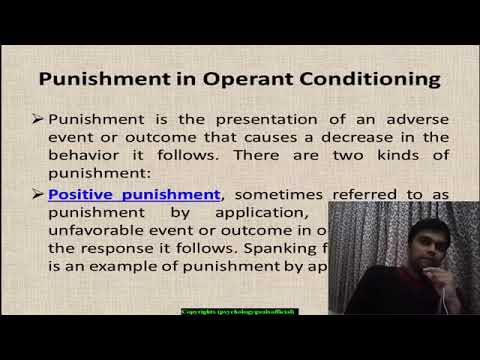
Behaviorism Operant Conditioning BF Skinner, Thorndike | Hindi | Urdu
Keywords
Summary
147 words
Critical Evaluation
Value of the Information & Strength of the Argument
The video provides a straightforward and accessible explanation of operant conditioning, making complex psychological concepts understandable for beginners. The argumentation is built on classic experiments (Skinner’s box, Thorndike’s puzzle box) and real-life examples, which strengthens the pedagogical value. The distinction between reinforcement and punishment is clearly articulated, helping to resolve common confusions. However, the presentation lacks depth in discussing nuances such as schedules of reinforcement or ethical considerations, limiting its value for advanced learners. The argumentation is logically consistent, though occasionally repetitive, and the use of Hindi/Urdu makes it valuable for regional audiences.
Scientific Rigor, Source Quality, Title Accuracy
The video is a tutorial that references key figures (Skinner, Thorndike) and their foundational experiments, but it does not cite specific studies or publications. The absence of external sources reduces the scientific rigor, though the core concepts are accurately presented at an introductory level. The title ‘Behaviorism Operant Conditioning BF Skinner, Thorndike’ aligns perfectly with the content, which focuses on operant conditioning from these theorists. The description provides no additional references, so the information is self-contained but not deeply sourced. The presentation is clear and methodical, with practical examples that enhance understanding.
200 words
Title / Content Match
The title accurately reflects the content, which focuses on operant conditioning as developed by B.F. Skinner and Edward Thorndike, presented in Hindi/Urdu.
Quality & Reliability
7/10
Clear and structured explanation of operant conditioning, reinforcement, and punishment, with practical examples. Minor inaccuracies in wording and occasional ambiguity but overall reliable for introductory purposes.
Key Moments
Markers derived by PSI from the transcript: the creator did not define chapters.
- Introduction and overview of operant conditioning.
- Definition of operant conditioning and its components.
- Explanation of reinforcement and punishment in general.
- Skinner's experiment with the rat in a box.
- Thorndike's law of effect and its significance.
- Distinction between respondent and operant behaviors.
- Positive and negative reinforcement with examples.
- Positive and negative punishment with examples.
- Comparison between reinforcement and punishment.
- Summary and final review of key points.
Cited Sources
- B.F. Skinner — Mentioned as the main proponent of operant conditioning.
- Edward Thorndike — Mentioned for his law of effect.
Contribution & Novelties
The video offers a concise, beginner-friendly introduction to operant conditioning, emphasizing the practical application of reinforcement and punishment in everyday settings. It successfully clarifies the often-confused distinction between reinforcement and punishment, and between positive and negative variants. The contribution is primarily pedagogical, making a foundational psychological theory accessible to a Hindi/Urdu-speaking audience.
Pour aller plus loin :
- Operant conditioning — Comprehensive overview of the theory and its mechanisms.
- B.F. Skinner — Biographical and scientific details of Skinner’s work.
- Edward Thorndike — Background on Thorndike’s law of effect and his experiments.
- Schedules of reinforcement — Advanced topic extending the basic concepts presented in the video.
104 words
Radar Profile
The radar profile shows high scores in quantity and quality of information, with moderate technical depth and reliability. This indicates a solid introductory resource that is informative and generally accurate, though not deeply technical or heavily sourced.