African Studies Global Virtual Forum: Decoloniality & Southern Epistemologies - Arturo Escobar
Keywords
Summary
158 words
Critical Evaluation
Value of the Information & Strength of the Argument
The talk offers substantial intellectual value by synthesizing decolonial theory with Latin American activist practices. Escobar constructs a coherent argument that moves from critique of monohumanism to a proposal of a new civilizational narrative, supported by concrete examples such as the Atrato River case and the concept of ’terricidio’. The argumentation is persuasive, appealing to both reason and lived experience, and is enriched by references to thinkers like Gramsci, Wynter, and Krenak. The presentation is dense but well-structured, making a compelling case for the necessity of ontological shifts. However, the pace is rapid and some concepts are touched upon only briefly, which might leave non-specialists wanting more depth. Overall, the value lies in its integrative framework and its ability to inspire new ways of thinking about societal transitions.
Scientific Rigor, Source Quality, Title Accuracy
The talk demonstrates strong scholarly rigor, drawing on a wide range of sources including academic literature, indigenous philosophies, and political movements. Escobar does not provide explicit citations during the talk, but his references to specific thinkers and his own published works imply a solid grounding. The title ‘Beyond Monohumanism: An Emerging Narrative From Latin America’ accurately captures the central theme and scope. The talk aligns perfectly with the forum’s focus on decoloniality and southern epistemologies, which enhances its relevance and coherence. While the lack of visual citations might be seen as a minor limitation, the oral tradition of delivery and the depth of expertise compensate for this. The announcements at the beginning about the book series also reinforce the scholarly nature of the event, but they are distinct from the main content and do not detract from its rigor.
282 words
Title / Content Match
The title precisely matches the talk's focus on contrasting monohumanism with a nascent Latin American civilizational narrative.
Quality & Reliability
8/10
The talk is grounded in extensive academic and activist work, referencing key thinkers and concepts, but relies on oral presentation without explicit citation of sources during the delivery.
Key Moments
Markers derived by PSI from the transcript: the creator did not define chapters.
- Escobar begins his presentation, framing the talk around civilizational crisis and the need for new narratives.
- Discussion of terricidio and the connection between ecological and epistemic violence.
- Introduction of Sylvia Wynter's concept of monohumanism and the call to move beyond it.
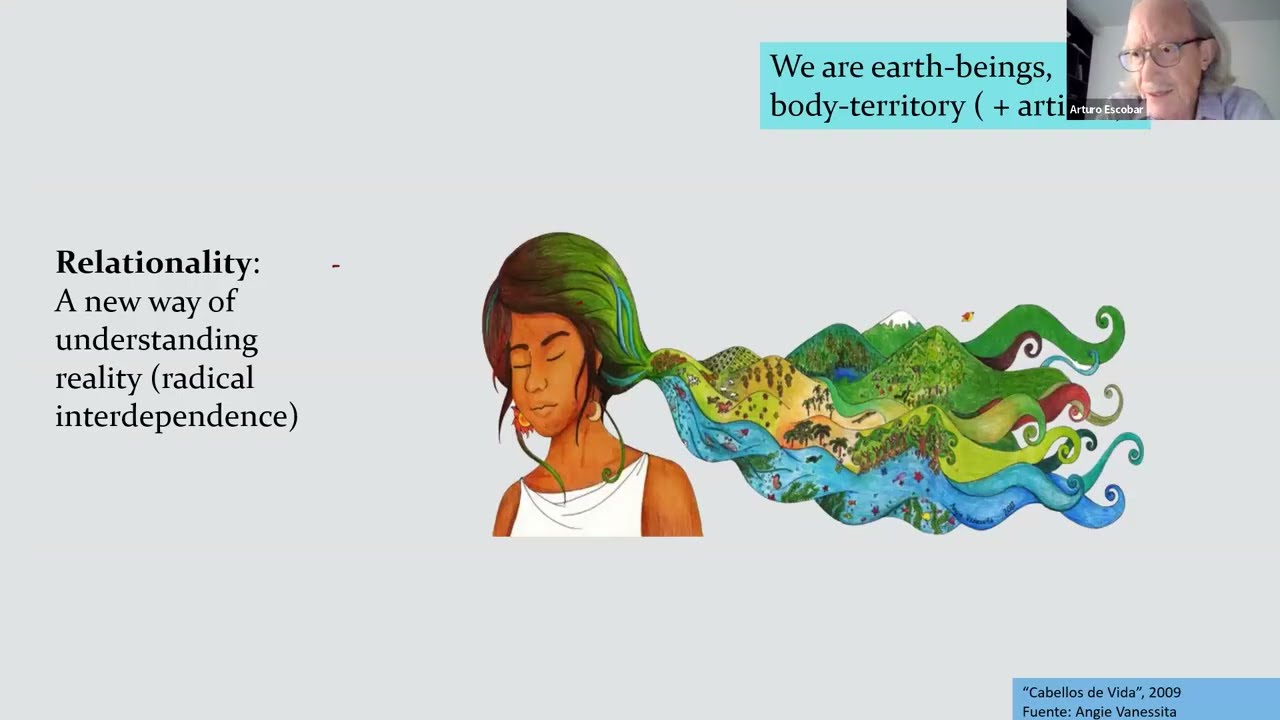
- Proposal of interdependence and relationality as key principles for new civilizational narratives.
- Detailed explanation of the six concepts: territoriality, communality, autonomy, reexistence, transitions to buen vivir, and politics in the feminine.
- Concluding remarks on the pluriverse and the political activation of relationality.
Cited Sources
- Encountering Development: The Making and Unmaking of the Third World — Cited as Escobar's well-known book during the introduction.
- Designs for the Pluriverse: Radical Interdependence, Autonomy, and the Making of Worlds — Listed among Escobar's recent publications.
- Pluriversal Politics: The Real and the Possible — Another of Escobar's recent books mentioned in the introduction.
- Decolonial Voices, Language and Race — First volume in the forum's book series, announced during the talk.
Contribution & Novelties
This talk provides a novel framework linking civilizational crisis with concrete Latin American epistemologies, articulated through six interconnected concepts. Escobar’s emphasis on ‘politics in the feminine’ as a unifying theme offers a fresh perspective on care and reproduction of life. The talk innovatively bridges academic theory with grassroots movements, proposing a shift from resistance to ‘reexistence’. It contributes to the decolonial project by centering relationality and the earth as active subjects.
Pour aller plus loin :
- Decoloniality — Key conceptual background for understanding the talk’s foundation.
- Buen Vivir — Central to the proposed transitions and rooted in Andean cosmovisions.
- Pluriverse — Concept of multiple worlds that aligns with Escobar’s call beyond monohumanism.
- Sylvia Wynter — The intellectual source of the term ‘monohumanism’ and related critiques.
125 words
Radar Profile
The radar chart would likely show high scores in information quantity and quality, reflecting the dense and well-supported content, with slightly lower but still robust scores on technical depth and reliability. This suggests a talk that is both intellectually stimulating and trustworthy, appealing to an academic audience familiar with decolonial terminology.