African Studies Global Virtual Forum: Decoloniality & Southern Epistemologies - Vavrus
Keywords
Summary
129 words
Critical Evaluation
Value of the Information & Strength of the Argument
The talk provides a compelling and original perspective on education, challenging the dominant narrative that schooling inevitably leads to certainty. Vavrus argues convincingly that in contexts of profound structural inequality, schooling can become a form of ‘cruel optimism’ that hinders well-being rather than fostering it. She supports her claims with rich ethnographic evidence from a longitudinal study of nearly 300 Tanzanian youth, interwoven with personal memoir, which strengthens the argument by showing the entanglement of researcher and researched. The discussion is theoretically informed, drawing on Lauren Berlant’s concepts of ‘crisis ordinariness’ and ‘cruel optimism’, as well as Johannes Fabian’s idea of ‘co-evalness’, to analyze how uncertainty is experienced and navigated. The argumentation is nuanced and does not dismiss the aggregate benefits of schooling, but rather highlights the social contingencies—such as family support, sponsors, and relationships—that are often decisive. The lecture effectively demonstrates that uncertainty is both a limiting condition and a generative force, as anticipatory knowledge production. The use of paired chapters to alternate personal and research perspectives proves an innovative way to present findings, though at times the memoir elements may overshadow the ethnographic data.
Scientific Rigor, Source Quality, Title Accuracy
The presentation demonstrates strong scholarly rigor. Vavrus is a professor at the University of Minnesota with extensive field experience in Tanzania, and her talk is based on a published book and supported by longitudinal data and theoretical references. She cites specific authors and works, such as Ruth Behar, Johannes Fabian, Lauren Berlant, and Sandra Calkins, grounding her arguments in established academic literature. The research methods include ethnography, interviews, surveys, and a 12-year longitudinal demographic study, which adds credibility. The title of the talk mentions decoloniality and southern epistemologies, which are relevant to the critique of Western-centric educational assumptions and the emphasis on local contexts and relational knowledge; however, the core content focuses more on uncertainty and schooling than on explicit decolonial theory. The video includes no sponsored content. The presentation is an academic lecture, and the Q&A portion (not transcribed) likely deepens the discussion. Overall, the sources are credible, and the content aligns with academic standards.
357 words
Title / Content Match
The title references decoloniality and southern epistemologies, which connect to the talk's focus on Tanzanian education and uncertainty, though the central topic is schooling and uncertainty.
Quality & Reliability
8/10
High-quality academic presentation by a recognized expert, grounded in longitudinal ethnographic research and published scholarship, though it largely reflects personal narrative and interpretation.
Key Moments
Markers derived by PSI from the transcript: the creator did not define chapters.
- Introduction by host and presentation of Frances Vavrus.
- Vavrus discusses background of the project, starting as essays in 2007.
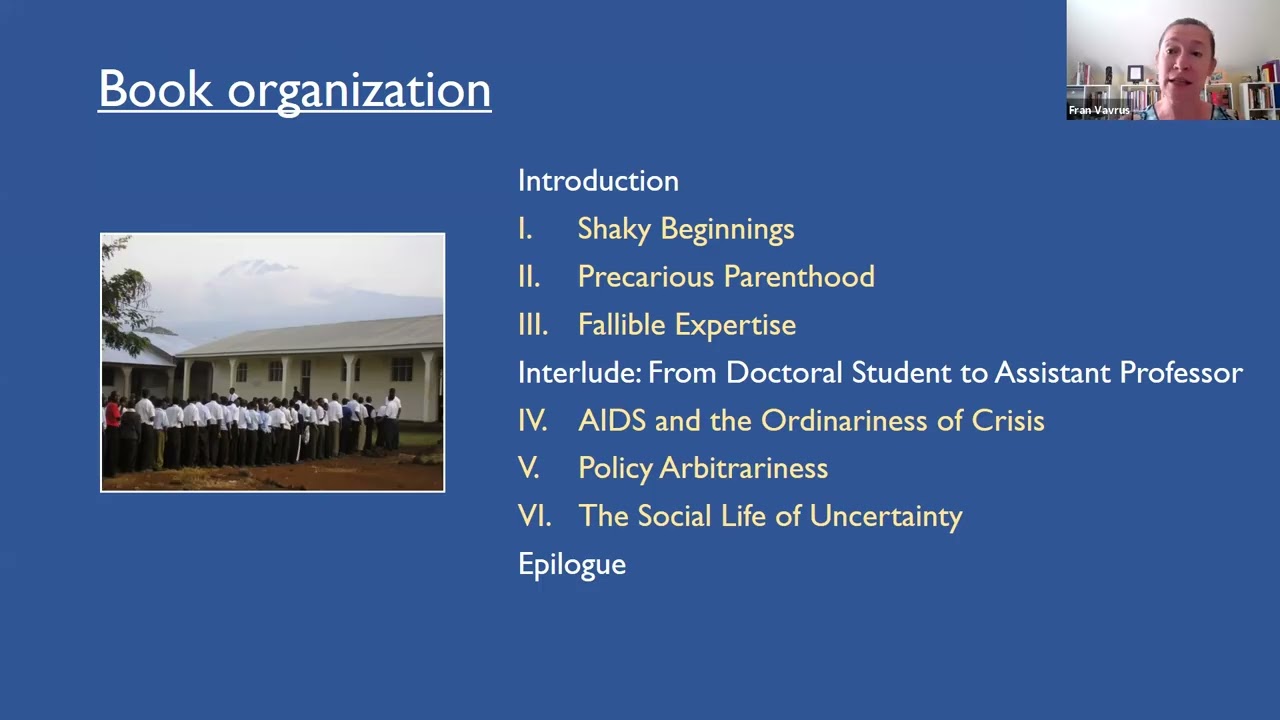
- Overview of the book's structure with six paired chapters.
- Presentation of three key arguments: biography as knowledge production, uncertainty, and cruel optimism.
- Examples from paired chapters: shaky beginnings, precarious parenthood, fallible expertise, and gendered contingencies.
- Discussion and Q&A session begins.
Contribution & Novelties
The original contribution of this talk lies in combining ethnography and memoir to explore uncertainty related to schooling, particularly in the Tanzanian context. The author proposes a relational and temporal approach to knowledge production, and questions the dominant optimism about education’s role.
For further reading:
- Lauren Berlant — The theorist behind ‘cruel optimism’ and ‘crisis ordinariness’, central to the talk’s framework.
- Johannes Fabian — Anthropologist who introduced the concept of ‘co-evalness’, used to argue for shared temporality in ethnographic research.
- Decoloniality — The broader epistemological movement that critiques Eurocentric knowledge production, relevant to the talk’s emphasis on Southern perspectives.
99 words
Radar Profile
The radar shows strong scores in information quality and reliability, with a slightly lower quantity and technical level, reflecting the humanities-oriented, personal-narrative approach. Overall, the presentation is highly credible and informative.