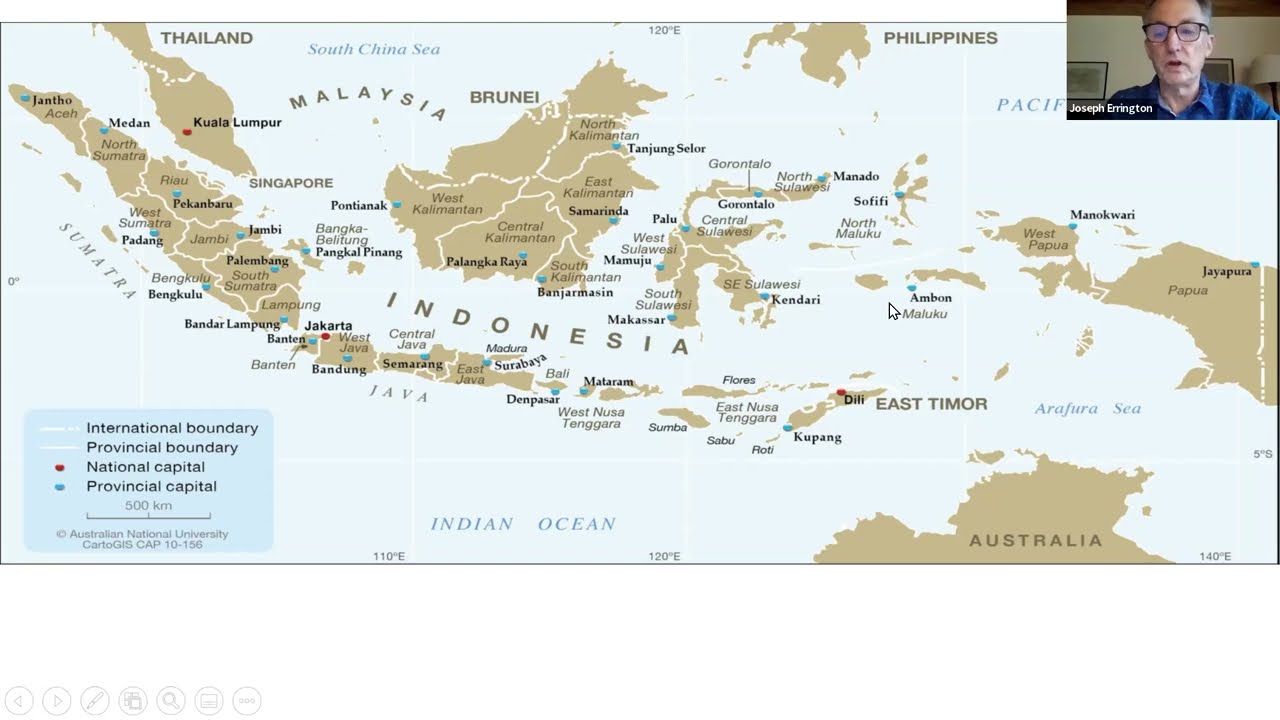
African Studies Global Virtual Forum: Decoloniality & Southern Epistemologies - Joseph Errington
Keywords
Summary
203 words
Critical Evaluation
Value of the Information & Strength of the Argument
The talk’s primary value lies in its reevaluation of theoretical frameworks from the global north using Indonesian evidence. Errington convincingly argues that Indonesian’s status as a lingua franca without native speakers disrupts conventional associations between language, territory, and identity. He builds a case that the ideologies of anonymity and authenticity, which usually underpin national languages in Europe, are split in Indonesia, allowing the national language to remain neutral while vernaculars provide authentic local ties. His argumentation is systematic, moving from macro-level historical analysis to micro-level urban case studies, and he explicitly acknowledges the limitations of his choices (e.g., skipping empirical data for time). The discussion of English as a global lingua franca is integrated into the larger picture, highlighting how Indonesia’s multilingual landscape navigates both national and global linguistic pressures. The talk is intellectually stimulating and offers a fresh perspective on language policies in postcolonial contexts.
Scientific Rigor, Source Quality, Title Accuracy
Errington demonstrates strong scholarly rigor by grounding his claims in well-established sociolinguistic theories and empirical research. He references influential works such as the Comaroffs’ ‘Theory from the South’, Gal and Woolard on language ideologies, and recent studies on language revitalization and superdiversity in Europe. His own long-term fieldwork in Indonesia lends credibility to the case studies. However, the talk is a synthetic overview rather than a detailed data presentation, so some assertions are presented without full evidence in this forum. The title of the video explicitly connects the talk to decoloniality and southern epistemologies, which aligns with the content’s focus on challenging Eurocentric assumptions about language and nationalism. The specific subtitle ‘Living with lingua francas: English in Indonesia and Indonesian’ is an accurate summary of the core discussion. Overall, the sources are appropriate and the title faithfully reflects the substance.
301 words
Title / Content Match
The title accurately reflects the content: the talk examines Indonesian as a national lingua franca without native speakers and contrasts it with English as a global lingua franca, all within the broader theme of decoloniality and southern epistemologies.
Quality & Reliability
8/10
The talk is given by a senior professor of linguistic anthropology with 40 years of experience, presenting arguments grounded in established sociolinguistic theory and empirical research from multiple Indonesian sites. The reasoning is explicit and coherent, though it relies heavily on the speaker's own expertise and the audience is assumed to be familiar with key concepts.
Key Moments
Markers derived by PSI from the transcript: the creator did not define chapters.
- Announcement of the Routledge Handbook of Language in the Global South, with details on its structure and contributions.
- Introduction of Joseph Errington and his talk on living with lingua francas, focusing on Indonesian and English.
- Discussion of ideologies of anonymity and authenticity in national languages, and the role of the native speaker concept.
- Overview of Indonesian's development as a national lingua franca, including historical stages from colonial to post-independence.
- Presentation of vernacular Indonesian case studies in Kupang and Pontianak, illustrating the emergence of regional lingua francas.
- Discussion of English as a global lingua franca and its ambiguous relationship with Indonesian in the context of modernity.
Cited Sources
- Theory from the South: Or, How Euro-America is Evolving Toward Africa — Referenced as framing the comparison of sociolinguistic dynamics between the global north and south.
- Languages and Publics: The Making of Authority — Mentioned in relation to Gal and Woolard's distinction between anonymity and authenticity in national languages.
- Woolard's work on Catalan in the Catalonian independence movement — Used as an example of the dissociation of anonymity and authenticity in a European context.
- Standard Languages and Language Standards in a Changing Europe (2011) — Cited as evidence of de-standardization of national languages in Western Europe, particularly Dutch.
- Joshua Fishman's concept of the 'Indonesian miracle' — Mentioned to highlight Indonesia's success in overcoming linguistic heterogeneity.
Contribution & Novelties
Errington’s contribution is to present Indonesia as a counterexample to the standard European model of language nationalism, showing that a national language can be a lingua franca with no native speakers and yet succeed. He introduces the idea that the split between anonymity and authenticity, which in Europe creates tension, is in Indonesia a productive separation that allows both national and vernacular languages to thrive. This challenges conventional sociolinguistic theory. The talk also highlights the role of urban vernaculars as emerging regional lingua francas that can threaten local languages more than the standard language does. Finally, by examining English as a global lingua franca alongside Indonesian, he situates Indonesia within wider discussions of globalization and linguistic inequality.
Pour aller plus loin :
- Lingua franca — A useful overview of the concept central to the talk, explaining its historical and contemporary meanings.
- Diglossia — Ferguson’s classic concept that underlies the high-low language distinction Errington discusses in Indonesia.
- New speaker — A term from language revitalization research that parallels the rise of vernacular speakers in Indonesian urban centers.
- Decoloniality — The broader intellectual framework mentioned in the video title and relevant to the talk’s critical perspective on Eurocentric linguistics.
197 words
Radar Profile
The profile shows a high balance across all dimensions, with slightly lower technicality (7) compared to information quantity and quality (8 each). This suggests an accessible but intellectually rigorous presentation suitable for an academic audience. The reliability score (8) reflects the speaker's authority and use of established theories, though the talk is primarily an expert synthesis rather than a data-driven study.