Prof. Michael Wolf | Equipartitions of positive operators
Keywords
Summary
150 words
Critical Evaluation
Value of the Information & Strength of the Argument
The talk provides a novel and unifying perspective on several open problems in quantum information by framing them as equipartition problems. The argumentation is rigorous, building from a simple toy example (using the Borsuk-Ulam theorem) to a more general framework involving flag manifolds and equivariant cohomology. The speaker is careful to distinguish between what can be proven and what remains conjectural, and he explicitly acknowledges the limitations of the method. The value lies in the potential to apply topological tools to quantum information problems, offering a new avenue for research.
Scientific Rigor, Source Quality, Title Accuracy
The talk is scientifically rigorous, with clear definitions and logical progression. The speaker cites the work of Ruskai and others, and the context of the Isaac Newton Institute adds credibility. However, no specific sources are cited in the talk itself, and the description only provides links to the institute and the seminar page. The title accurately reflects the content, which is a focused mathematical exposition. The presentation is a research seminar, not a peer-reviewed publication, so the claims are presented as work in progress rather than established results.
193 words
Title / Content Match
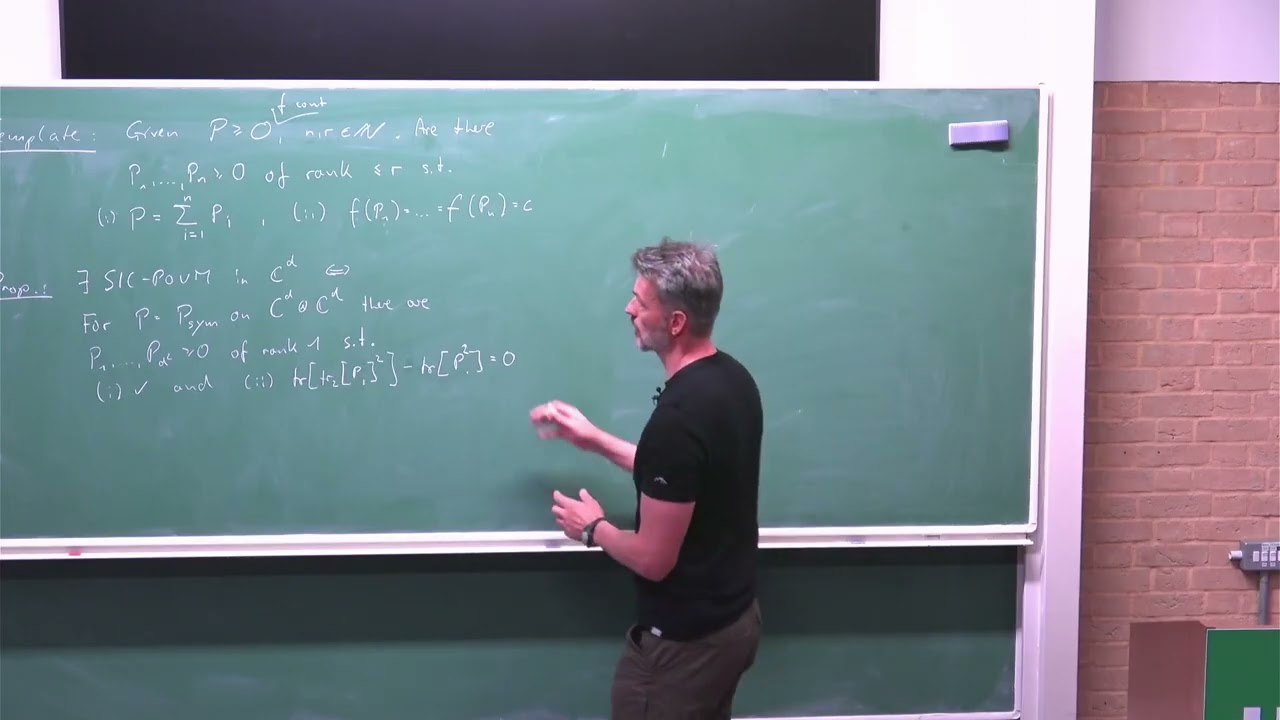
The title accurately reflects the content: the talk focuses on equipartitions of positive operators, presenting definitions, examples, and a topological method.
Quality & Reliability
8/10
Talk by a recognized expert in mathematical physics, presenting rigorous mathematical arguments and reformulations of open problems. The content is highly technical and relies on established mathematical tools (Borsuk-Ulam theorem, equivariant cohomology). No sources are cited in the talk itself, but the context (INI seminar) and the speaker's expertise lend credibility. The presentation is a research-level exposition, not a peer-reviewed publication.
Key Moments
Markers derived by PSI from the transcript: the creator did not define chapters.
- Introduction and motivation for the talk.
- Definition of equipartition problem for positive operators.
- Example: SIC-POVM problem reformulated as equipartition.
- Example: Mutually unbiased bases reformulated.
- Introduction of Ruskai's conjecture on convex decompositions of quantum channels.
- Toy example using Borsuk-Ulam theorem.
- Generalization to flag manifolds and equivariant cohomology.
- Discussion of the main lemma relating equivariant maps to existence of decompositions.
Cited Sources
- Isaac Newton Institute for Mathematical Sciences — Homepage of the institute hosting the seminar.
- Seminar page for the talk — Official page for the seminar, providing details about the event.
Concurring Sources
- Isaac Newton Institute for Mathematical Sciences — The institute's website provides context for the seminar and the speaker's affiliation.
Contribution & Novelties
The talk offers a fresh perspective on open problems in quantum information by unifying them under the concept of equipartitions of positive operators. It introduces a topological method based on equivariant cohomology to prove existence of such decompositions, which is a novel approach in this context. The speaker also highlights the connection to the Borsuk-Ulam theorem, providing a concrete example of how topology can be applied.
Pour aller plus loin :
- Borsuk-Ulam theorem — The theorem used in the toy example to prove existence of a decomposition.
- Equivariant cohomology — The mathematical tool proposed for generalizing the toy example.
- SIC-POVM — One of the open problems reformulated as an equipartition problem.
- Mutually unbiased bases — Another open problem discussed in the talk.
122 words
Radar Profile
The radar profile shows high scores in technical level and information quality, reflecting the advanced mathematical content and the speaker's expertise. The quantity of information is also high, but the global reliability is slightly lower due to the lack of cited sources and the speculative nature of some parts. The overall profile indicates a specialized, rigorous talk suitable for researchers.