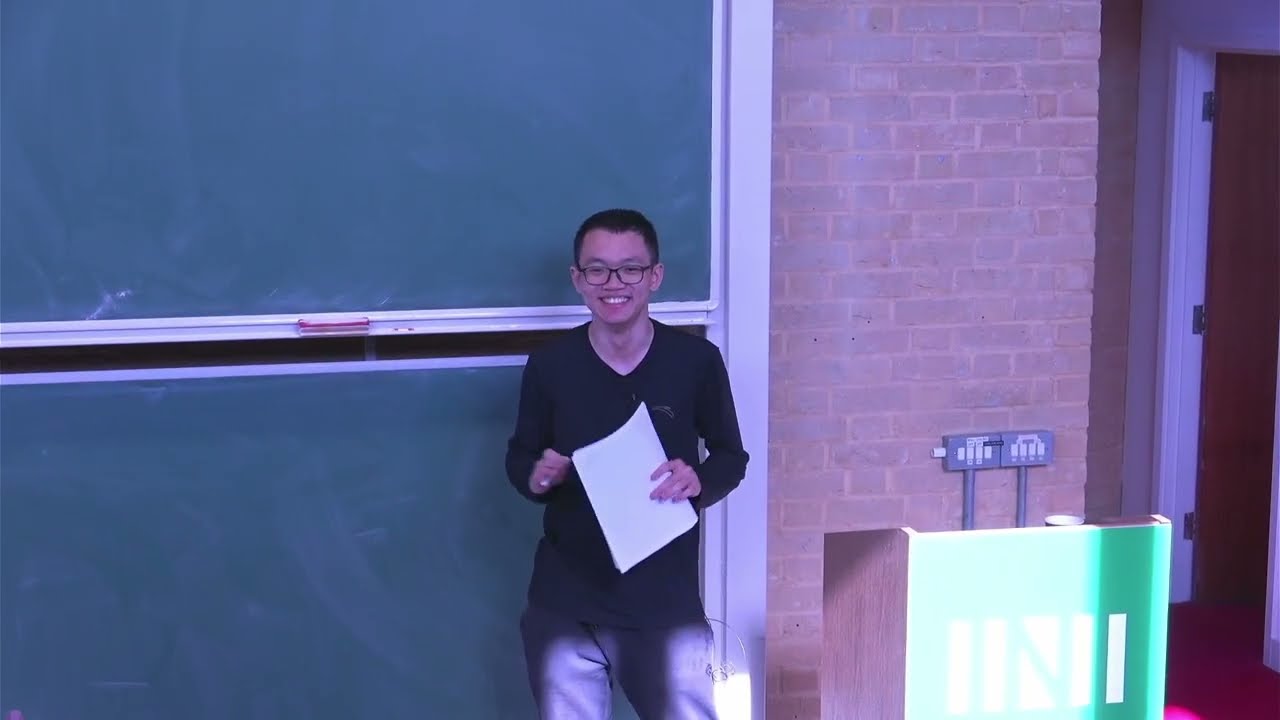
Tianqi Yang | Does a Range Avoidance Oracle Help Solve Decision Problems?
Keywords
Summary
118 words
Critical Evaluation
Value of the Information & Strength of the Argument
This talk provides a significant novel result: P^RASP is contained in AM, which is surprising given that RASP is believed to be hard. The argumentation is rigorous, relying on standard complexity theory tools such as decision trees and probabilistic arguments. The proof is clearly presented, walking the audience through the construction of an AM protocol that simulates a polynomial-time algorithm with a RASP oracle. The value lies in clarifying the power of a range avoidance oracle, showing it does not elevate problems beyond the class AM. The argumentation is solid and well-motivated, despite being a seminar sketch rather than a fully detailed paper.
Scientific Rigor, Source Quality, Title Accuracy
The talk is given at the Isaac Newton Institute, a renowned research center, and the speaker is an academic from Columbia University. The content is rooted in established complexity theory, referencing known results and building upon them. The title perfectly aligns with the content: the central question is whether a range avoidance oracle helps solve decision problems, and the talk provides definitive answers. No public comments were available for analysis, so this assessment is based solely on the technical content.
198 words
Title / Content Match
The title accurately describes the focus on the computational complexity implications of a range avoidance oracle.
Quality & Reliability
9/10
Seminar at the Isaac Newton Institute presenting original research in computational complexity. The speaker is a researcher from Columbia University. The content is technical and rigorous, rooted in established complexity theory.
Key Moments
Markers derived by PSI from the transcript: the creator did not define chapters.
- Introduction to the talk and preliminary question about audience familiarity with RASP.
- Definition of the Range Avoidance Problem and known upper and lower bounds.
- Presentation of the main results: P^RASP is contained in AM, and promise versions also.
- Proof idea using decision trees and Arthur-Merlin protocol; handling non-injective circuits.
- Technical details on estimating range size and converting to constant-round AM.
Cited Sources
- Seminar page - Logical foundations of complexity theory — Official seminar page with details about the talk and speaker.
- Isaac Newton Institute for Mathematical Sciences — Host institution for the seminar.
Contribution & Novelties
The talk presents an original contribution by proving that P^RASP is contained in AM, which is a strong containment result for a problem believed to be hard. This clarifies the computational power of a range avoidance oracle, showing it does not exceed the second level of the polynomial hierarchy in a certain sense. The proof technique, using a decision tree and an AM protocol with randomness from a hash function, is innovative.
Pour aller plus loin :
- Arthur–Merlin protocol — Relevant complexity class central to the talk’s results.
- Computational complexity theory — General background on complexity classes and oracles.
- Range Avoidance Problem — Note: This Wikipedia page does not exist, but the problem is discussed in complexity literature; for further reading, one might consult recent papers on the topic.
129 words
Radar Profile
The radar profile indicates a seminar with very high technical depth and information quality, balanced by equally high reliability. The scores suggest an advanced audience, as the level of technicality is maximized, but the content is solid and well-sourced.