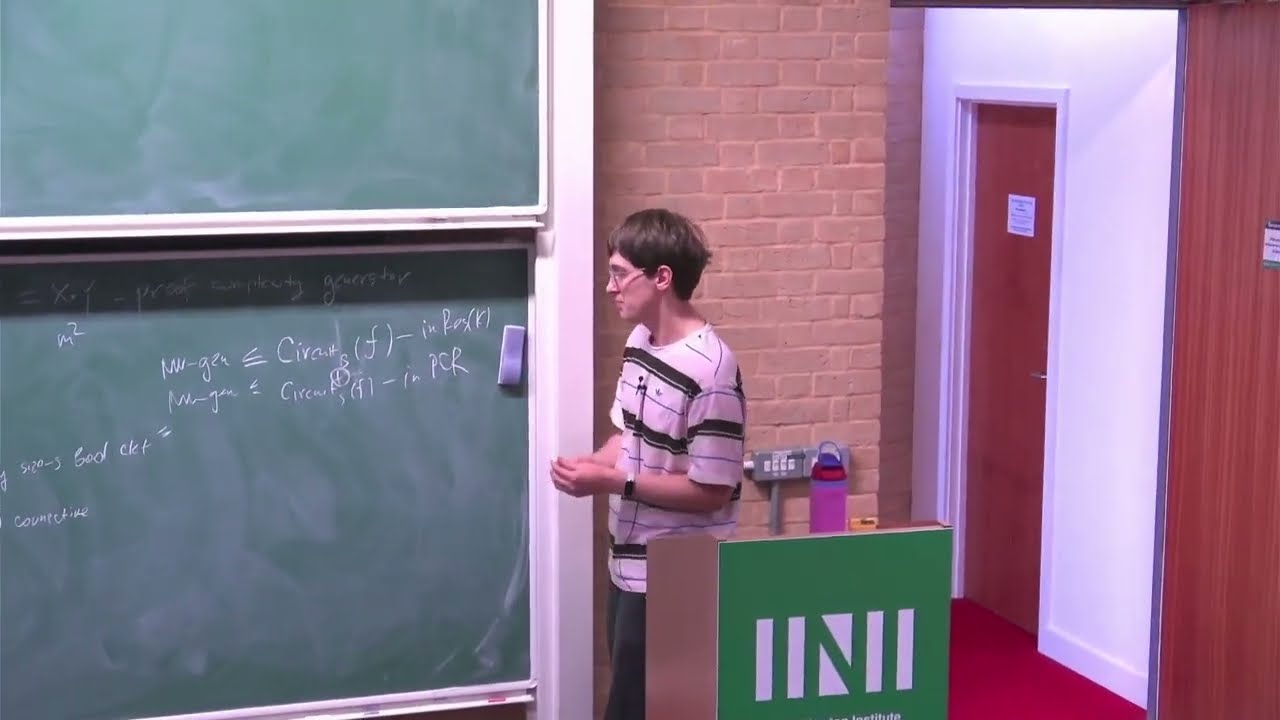
Svyatoslav Gryaznov | Weak Rank Principle and Circuit Lower-Bound Statements ( Part I )
Keywords
Summary
219 words
Critical Evaluation
Value of the Information & Strength of the Argument
The talk presents a well-motivated research problem with a clear connection to fundamental questions in proof complexity. The speaker argues that the weak rank principle is a natural algebraic statement whose hardness could yield important circuit lower-bound results. He carefully explains the intuition behind the principle, its relationship to the weak pigeonhole principle, and its potential as a generator for proof systems. The argumentation is logical and structured, moving from abstract motivation to concrete encodings and technical discussion. The speaker also engages with audience questions, clarifying subtleties such as the role of fields and the sensitivity of proof sizes to encoding choices. The overall value lies in identifying a novel principle and outlining a research program that could unify several lower-bound efforts.
Scientific Rigor, Source Quality, Title Accuracy
The scientific rigor is high: the talk is given at the Isaac Newton Institute during a workshop on logical foundations of complexity theory, and the speaker references prior work (e.g., results by Razborov and others) without providing formal citations in the transcript. The sources explicitly provided are the seminar page and the institute’s website, which align with the event context. The title ‘Weak Rank Principle and Circuit Lower-Bound Statements (Part I)’ is perfectly appropriate: the entire talk is dedicated to introducing the principle and its potential for lower bounds, with a promise of lower-bound proofs in a subsequent part. No comments were supplied for analysis.
242 words
Title / Content Match
Title accurately reflects content: the talk focuses on the weak rank principle and its applications to circuit lower-bound statements, as the first of two parts.
Quality & Reliability
8/10
Talk delivered at the Isaac Newton Institute, a leading research center. Speaker builds on existing literature and presents original work, with rigorous technical derivation and clear engagement with audience questions.
Key Moments
Markers derived by PSI from the transcript: the creator did not define chapters.
- Introduction and outline of the talk
- Definition of the weak rank principle and motivation
- Connection to proof complexity generators and circuit lower bounds
- Discussion of three encodings: algebraic, perfect matching, and bamboo tree
- Comparison with weak pigeonhole principle and relation to Nisan generators
- Technical aspects of F2 and polynomial calculus, open problems
- Summary and outlook for Part II
Cited Sources
- Isaac Newton Institute Seminar Page — Event page for the seminar, providing details on the talk and the workshop
- Isaac Newton Institute for Mathematical Sciences — Institute's main website, context for the seminar series
Contribution & Novelties
The talk introduces the weak rank principle as a focal point for proving circuit lower bounds in proof complexity, particularly over F2. It provides a nuanced discussion of different encodings (algebraic, perfect matching, bamboo tree) and highlights the principle’s relation to the weak pigeonhole principle and Nisan generators. The speaker indicates that his own work (presented in Part II) establishes hardness results for this principle, addressing a gap left by prior work that only covered fields of characteristic not equal to 2. This principle could serve as a unifying framework for lower bounds in various proof systems.
Pour aller plus loin :
- Pigeonhole principle — The weak pigeonhole principle is a close relative; its hardness is a classic topic in proof complexity.
- Proof complexity — Background on the study of proof systems and lower bounds.
- Circuit complexity — The target of the lower-bound statements discussed.
- Polynomial calculus — A proof system used in the talk, central to the technical arguments.
160 words
Radar Profile
The radar profile shows very high scores in technical level and reliability, with slightly lower but still strong values for quantity and quality of information. This indicates a dense, expert-level talk with solid foundations, though not intended for a general audience.