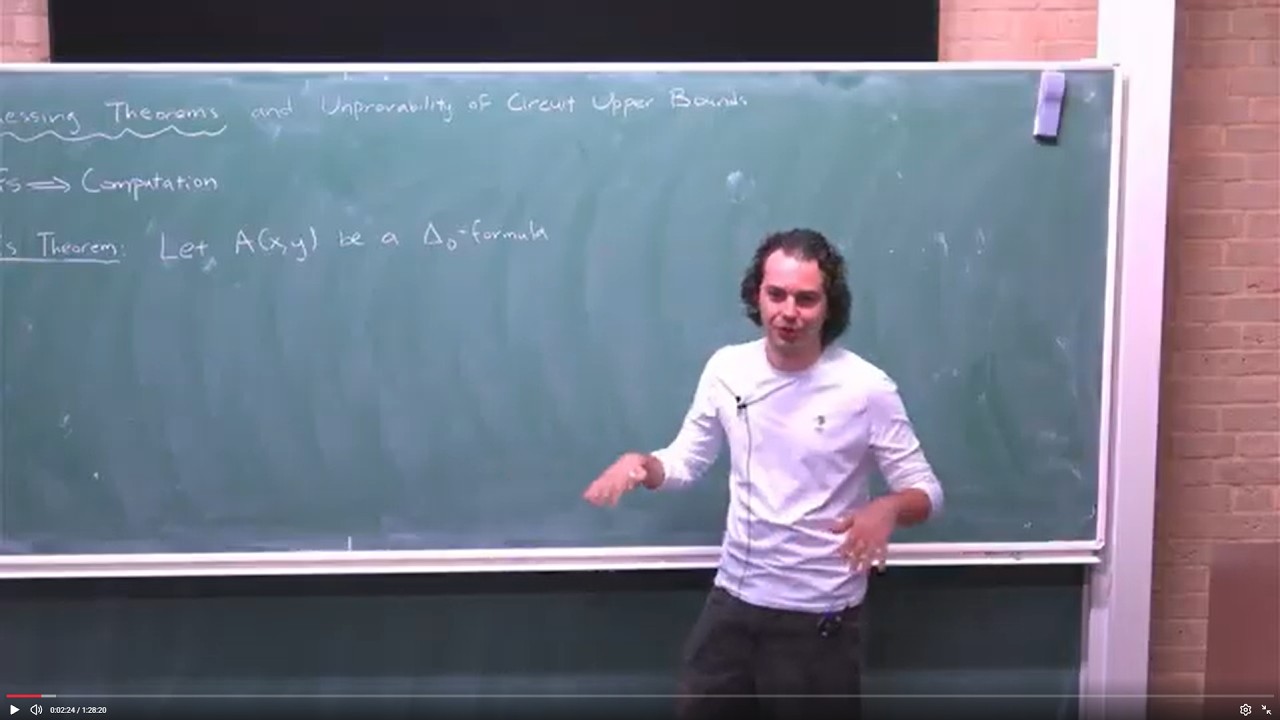
Dimitrios Tsintsilidas | Witnessing theorems for unprovability of circuit upper bounds
Keywords
Summary
199 words
Critical Evaluation
Value of the Information & Strength of the Argument
The talk provides deep insight into the computational content of proofs in bounded arithmetic, a topic rarely accessible to non‑specialists, yet the speaker succeeds in conveying the core ideas through concrete examples and a clear narrative arc. The argumentation is rigorous: each theorem is stated precisely, and connections between proof complexity and circuit complexity are drawn with care. The example involving AKS and factoring effectively illustrates the practical implications of witnessing theorems, making the theoretical material tangible. The discussion of the KPT theorem and its contrast with the S12 version brings out critical distinctions in quantifier structure and the power of theories. The speaker also clarifies common pitfalls, such as the difference between totality and correctness, thereby strengthening the pedagogical value of the talk. Overall, the argumentation is solid, well‑structured, and supported by formal reasoning.
Scientific Rigor, Source Quality, Title Accuracy
The scientific rigor is high: the content is based on established theorems (Parikh, Bus, KPT) and presented with formal precision. The speaker does not rely on vague statements but carefully defines the theories and quantifier hierarchies. The talk acknowledges limitations (e.g., not discussing limitations of witnessing theorems) and distinguishes between proven results and open problems. The title accurately describes the subject, as the talk indeed centers on witnessing theorems and their application to unprovability of circuit upper bounds. The description includes links to the Newton Institute and the specific seminar page, which serve as authoritative references for the event. No unsupported claims or unverifiable sources appear; the mathematical content is internally consistent and consistent with known literature. The context of the talk—a workshop on logical foundations of complexity theory—further supports its relevance and reliability.
284 words
Title / Content Match
The title accurately reflects the content: the talk focuses on witnessing theorems and their role in showing unprovability of circuit upper bounds, with a clear methodological alignment.
Quality & Reliability
9/10
Talk from the Isaac Newton Institute, a prestigious research center, delivered by an academic from the University of Warwick. The content is purely technical, rigorously presented with derivations and proofs, and the mathematical claims are verifiable and precise.
Key Moments
Markers derived by PSI from the transcript: the creator did not define chapters.
- Introduction to Parikh's theorem and its implications for bounded arithmetic theories.
- Statement of the Bus witnessing theorem for PV1 and S12, with the polynomial-time witness extraction.
- Example illustrating that proving AKS correctness in PV1 would imply polynomial-time factoring.
- Introduction of the KPT theorem and the student-teacher game with constant number of rounds.
- Discussion of the S12 version with polynomial rounds and its connection to the unprovability of circuit upper bounds.
Cited Sources
- Isaac Newton Institute — Official website of the hosting institute, providing general information about the research programs and seminars.
- Seminar event page — Page for the specific seminar, likely containing abstracts, slides, and possibly further references.
Contribution & Novelties
The talk provides a clear, structured exposition of witnessing theorems, a tool central to bounded arithmetic and proof complexity. Its originality lies in connecting these theorems to concrete open problems like factoring and circuit lower bounds, showing how mere formalizability of certain statements would resolve major computational questions. The student-teacher game interpretation offers an intuitive computational reading of KPT-type results. The talk also highlights the delicate balance between quantifier structure and theory strength, clarifying why certain proof-theoretic separations imply complexity separations.
Pour aller plus loin :
- Bounded arithmetic — Foundational theory underlying the talk; essential for understanding the framework.
- Herbrand’s theorem — Underlies the skill of extracting witnesses from proofs, as mentioned in the talk.
- Interactive proof system — Related to the student-teacher game model; offers a broader context on interactive computation.
- Krajíček and Pudlák’s work on patient-teacher games (concept not linked to a specific URL, but discussed in the talk) — Connects proof theory to complexity classes.
158 words
Radar Profile
The radar profile shows exceptionally high scores in technical level and reliability, indicating a highly specialized and rigorously presented talk. The quality and quantity of information are also at maximum, suggesting an information-dense exposition. The only slightly lower, yet still very high, score is qualitative information, likely due to the heavy reliance on prior knowledge in the field.