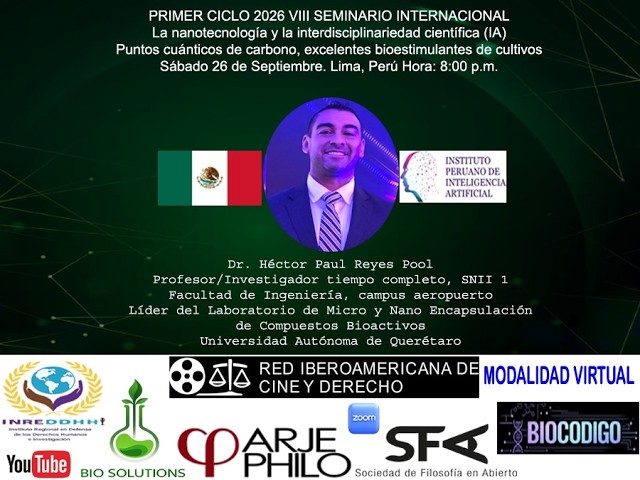
La nanotecnología e IA: Puntos cuánticos de carbono, excelentes bioestimulantes de cultivos
Nanotechnology and AI: Carbon quantum dots, excellent crop biostimulants
Keywords
Summary
195 words
Critical Evaluation
Value of the Information & Strength of the Argument
The value of this presentation lies in its practical orientation: the speaker shares hands-on experience in synthesizing carbon quantum dots from waste materials using low-cost, rapid microwave methods, making the technology accessible. He clearly explains the seed priming process and its physiological effects, including enzyme activation and improved germination, which could be immediately beneficial for agricultural practitioners. However, the argumentation is built largely on anecdotal evidence and general mechanisms, without presenting specific experimental data or statistical analyses. The speaker acknowledges this by stating results are withheld for patent protection. While his expertise is credible, the lack of detailed citations and the absence of comparative data weaken the scientific rigor. The mention of AI is peripheral, not substantiated with concrete examples, reducing its impact on the overall argument.
Scientific Rigor, Source Quality, Title Accuracy
The scientific rigor is moderate. The speaker does not cite specific studies or provide references, relying on his laboratory’s unpublished work and a few general statements about existing literature. He mentions a commercial product but provides no verifiable source. The title accurately reflects the core topic—carbon quantum dots as biostimulants—but overemphasizes AI, which is only briefly touched upon. The presentation contains some technical details about synthesis and mechanisms that are plausible but not verified with peer-reviewed evidence. Overall, the talk is more of an experience report than a systematically reviewed scientific lecture. The absence of source citations and the lack of transparency about experimental conditions limit its reliability as a scientific reference.
254 words
Title / Content Match
The title adequately reflects the main topic of carbon quantum dots as biostimulants, but the emphasis on AI is minimal; only a brief mention of AI's potential is made, making the title somewhat overstated.
Quality & Reliability
6/10
The presentation is based on the speaker's professional experience and laboratory work, but it lacks peer-reviewed citations and presents some claims without rigorous evidence. The methodology is described in a general manner, and specific quantitative results are not shown. The title mentions AI, but the treatment of AI is superficial, which slightly reduces reliability.
Key Moments
Markers derived by PSI from the transcript: the creator did not define chapters.
- Introduction to carbon quantum dots: definition, size (<10 nm), and key properties (photoluminescence, conductivity, biocompatibility).
- Synthesis methods: bottom-up vs. top-down approaches, with emphasis on microwave and hydrothermal methods as low-cost, green alternatives.
- Agricultural applications: biostimulation, stress modulation, nanofertilizers, and sensor development for precision agriculture.
- Seed priming technique: soaking seeds in CQD suspension (1 g/L) to enhance germination, water uptake, and seedling vigor; dose-dependent effects noted.
- Mechanisms: activation of antioxidant enzymes (SOD, catalase, peroxidase) and amylase, leading to free radical elimination and starch mobilization.
- Mention of AI's potential to accelerate experimentation and data analysis, though not detailed; concluding remarks on future research directions.
Contribution & Novelties
This presentation offers a practical, hands-on perspective on carbon quantum dots for agricultural biostimulation, specifically via a simple and rapid microwave-assisted synthesis from biomass waste. The speaker emphasizes seed priming as a low-cost application, providing mechanistic insights into enzyme modulation and physiological responses. The novelty lies in the integration of green synthesis, circular economy concepts, and agricultural application, while also hinting at AI’s role in accelerating R&D. This is a relevant contribution for practitioners and researchers seeking accessible nanobiotechnology solutions.
Pour aller plus loin :
- Carbon quantum dots — Overview of synthesis, properties, and applications of carbon quantum dots.
- Seed priming — Explanation of seed priming techniques and benefits in agriculture.
- Nanotechnology in agriculture — General overview of nanotechnology applications, including nanofertilizers and crop enhancement.
125 words
Radar Profile
The profile shows strong quantity of information and technical level, indicating a detailed and precise presentation. However, reliability and quality scores are lower, reflecting the lack of verifiable sources and the informal nature of the talk. This suggests a knowledgeable expert sharing practical experience rather than a rigorous, literature-based academic lecture.