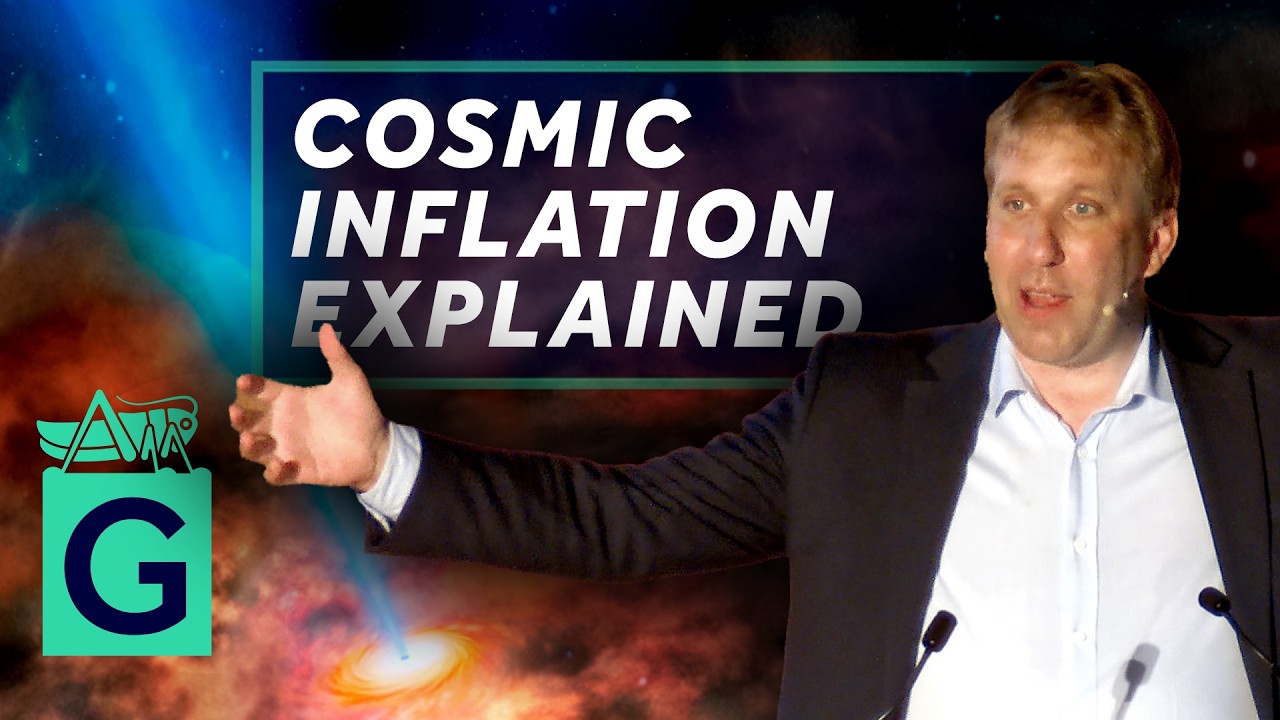
Cosmology’s Mad Idea: Inflation & the Creation of Our Universe - Chris Lintott
Keywords
Summary
131 words
Critical Evaluation
Value of the Information & Strength of the Argument
The lecture provides a valuable synthesis of cosmic inflation, bridging theoretical concepts and observational evidence. Lintott’s argumentation is clear and logically structured, moving from established facts to theoretical extensions. He effectively uses analogies (Escher’s cubes, the fog box) to make complex physics accessible. The discussion of recent tests (helium abundance, BICEP2) demonstrates a balanced view, acknowledging both successes and challenges. The argument for inflation is presented as a compelling solution to known problems, while openly noting the speculative nature of eternal inflation.
Scientific Rigor, Source Quality, Title Accuracy
The scientific rigor is high: Lintott is a professor of astrophysics, and the content aligns with current cosmological consensus. He cites specific observational results (COBE, Planck, Hubble, LBT) and theoretical work (Guth, Weinberg). The references are embedded in the description, including the transcript page and a Q&A video. The title matches the content precisely, and the lecture is well-structured with clear chapters. As a public lecture, it avoids over-technicality but maintains accuracy.
169 words
Title / Content Match
The title accurately reflects the content: the lecture explores the concept of cosmic inflation and its role in the creation of the universe.
Quality & Reliability
9/10
Lecture by a professor of astrophysics at Oxford, presenting established cosmology and evidence for inflation, with references to observational data and recent tests.
Chapters
- // Introduction
- // What is inflation?
- // The expanding universe and redshift
- // Hubble, Cepheids and measuring cosmic distances
- // Escher's cubes: why galaxies recede
- // The cosmic microwave background
- // The first three minutes: making helium
- // Testing the Big Bang with "boring" galaxies
- // Ripples in the microwave background
- // The horizon problem
- // The flatness problem
- // Missing magnetic monopoles
- // Alan Guth's "spectacular realization"
- // Inflation: from pinhead to grapefruit
- // Quantum fields, the Higgs and the inflaton
- // Gravitational waves and the BICEP2 claim
- // Quantum fluctuations: the seeds of galaxies
- // The evidence for inflation
- // The block of cheese: eternal inflation and the multiverse
- // Conclusion
Cited Sources
- Gresham College — Official Gresham College website, hosting the lecture and related resources.
- Transcript of the lecture — Full transcript and details of the lecture, including supplementary materials.
- Q&A session — Follow-up Q&A session from the same lecture event.
Contribution & Novelties
The lecture offers an up-to-date perspective on cosmic inflation, integrating recent observations and clearly explaining the reasoning behind this ‘mad idea’. It distinguishes between well-established Big Bang cosmology and the more speculative inflation theory, providing the audience with a nuanced understanding of current astrophysical debates.
Pour aller plus loin :
- Inflation (cosmology) — Overview of the theory, its origin, and observational status.
- Alan Guth — Physicist who proposed inflation; his biography and contributions.
- BICEP2 — Experiment that claimed detection of inflationary gravitational waves, later retracted; illustrates the challenges of verification.
- Cosmic microwave background — Key evidence for the Big Bang and inflation, observed by COBE, WMAP, and Planck.
108 words
Radar Profile
The radar profile shows high scores in information quantity and quality, reflecting a dense but accurate lecture. Technical level is moderate, aiming at a general audience with some background. Fiabilité is excellent due to the presenter's expertise and the use of verifiable data.