The Intersection Of AI And Voice At The Edge
Keywords
Summary
211 words
Critical Evaluation
Value of the Information & Strength of the Argument
The video provides valuable and current information on the state of AI-driven voice processing at the edge. The speaker offers concrete examples (e.g., the CES demo, car audio evolution) and explains technical trade-offs, such as the balance between frequency scaling and power/area constraints. The argumentation is coherent and well-structured, arguing that voice AI is following a similar trajectory to computer vision but with a lag, and that hardware must be flexible to accommodate rapid model changes. The discussion of hybrid architectures (DSP + hardware accelerators) is a strong point, addressing practical engineering concerns. However, the value is somewhat limited by its promotional context; the speaker represents a company that sells relevant IP, which may bias the emphasis on flexibility and future needs.
Scientific Rigor, Source Quality, Title Accuracy
The scientific rigor is moderate: the content is based on industry experience and practical observations rather than peer-reviewed research. Sources are not formally cited, but the video names specific technologies (TFLM, SLM, FP8) and partner demonstrations (MosChip). The title accurately reflects the content, and the discussion is consistent with known trends in edge AI and voice interfaces. The lack of explicit references reduces the verifiability, but the technical details align with public knowledge from credible sources like TensorFlow documentation and industry whitepapers. The video does not present any controversial claims, so there are no major discordant sources.
234 words
Title / Content Match
The title accurately describes the core topic: the convergence of AI and voice processing in edge devices. The content thoroughly addresses this intersection, including hardware, models, and applications.
Quality & Reliability
8/10
The discussion is technically detailed, coherent, and reflects current industry trends in AI-driven voice processing at the edge. However, it is presented by a company representative (Cadence), which introduces potential promotional bias. The claims are plausible, and the technical specifics (e.g., GOPS, TFLM, SLM) are consistent with existing literature.
Key Moments
Markers derived by PSI from the transcript: the creator did not define chapters.
- Introduction and overview of voice at the edge
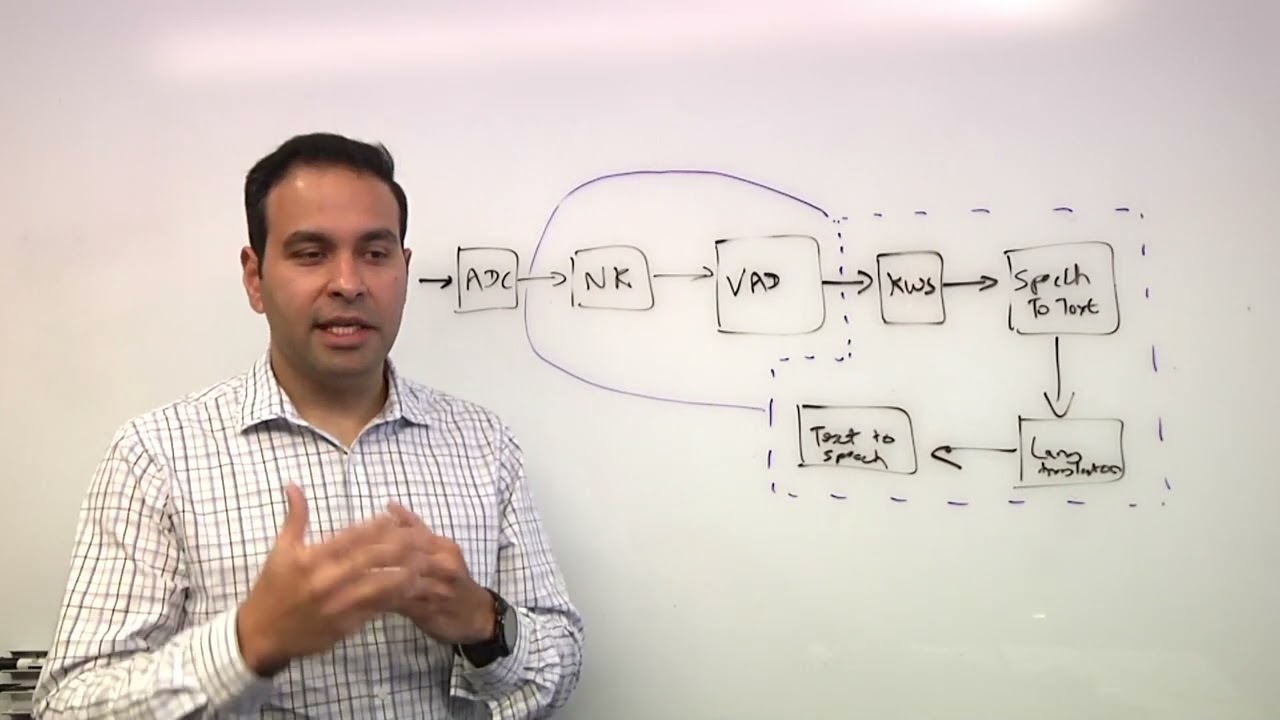
- Speech processing pipeline: from ADC to speech-to-text
- Compute requirements and transition to AI models for all components
- Hardware agnosticism: data type support for voice vs. vision
- Natural language processing in cars: from command-driven to conversational
- Edge vs. cloud, hybrid models, and CES 2026 demo with SLM
- Speed vs. width: MAC throughput, efficiency, and future-proofing hardware
- Automotive audio: more speakers, immersive sound, and compute demands
- Future trends: microphone arrays, noise cancellation, and conclusion
Cited Sources
- Cadence Tensilica DSPs — Core technology discussed in the interview; the speaker is responsible for this product line.
- TensorFlow Lite for Microcontrollers (TFLM) — Mentioned as used for lightweight AI models in voice activity detection.
- Natural Language Processing (Wikipedia) — Background concept central to the discussion of voice interfaces.
- MosChip Technologies — Partner company for the CES 2026 demo demonstrating an on-device small language model for car manuals.
Concurring Sources
- Architecture of TensorFlow Lite for Microcontrollers — Academic paper detailing TFLM's design, consistent with its use in low-power voice applications mentioned in the video.
Contribution & Novelties
The interview provides an up-to-date perspective on how AI is reshaping voice processing at the edge, emphasizing the shift from classical signal processing to neural networks even for low-level components like VAD. It also highlights the hardware flexibility required to handle evolving models, and the automotive sector’s growing compute demands for immersive audio and conversational AI. The discussion of hybrid architectures (DSP + accelerators) as a future-proofing strategy is a noteworthy practical insight.
Pour aller plus loin :
- TensorFlow Lite for Microcontrollers — Official documentation for running AI models on low-power edge devices, directly relevant to the video’s mention of TFLM.
- Edge Computing — A comprehensive overview of edge computing concepts, aligning with the video’s focus on bringing AI to edge devices.
- Speech Recognition — Background on speech-to-text technology, which is a key component of the pipeline discussed.
- Small Language Model (SLM) — The video discusses using an SLM for car manuals; this page explains language models in broader context.
160 words
Radar Profile
The radar shows high scores in information quantity, quality, and technical depth, indicating a rich and detailed discussion. The slightly lower reliability score reflects the promotional context of the interview, reducing perceived objectivity. Overall, the profile suggests a technically strong but commercially influenced source.