Efekt fotoelektryczny
Photoelectric effect
Keywords
Summary
163 words
Critical Evaluation
Value of the Information & Strength of the Argument
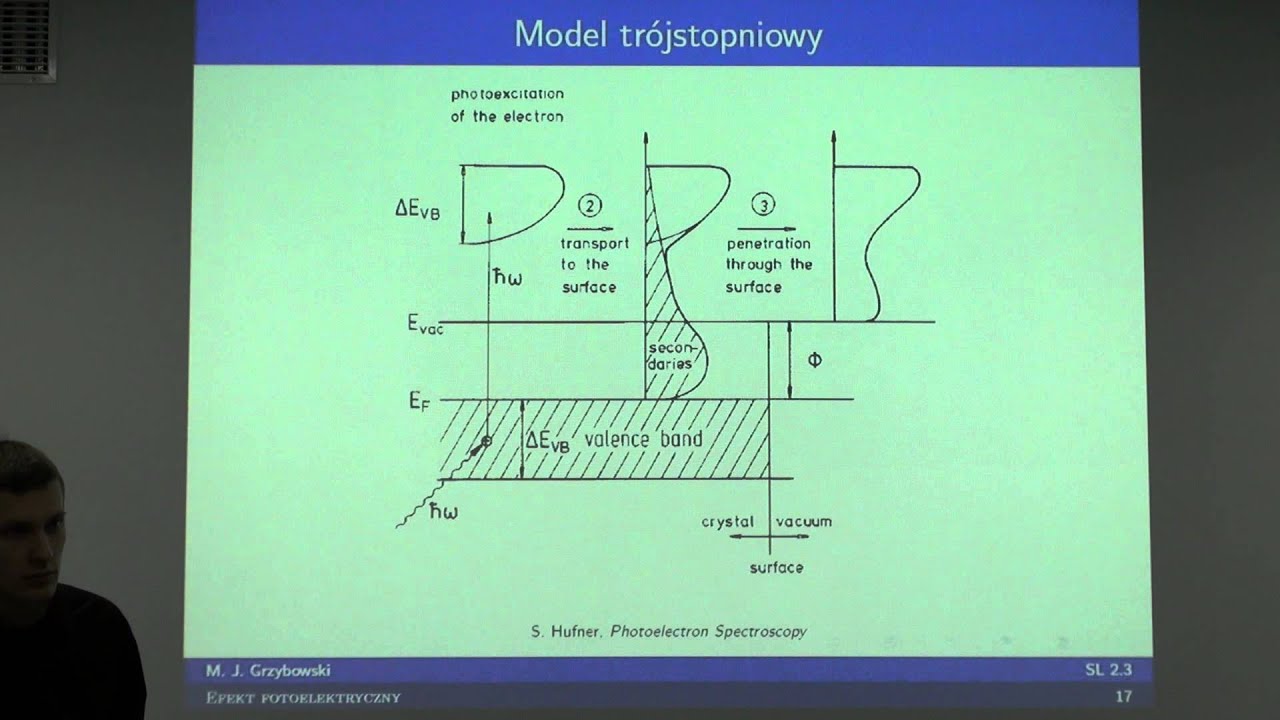
The lecture offers valuable information by connecting historical context with modern experimental techniques. The argumentation is solid: the historical narrative is well-structured, and the physics is explained with clarity, avoiding oversimplification. The speaker systematically derives the photoelectric equation and shows how experimental observations led to the quantum interpretation. The use of concrete examples, such as spectra for gold and silver, strengthens the explanatory value. However, the lecture is a seminar-style overview rather than a critical analysis, and it lacks in-depth comparison of alternative theories or recent controversies. The argumentation favors the standard quantum picture without exploring anomalies, but this is appropriate given the pedagogical intent.
Scientific Rigor, Source Quality, Title Accuracy
The scientific rigor is acceptable for a lecture: the historical facts are standard and accurate, and the experimental data shown come from well-known sources. The title fully reflects the content, as the entire presentation is devoted to the photoelectric effect and its applications. No explicit citations are provided within the talk, which limits the ability to verify specific claims, but the information is consistent with established physics. The lecture does not include a discussion of contemporary debates or unresolved questions, so the overall quality is good but not exceptional. The lack of a reference list is a moderate weakness, though as a seminar lecture this is common.
227 words
Title / Content Match
The title exactly matches the content: a comprehensive review of the photoelectric effect, its history, physics, and applications.
Quality & Reliability
8/10
The lecture is delivered by a physicist with expertise in the field, based on well-established historical and experimental evidence. The content is coherent and technically accurate, though limited by the informal seminar format without explicit citations.
Key Moments
Markers derived by PSI from the transcript: the creator did not define chapters.
- Introduction and historical context of the wave-particle debate
- Hertz's observation of the photoelectric effect and early experiments
- Einstein's explanation and the linear relation between kinetic energy and frequency
- Modern applications: photoelectron spectroscopy and its surface sensitivity
- Angle-resolved and spin-resolved photoemission, examples with graphene and topological materials
Contribution & Novelties
The lecture provides a coherent synthesis of the photoelectric effect’s history and its modern incarnation as photoelectron spectroscopy, highlighting the connection between fundamental quantum physics and advanced materials characterization. The originality lies not in new results but in the pedagogical framing that emphasizes the evolution from Hertz’s accidental discovery to highly sophisticated spectroscopic tools. The discussion of surface sensitivity and the necessity of ultra-high vacuum, as well as the extension to angle- and spin-resolved measurements, offers insight beyond elementary textbooks.
Pour aller plus loin :
- Photoelectric effect - Wikipedia — Foundational explanation of the phenomenon and its quantum interpretation.
- Angle-resolved photoemission spectroscopy - Wikipedia — Detailed description of the modern technique discussed in the lecture.
- Work function - Wikipedia — Key concept linking the material property to the photoelectric threshold.
- Fermi level - Wikipedia — Relevant to understanding the energy distribution of emitted electrons.
144 words
Radar Profile
The radar profile shows high scores across all dimensions, indicating a well-rounded lecture with strong informational content, technical depth, and reliability. The slight dip in quantity (score 8) compared to other aspects suggests the presentation is more focused than exhaustive, but it remains substantial for a seminar.