Gwiezdne Wojny: dla tych co się nie dostali na premierę
Star Wars: for those who didn't make it to the premiere
Keywords
Summary
245 words
Critical Evaluation
Value of the Information & Strength of the Argument
The lecture provides substantial original content by applying school-level physics calculations to fictional Star Wars technology. Turski uses clear, step-by-step derivations (e.g., gravitational binding energy) and draws meaningful parallels with real physics, such as gamma-ray bursts and electromagnetic pulses. The argumentation is solid: he does not simply speculate but shows quantitative estimates and compares with known physical limits. However, some simplifications (e.g., assuming Earth-like density for the target planet) are acknowledged, which is acceptable for a popular science context. The reasoning is generally coherent and persuasive, though some numerical assumptions (like the 900 km diameter for the Death Star) are taken from fan sources without deeper verification.
Scientific Rigor, Source Quality, Title Accuracy
The scientific rigour is good for a popular lecture: the speaker openly discusses limitations and references known astrophysical events (e.g., gamma-ray bursts) and historical anecdotes (the first nuclear tests and electromagnetic pulse discovery). He also mentions the ‘Pi of the Sky’ project, which is real and based in Poland. However, no direct citations or links are provided in the video description, and the talk relies on general knowledge rather than citing specific papers. The title is somewhat broad but accurately reflects the Star Wars theme; it does not promise a detailed physics analysis but the content delivers that. The correlation between title and content is adequate, earning a slight positive adjustment but not a major one.
238 words
Title / Content Match
The title hints at discussing Star Wars for those who missed the premiere, which matches the content about the physics behind the film's devices. However, it does not explicitly mention the scientific focus, yet the connection is clear.
Quality & Reliability
8/10
The lecture is delivered by a physicist (CFT PAN) with solid academic credentials. It presents real calculations and references to astrophysical phenomena, but some points are simplified and lack rigorous citation. Overall, reliable for a public science talk.
Key Moments
Markers derived by PSI from the transcript: the creator did not define chapters.
- Introduction: the lightsaber as the most mysterious device, question of its finite length and comparison with welding arcs.
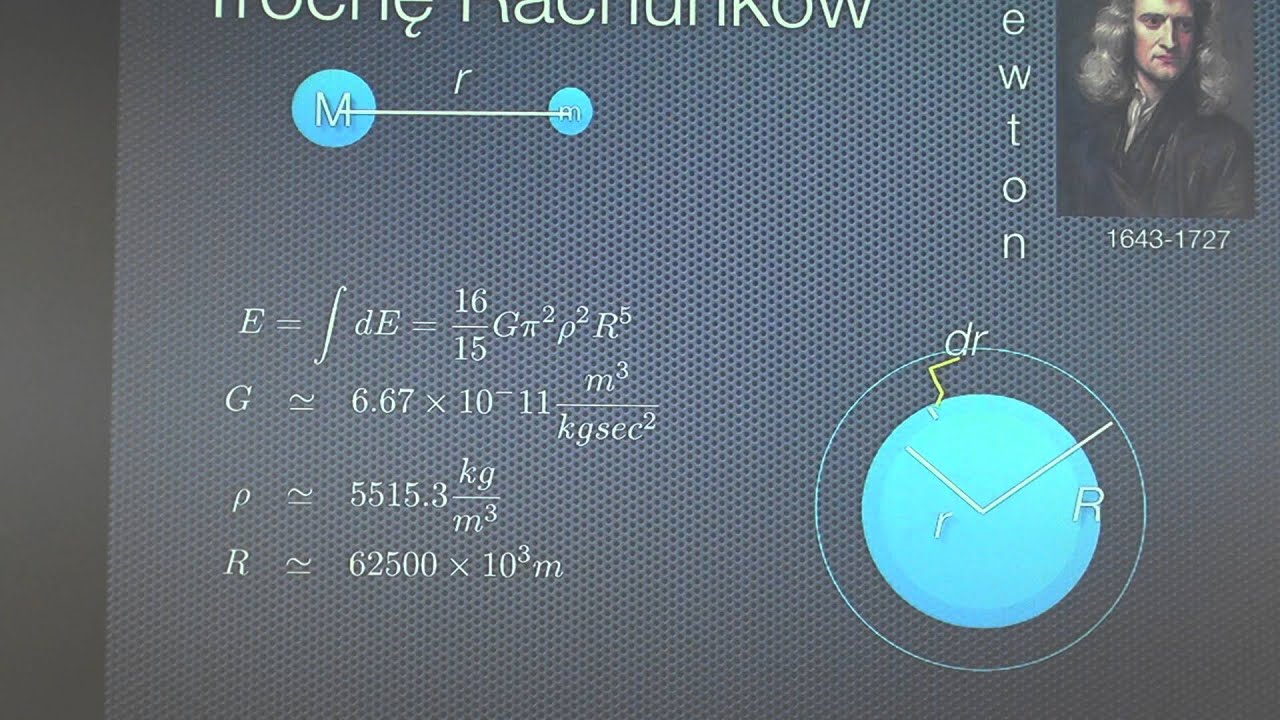
- Death Star energy calculation: gravitational binding energy of Earth, estimate of 10^32 J, and fuel requirements.
- Comparative energy densities of fuels; nuclear fusion as the only viable source; discussion of electromagnetic pulse from nuclear explosions.
- Transition to gamma-ray bursts and the Polish 'Pi of the Sky' observatory project; potential dangers of such bursts.
- Analysis of Anakin's speeder: technical specs (mass 1600 kg, speed 720 km/h, acceleration 70 g) and comparison with a Corvette and the Eurostar train.
- Discussion on human tolerance to acceleration, record of 15 g by John Stapp, and effects of high g-forces on the body.
Contribution & Novelties
The video uniquely bridges popular film culture with quantitative physics, offering back-of-the-envelope calculations that are rarely found in typical Star Wars discussions. It provides educational insights into concepts like gravitational binding energy, density of energy carriers, and electromagnetic pulse, while also exposing the audience to actual astrophysical phenomena (gamma-ray bursts). The comparison of fictional technology with real-world engineering limits (e.g., acceleration tolerance) adds an original perspective.
Pour aller plus loin :
- Gravitational binding energy — Directly relevant to the Death Star calculation; the formula used by Turski is explained here.
- Gamma-ray burst — Discussed in the lecture; gives background on these powerful cosmic events.
- Pi of the Sky — The project mentioned in the talk; a real Polish wide-field telescope installation.
- Electromagnetic pulse — Related to the effect of nuclear explosions on electronics, which Turski explains.
136 words
Radar Profile
The radar profile shows high information quantity and good reliability, with moderate technical level. This indicates a dense lecture filled with scientific content but accessible to a broad audience. The strongest scores are in information volume and trustworthiness, while the technical depth is moderate, reflecting its popular science nature.