Keywords
Summary
191 words
Critical Evaluation
Value of the Information & Strength of the Argument
The lecture’s primary value lies in its remarkable breadth and pedagogical clarity, successfully connecting seemingly disparate fields like metrology, navigation, astrophysics, and quantum mechanics. The argumentation is solid, consistently anchored in well-established scientific principles—such as the secular deceleration of Earth’s rotation due to tidal forces and the necessity for relativistic corrections in GPS operations, without which positioning fails within a year. The speaker supports statements with specific quantitative examples (e.g., a drift of one minute over four months for Harrison’s clock, or a relative stability of 10^-18 for optical lattice clocks), which strengthens the credibility of the presentation. Honest admission of personal knowledge gaps—notably regarding the operational intricacies of an atomic clock—adds to the authenticity of the exposition without detracting from its rigor.
Scientific Rigor, Source Quality, Title Accuracy
The presentation demonstrates strong scientific rigor, systematically referencing authoritative institutions and established standards such as NIST, the International Bureau of Weights and Measures, and historical bodies like the Royal Society. It correctly cites John Harrison’s role in solving the longitude problem and accurately describes the leap second adjustments necessary to reconcile atomic time with astronomical time. The title ‘Time?’ is an extremely apt descriptor of the content, serving as a broad and accurate umbrella for a talk that ranges across twenty-four zones of metrology and physics. The notable mention of Poland’s pioneering pulsar clock provides a specific, verifiable technological milestone, further enhancing the overall reliability of the information presented.
247 words
Title / Content Match
The broad title 'Time?' perfectly matches the lecture's comprehensive exploration of the concept, measurement, and physics of time, from ancient calendars to cosmological horizons.
Quality & Reliability
9/10
The lecture is delivered by a recognized astrophysicist and demonstrates high pedagogical quality. The scientific content correctly covers established metrology principles, calendar history, and relativistic time corrections (e.g., GPS). The speaker openly acknowledges personal uncertainties regarding details of atomic clock mechanisms, which maintains a rigorous and honest tone.
Key Moments
Markers derived by PSI from the transcript: the creator did not define chapters.
- Introduction and humorous anecdote about the circular problem of setting clocks according to each other, setting the stage for the lecture.
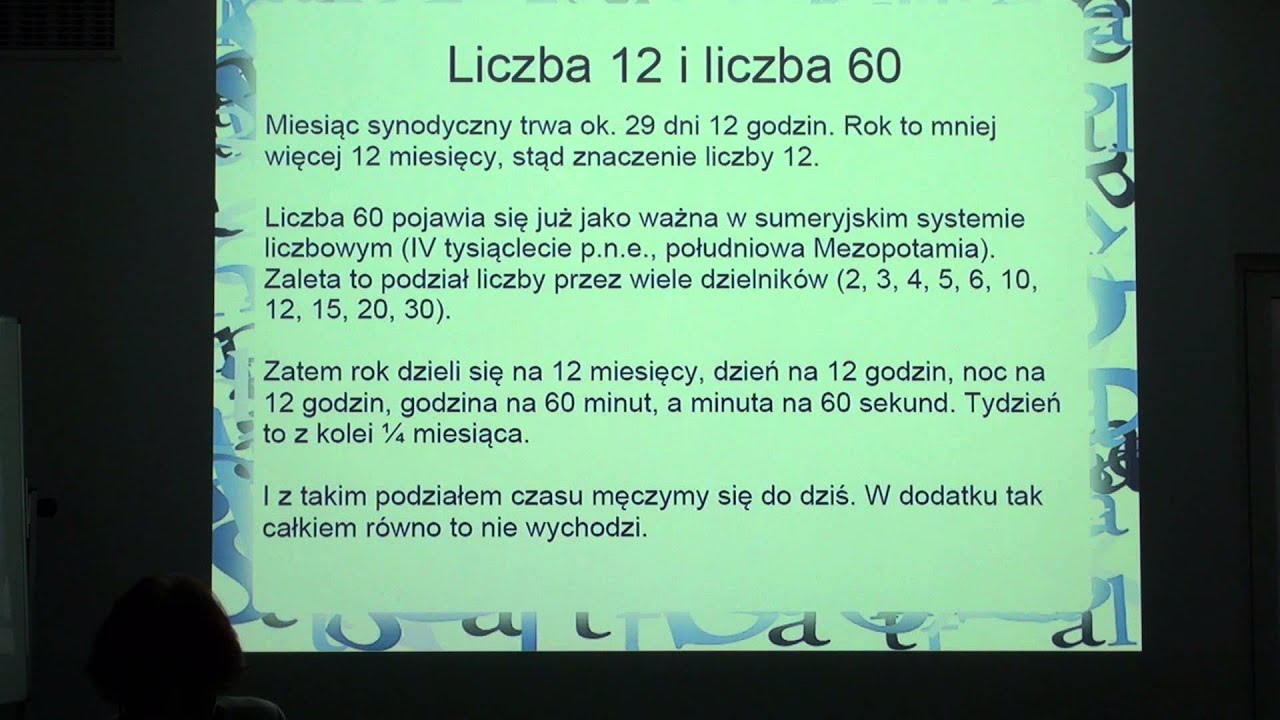
- Discussion of the astronomical roots of time units (day, month, year) and the historical division into 60-based units from ancient Mesopotamia.
- Explanation of Julian Day Numbers as a practical tool for astronomers, and their difference from the Julian calendar.
- Analysis of irregularities in Earth's rotation, including tidal slowdown, seasonal changes, and the impact of major earthquakes like the Nepal quake.
- Overview of early timekeeping devices: sun, water, sand, and mechanical clocks, leading up to John Harrison's marine chronometer.
- Detailed discussion of atomic clocks, their components, and the quest for higher precision, including the NIST cesium clock achieving 10^-16 accuracy.
- Presentation of pulsar-based clocks, highlighting the pioneering clock constructed in Gdańsk, Poland, based on signals from 16 antennas.
- Explanation of how special and general relativity affect time measurement, and the mandatory relativistic corrections in GPS satellites.
- Exploration of the quantum mechanical limits of time, including Planck time, and the cosmological context of the universe's beginning and expansion.
Contribution & Novelties
The lecture provides an original and highly integrative synthesis of time metrology, bridging the history of ancient calendars with the cutting-edge domains of quantum optical clocks and pulsar-based timing systems. It notably highlights a significant, yet perhaps underappreciated, Polish contribution to the field, thereby enriching the broader narrative of international scientific achievement. The clear exposition of how classic relativity is a necessary engineering component in modern navigation technologies serves as a compelling educational bridge between abstract theory and practical application.
Pour aller plus loin :
- International Atomic Time — Foundational standard for atomic timekeeping referenced in the lecture.
- John Harrison — The historical figure credited with the breakthrough marine chronometer discussed in the talk.
- Pulsar clock — Directly relevant to the pioneering Polish pulsar clock project in Gdańsk.
- Planck time — The theoretical lower limit of time measurement discussed in the quantum gravity segment.
- Global Positioning System timekeeping — Explains the precise relativistic corrections necessary for GPS operation, as emphasized by the speaker.
163 words
Radar Profile
The radar profile displays exceptionally high scores across all axes, particularly in quality of information and technical level. This indicates the content is a dense, well-structured lecture with highly reliable scientific substance, suited for an advanced audience interested in the physical and technological underpinnings of time measurement.