Od choroby Alzheimera do kropek kwantowych
From Alzheimer's disease to quantum dots
Keywords
Summary
166 words
Critical Evaluation
Value of the Information & Strength of the Argument
The presentation delivers valuable insights by showing concrete experimental results from the speaker’s own laboratory, including images of quantum dots in cells and comparisons of upconversion efficiency. The argumentation is solid and logical: he defines the biological problem (Alzheimer’s, cancer), explains the physical principles (quantum confinement, upconversion), and then demonstrates how these principles are harnessed in practice. He is transparent about limitations such as low upconversion yield and toxicity concerns, and he contextualizes the work as part of a larger global effort. The argument is persuasive because it combines fundamental science with practical applications, and he offers quantitative details (e.g., 20% upconversion efficiency) to support his claims.
Scientific Rigor, Source Quality, Title Accuracy
The speaker does not cite external publications, but he references his own research and well-known concepts in the field. The title is highly appropriate as it maps the journey from a medical issue (Alzheimer’s) to a physical tool (quantum dots). The scientific rigor is strong in terms of experimental demonstrations, but the lack of explicit citations makes it harder to verify specific claims. The talk appears to be aimed at a scientific audience, and the speaker acknowledges that many groups worldwide are working on similar challenges, which helps situate the work without overstating novelty. Overall, the content is credible but would benefit from more explicit sourcing.
228 words
Title / Content Match
The title accurately reflects the content: the lecture starts with Alzheimer's disease as a medical challenge and leads to quantum dots as a technological solution, exactly as the title suggests.
Quality & Reliability
8/10
Lecture by a professor at the Polish Academy of Sciences, presenting his own research results with proper scientific context. However, no external sources are explicitly cited, and the content dates from 2015, so some information may be outdated.
Key Moments
Markers derived by PSI from the transcript: the creator did not define chapters.
- Introduction discussing the shift in causes of death and the impact of antibiotics.
- Introduction of Alzheimer's disease, diagnostic challenges, and imaging techniques like PET.
- First mention of quantum dots, their optical properties, and synthesis methods.
- Functionalization of quantum dots with antibodies for targeting and intracellular delivery.
- Upconverting nanoparticles and their application in photodynamic therapy and imaging.
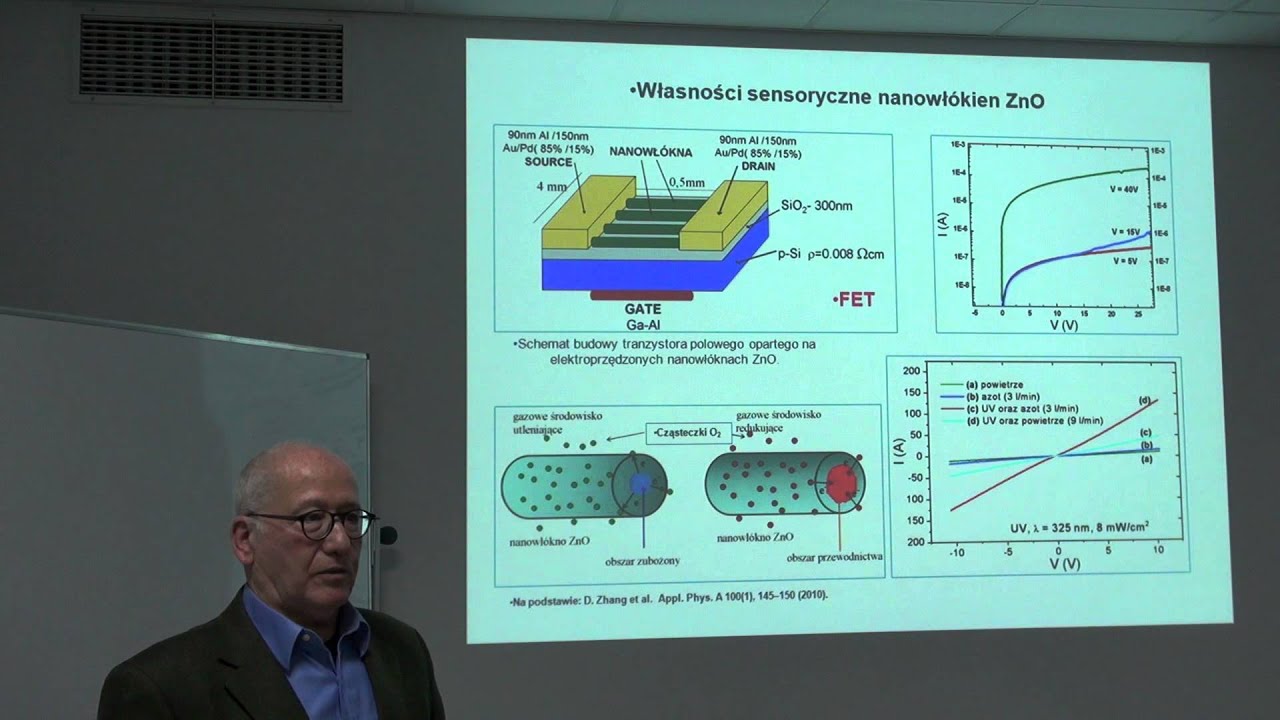
- One-dimensional nanofiber sensors for biomarker detection.
- Discussion on costs, limitations, and the future of nanomedicine.
Contribution & Novelties
The lecture presents original contributions from the speaker’s research group, including a method to synthesize efficient upconverting quantum dots with ~20% efficiency, live cell imaging without damage using pulsed laser excitation, and the development of nanofiber-based sensors for rapid analyte detection. These advances demonstrate practical nanotechnological solutions for biomedical challenges.
Pour aller plus loin:
- Quantum dot - Wikipedia — Overview of quantum dots, their properties and applications.
- Alzheimer’s disease - Wikipedia — Pathology and diagnostic challenges of Alzheimer’s.
- Photodynamic therapy - Wikipedia — Mechanism of photodynamic therapy using light and photosensitizers.
- Upconversion nanoparticles - Wikipedia — More about upconversion phenomena and uses.
- Nanomedicine - Wikipedia — General context of applying nanotechnology in medicine.
113 words
Radar Profile
The radar profile shows high scores in quality of information and reliability, reflecting the speaker's authoritative research background. Quantitative and technical levels are moderate, indicating a balance between accessibility and depth, suitable for a scientific but non-specialist audience. The content is rich in novel applications, though the lack of explicit sources slightly lowers the overall reliability score.