Eötvös experiment
Keywords
Summary
189 words
Critical Evaluation
Value of the Information & Strength of the Argument
The value of the information lies in its detailed explanation of a pivotal experiment in physics, connecting historical development with modern significance. The argumentation is solid, as the speaker supports claims with specific measurements, references to original papers, and a clear logical progression from Eötvös’s early work to the final results. The mathematical derivations are concise and the experimental challenges are thoroughly discussed, including perturbations and statistical issues. The presentation is internally consistent and highlights the extraordinary sensitivity of the apparatus.
Scientific Rigor, Source Quality, Title Accuracy
The scientific rigor is high, as the lecture is based on primary sources and established historical accounts. The speaker cites specific papers, such as the 1890 and 1922 publications, and mentions later confirmations by Dicke and others. However, no external sources are provided in the video description, and the talk itself is the source. The title ‘Eötvös experiment’ is appropriate and accurately reflects the content. The lecture maintains a professional tone and avoids speculative claims, though the lack of visual aids in the transcript may limit accessibility.
183 words
Title / Content Match
The title accurately reflects the content, which focuses on the Eötvös experiment and its historical and technical details.
Quality & Reliability
8/10
The lecture is given by a physicist from a scientific institute, presenting a well-documented historical experiment. The content is detailed and references original works, but the transcript has many transcription errors, which may affect accessibility.
Key Moments
Markers derived by PSI from the transcript: the creator did not define chapters.
- Introduction to Loránd Eötvös's life and early education.
- Eötvös's work on surface tension and the invention of his rule.
- Development of the torsion balance from simple beam to sophisticated instruments.
- First torsion balance measurements in 1891 and the design of the experiment.
- Comparison of gravitational and inertial masses; explanation of the equivalence principle.
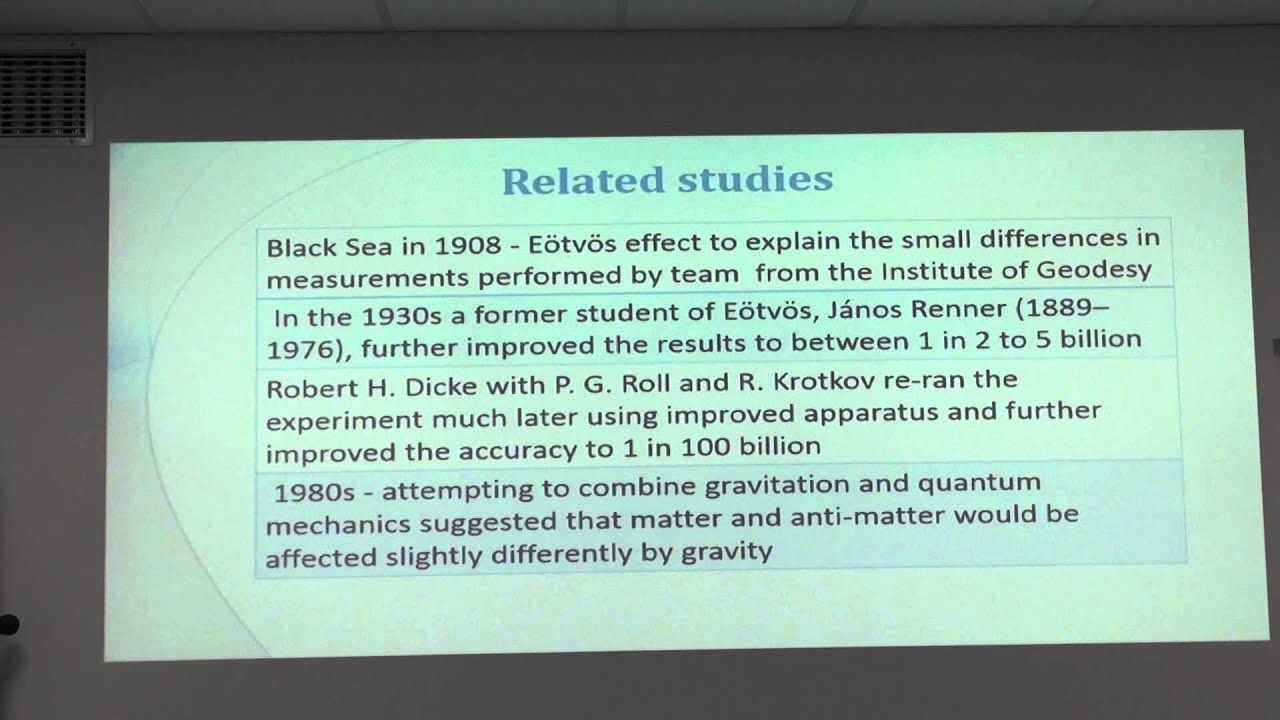
- Eötvös effect on moving ships and later confirmations by Dicke and other researchers.
- Discussion of experimental precision, statistical issues, and concluding remarks.
Cited Sources
- Eötvös, L. (1890). Über die Anziehung der Erde auf verschiedene Substanzen — Original paper describing early experiments on gravitational and inertial mass equivalence.
- Eötvös, L., Pekár, D., & Fekete, E. (1922). Beiträge zum Gesetze der Proportionalität von Trägheit und Gravität — Final paper summarizing the Eötvös experiment, published posthumously.
- Dicke, R. H. (1961). Eötvös experiment revisited — Later confirmation of the equivalence principle with higher precision.
Concurring Sources
- Wikipedia: Eötvös experiment — General information and historical account consistent with the lecture.
Contribution & Novelties
The lecture provides a thorough historical and technical overview of the Eötvös experiment, emphasizing its importance in establishing the equivalence principle. It clarifies the experimental design, including the use of a torsion balance and the methods to eliminate perturbations, and discusses the evolution of the apparatus over time. The talk also covers the Eötvös effect and its relevance to modern physics.
Pour aller plus loin :
- Equivalence principle — Foundational concept in general relativity, directly related to the experiment.
- Torsion balance — The instrument central to the experiment, with historical and technical details.
- Eötvös effect — A related effect on moving objects, also discussed in the lecture.
107 words
Radar Profile
The profile shows high scores in information quantity and quality, with a moderate technical level and good reliability. The lecture excels in providing detailed historical context and technical explanations, while the reliability is supported by the expert presenter and referenced work.