Topologiczne półmetale TaAs i NiTe2 wytworzone metodą epitaksji z wiązek molekularnych
Topological semimetals TaAs and NiTe2 fabricated by molecular beam epitaxy
Keywords
Summary
157 words
Critical Evaluation
Value of the Information & Strength of the Argument
The value of the presentation lies in the pioneering efforts to grow these topological semimetals as thin films, which is non-trivial due to their complex structures and the need for high-quality crystalline material. The speaker substantiates the growth quality through a combination of RHEED, X-ray diffraction, atomic force microscopy, and transmission electron microscopy, and demonstrates that the electronic structure, as probed by ARPES, matches expectations from bulk counterparts. The argumentation is solid, acknowledging limitations such as grain boundary scattering that obscures transport signatures, and honestly compares with competing groups’ results. The talk provides a clear methodological narrative and places the work in the context of the field.
Scientific Rigor, Source Quality, Title Accuracy
The speaker is rigorous in citing relevant literature, including the first experimental identification of Weyl semimetals in TaAs (2015) and prior work on NiTe2 bulk crystals. He compares his thin-film ARPES data with published bulk results, showing correspondence. The title accurately describes the content, as the lecture is specifically about the growth of TaAs and NiTe2 via MBE. The presentation is well-structured, with clear explanations of the physics and experimental details, and the speaker distinguishes his group’s contributions from parallel work by others. The technological and scientific challenges are addressed with appropriate caution and future outlook.
218 words
Title / Content Match
The title accurately reflects the content, which focuses on the growth and characterization of two topological semimetals, TaAs and NiTe2, by molecular beam epitaxy.
Quality & Reliability
8/10
The lecture presents original experimental research from a well-established group, with detailed growth and characterization results, referencing peer-reviewed publications. The speaker is a professor at the Institute of Physics of the Polish Academy of Sciences and the University of Warsaw. The transcript contains some errors from automatic speech recognition, but the scientific content is coherent and well-structured.
Key Moments
Markers derived by PSI from the transcript: the creator did not define chapters.
- Introduction to topological semimetals and their electronic properties
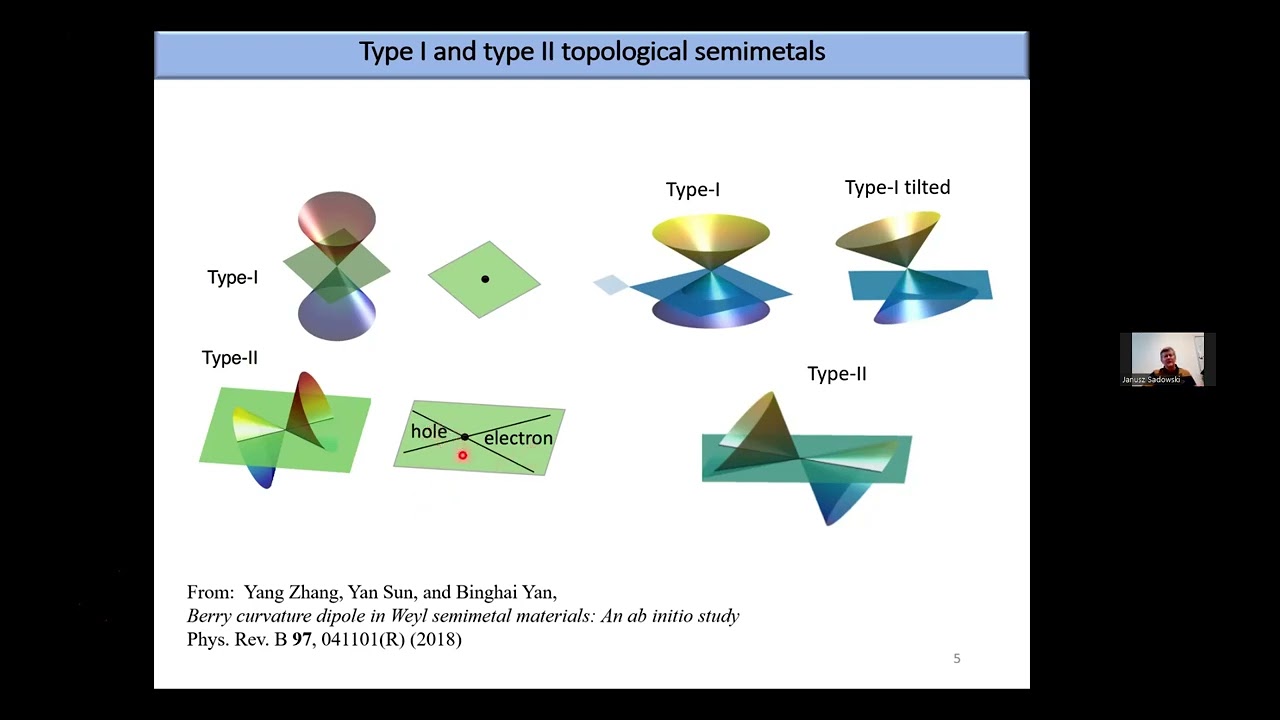
- Explanation of type I and type II Weyl semimetals, differences in band structure
- Growth of NiTe2 on GaN: substrate preparation, lattice matching, and initial observations
- ARPES measurements of NiTe2 thin films and comparison with bulk crystals
- Discussion of transport measurements and grain boundary effects in NiTe2
- Growth of TaAs on GaAs: unexpected two-dimensional growth and 45° rotation
- Characterization of TaAs: X-ray diffraction, AFM, and TEM analysis
Contribution & Novelties
The original contribution of this work is the successful growth of NiTe2 thin films by molecular beam epitaxy, which had not been reported before, and the first reported growth of TaAs thin films, albeit with a striped morphology. The lecture provides a detailed account of the growth challenges and the characterization strategies used to evaluate film quality. It also highlights the observation of expected Weyl fermion features in ARPES for NiTe2, matching bulk results, and identifies limitations in transport measurements due to grain boundaries. The research pushes forward the realization of topological semimetals in thin-film form for potential device applications.
Pour aller plus loin :
- Topological semimetal - Wikipedia — Overview of the class of materials and their properties.
- Molecular beam epitaxy - Wikipedia — Technique used for thin-film growth described in the lecture.
- Angle-resolved photoemission spectroscopy - Wikipedia — Key experimental method used to probe band structure.
148 words
Radar Profile
The radar profile shows high scores across all dimensions, particularly in technical level and reliability, indicating a scientifically dense and well-founded presentation, with a slightly lower score in information quantity due to the specialized focus.