Wprowadzenie do mechaniki kwantowej część II
Introduction to quantum mechanics part II
Keywords
Summary
209 words
Critical Evaluation
Value of the Information & Strength of the Argument
The lecture provides a clear, pedagogically structured introduction to the conceptual foundations of quantum mechanics. It builds arguments progressively, starting from classical mechanics and then highlighting the necessity of a wave function to explain experimental phenomena. The exposition is logical and uses simple examples (e.g., the harmonic oscillator) to illustrate abstract ideas. However, it does not present new research or novel interpretations; its value lies in its clarity and pedagogical effectiveness. The argumentation is sound, following well-established physical postulates and mathematical reasoning, but it lacks direct experimental evidence or citations to primary literature.
Scientific Rigor, Source Quality, Title Accuracy
The scientific rigor is adequate for an introductory lecture. The speaker correctly states the postulates and equations, and the mathematical derivations are accurate. The quality of sources is limited to the lecture itself; no external references are mentioned, but the content aligns with standard textbooks. The title ‘Wprowadzenie do mechaniki kwantowej część II’ corresponds precisely to the content, which indeed is an introduction to quantum mechanics, part 2. No discrepancies were noted between the title and the actual material.
187 words
Title / Content Match
The title exactly matches the content: this is a second part of an introductory lecture on quantum mechanics, following a previous session.
Quality & Reliability
7/10
Lecture presented by a physicist at a research institute, covering well-established standard material. No external citations or experimental details provided, but the exposition is coherent and consistent with textbook quantum mechanics.
Key Moments
Markers derived by PSI from the transcript: the creator did not define chapters.
- Recap of classical mechanics: state determined by position and velocity, Newton's second law.
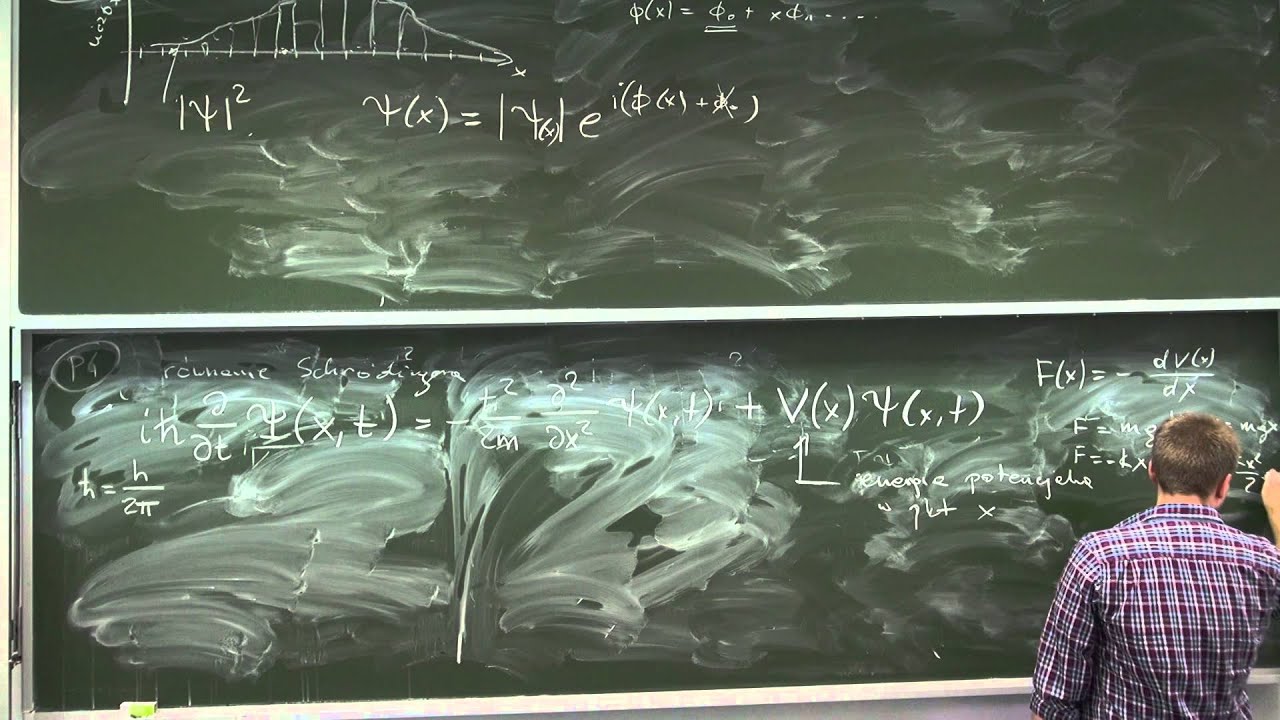
- Introduction of the quantum state as a complex function over all positions.
- Born rule: probability density as squared modulus of wave function; normalization condition.
- Dimensional analysis of the wave function in 1D, 2D, and 3D.
- Third postulate: repeatability of experiments and statistical interpretation.
- Importance of phase; relationship between phase and momentum probabilities.
- Introduction of the Schrödinger equation and its role in time evolution.
- Application to harmonic oscillator; deterministic evolution of wave function.
Contribution & Novelties
This lecture contributes a clear exposition of quantum mechanics fundamentals, particularly the conceptual shift from classical determinism to probabilistic wave-function description. Its originality lies in the pedagogical approach rather than new scientific content. For further exploration, consider the following concepts:
Pour aller plus loin :
- Quantum mechanics — Overview of the theory and its postulates.
- Wave function — Detailed treatment of the mathematical object central to the lecture.
- Schrödinger equation — The governing equation for wave-function evolution.
- Born rule — The probabilistic interpretation of the wave function’s modulus squared.
89 words
Radar Profile
The radar profile shows relatively high scores in quantity of information and technical level, reflecting a thorough introduction. Quality and reliability are slightly lower due to the lack of citations and experimental grounding, but the content remains sound.