Semiconductor optical cavities for photonic signal processing
Keywords
Summary
170 words
Critical Evaluation
Value of the Information & Strength of the Argument
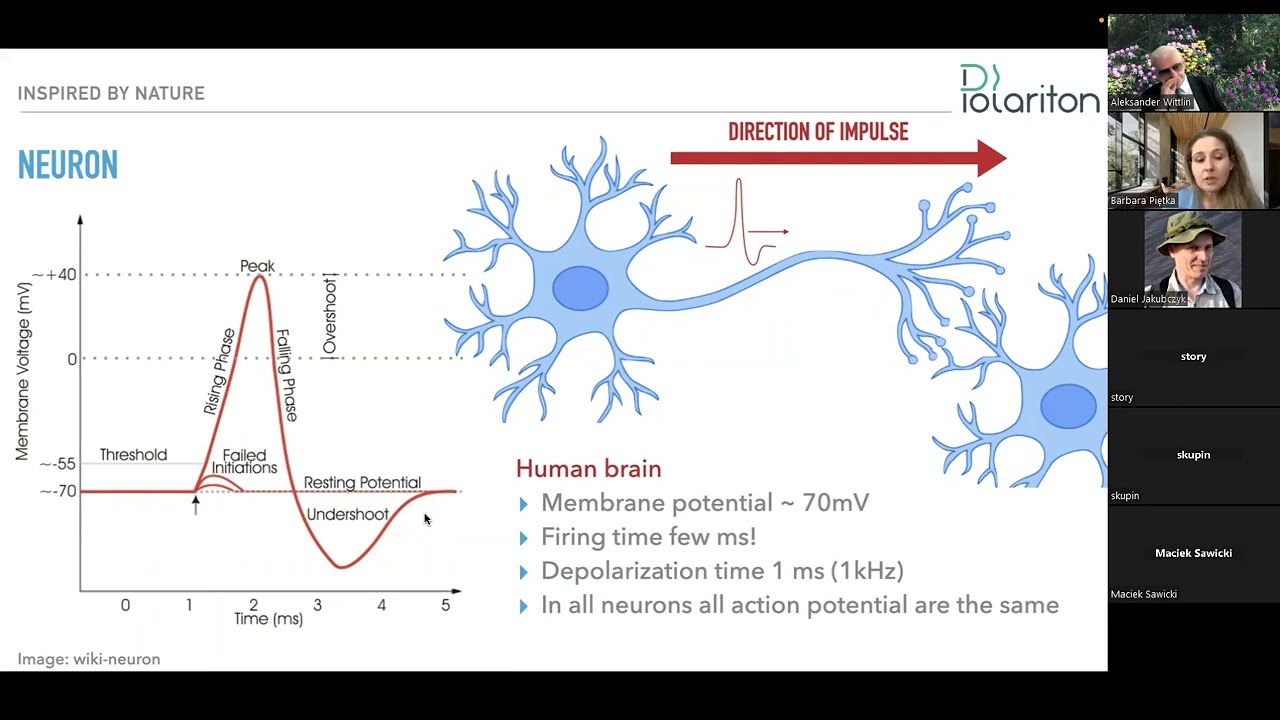
The lecture provides a comprehensive overview of photonic approaches to neuromorphic computing, presenting a clear argument for why polaritons are promising. It carefully contrasts electronics and photonics, identifying the advantages and challenges. The reasoning is logical: starting from biological inspiration, moving to mathematical models, then to electronic implementations, and finally proposing polaritons as a photonic solution that can overcome speed limitations while retaining nonlinearity at low energy. The speaker supports her claims with examples (e.g., IBM TrueNorth, Neuralgrid) and explains the physics behind polariton condensation. The main value lies in articulating a vision for photonic neuromorphic chips and grounding it in existing experimental work from her group.
Scientific Rigor, Source Quality, Title Accuracy
The talk is scientifically rigorous, relying on established physics of microcavity polaritons and referencing key implementations like TrueNorth. The speaker does not cite specific papers during the lecture, but the content is consistent with current research. The title is a good match, though it could be more specific about the polariton-based approach. The lack of explicit external references in the description is a minor weakness, but the talk is a seminar inviting discussion and is based on the presenter’s own research, which is typical for such lectures. The technical level is high, requiring background in physics, but the presentation is clear and structured.
225 words
Title / Content Match
The title accurately reflects the content, which focuses on semiconductor optical cavities and their use for photonic signal processing, particularly via polariton-based neuromorphic computing.
Quality & Reliability
8/10
Lecture by an expert from the University of Warsaw presenting original research on polariton-based photonic neuromorphic computing. The content is technically rigorous, well-structured, and grounded in established physics, though it is a seminar presentation rather than peer-reviewed publication.