Teoria nadprzewodnictwa wysokotemperaturowego: ilościowe porównanie z eksperymentem dla nadprzewo...
Keywords
Summary
146 words
Critical Evaluation
Value of the Information & Strength of the Argument
The value of the information lies in presenting a novel theoretical approach that goes beyond the mean-field approximation, achieving quantitative agreement with experiments for several key observables. The argumentation is solid: the speaker consistently compares theoretical results with experimental data, such as the phase diagram, Fermi velocity, and kinetic energy changes, and explains discrepancies where they exist. The methodology, involving systematic incorporation of correlations via diagrammatic techniques, is clearly outlined, and the successes and limitations are honestly stated. The talk strengthens the case for a particular pairing mechanism driven by kinetic energy and spin correlations, challenging conventional BCS-like descriptions.
Scientific Rigor, Source Quality, Title Accuracy
The talk demonstrates high scientific rigor: it is based on a detailed review article (about 137 pages) and several recent papers, with clearly defined models and parameters. The speaker does not oversimplify and openly discusses failures and unresolved issues. However, no external sources are explicitly cited in the video description, and the references mentioned (e.g., Anderson, Deutscher) are not linked. The title accurately reflects the content, which is a quantitative comparison of theory and experiment. Overall, the presentation adheres to academic standards, though the lack of accessible citations in the description slightly limits verifiability.
208 words
Title / Content Match
The title accurately describes the content: theory of high-temperature superconductivity with a strong emphasis on quantitative comparison with experiment. The talk covers model development, phase diagrams, Fermi velocity, and kinetic energy changes, all consistently linked to experimental findings.
Quality & Reliability
8/10
The talk is a rigorous, expert-level seminar by a professor from a leading Polish university, presenting original theoretical results with quantitative comparisons to experimental data. The approach and data appear derived from peer-reviewed publications, indicating high reliability.
Key Moments
Markers derived by PSI from the transcript: the creator did not define chapters.
- Introduction and plan of the talk; mention of collaborators.
- Presentation of the Hubbard t-J-U model for cuprates.
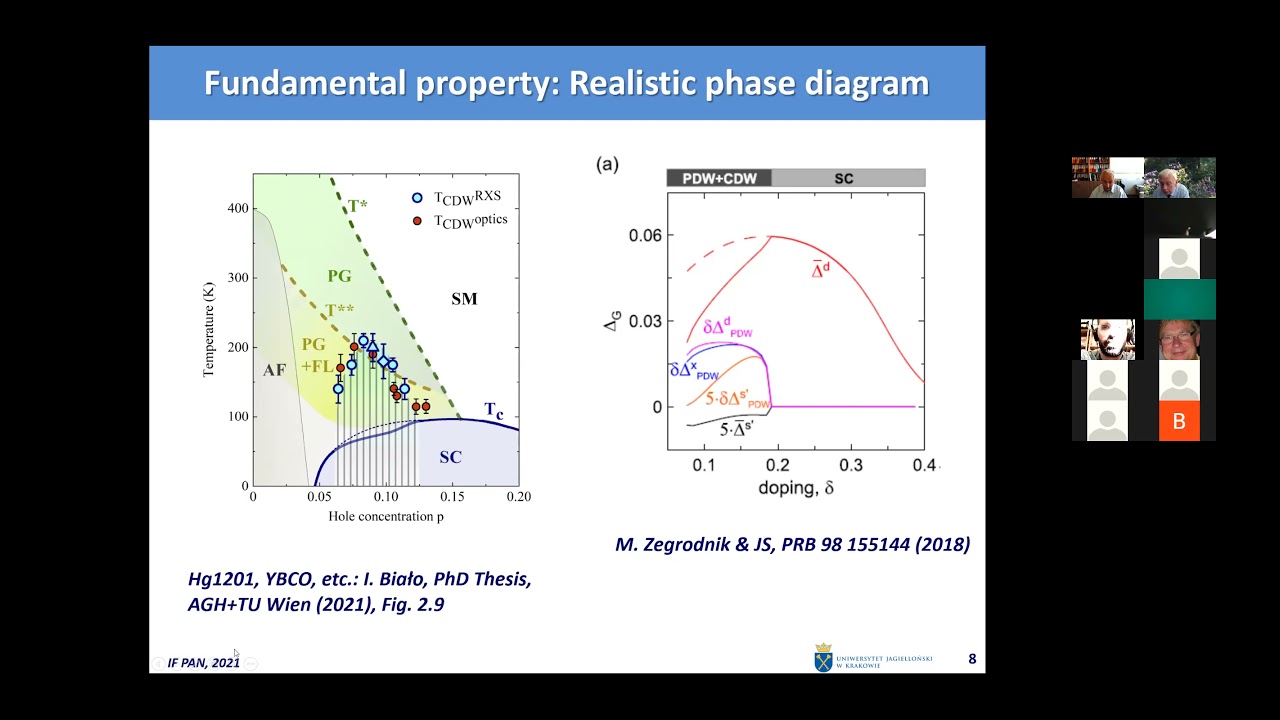
- Discussion of phase diagram, including charge-density-wave order and superconducting dome.
- Fermi velocity puzzle and resolution via beyond-mean-field approach.
- Collective excitations (paramagnons, plasmons) and outlook for future work.
Contribution & Novelties
The talk presents a major advancement in high-Tc superconductivity theory by systematically going beyond mean-field approximations, achieving quantitative agreement with experiments on phase diagrams, Fermi velocity, and kinetic energy. The novelty lies in the statistically consistent Gutzwiller approximation and the inclusion of quantum fluctuations, which collectively explain previously puzzling experimental observations.
Pour aller plus loin :
- High-temperature superconductivity — Context for the phenomenon.
- t-J model — The doped Mott insulator framework used in the talk.
- Hubbard model — The fundamental model underlying the t-J approach.
85 words
Radar Profile
The radar profile is strongly biased towards high technical level and high information quantity, with slightly lower quality and reliability scores, reflecting the advanced and peer-level nature of the content. This indicates a very technical, information-dense presentation that assumes a specialized audience.