Doświadczenie Millikana - pomiar ładunku elektrycznego
Millikan experiment - measurement of electric charge
Title history
- Doświadczenie Millikana - pomiar ładunku elektrycznego — observed on 20261026-1551 UTC (YouTube)
Keywords
Summary
216 words
Critical Evaluation
Value of the Information & Strength of the Argument
The value of the information lies in its detailed explanation of the Millikan experiment, including the theoretical derivation and the experimental procedure. The argumentation is logical and step-by-step, moving from the forces on droplets to the final formula for charge. The presenter clearly connects the experiment to the concept of quantization of charge. The interactive discussion adds depth by questioning assumptions and highlighting potential flaws, which strengthens the analysis by presenting a balanced view. However, the argumentation is sometimes interrupted by audience interjections, making the flow less smooth, but these interruptions themselves contribute critical insights.
Scientific Rigor, Source Quality, Title Accuracy
The scientific rigor is generally high, as the experiment is well-known and the derivation follows standard textbook physics. The presenter cites Millikan’s work and his values, but no specific sources are formally referenced in the video. The quality of sources is implicit; the discussion references historical evidence (e.g., the examination of Millikan’s notebooks by historians). The title adequately matches the content, which is solely about the Millikan oil-drop experiment and the measurement of electric charge. No extraneous topics are introduced. The rigor is somewhat compromised by the informal setting and the fact that the presenter is a PhD student, but the institutional backing (IF PAN) adds credibility.
217 words
Title / Content Match
The title accurately reflects the content, which focuses on Millikan's oil-drop experiment to measure the elementary charge. The presentation covers both the experimental setup and the resulting value, as well as historical aspects.
Quality & Reliability
7/10
The lecture is accurate in its presentation of the Millikan oil-drop experiment, its historical context, and the underlying physics. However, the presentation is a recording of a seminar with interactive discussion, during which the audience raises critical points about experimental methodology and data selection. The factual content is reliable, but the delivery is informal and the discussion sometimes challenges the presenter's statements. The information is consistent with standard physics knowledge, though the critical exchange adds nuance rather than new research.
Key Moments
Markers derived by PSI from the transcript: the creator did not define chapters.
- Introduction of the presenter and her academic affiliations.
- Biography of Robert Millikan, his Nobel Prize, and early career.
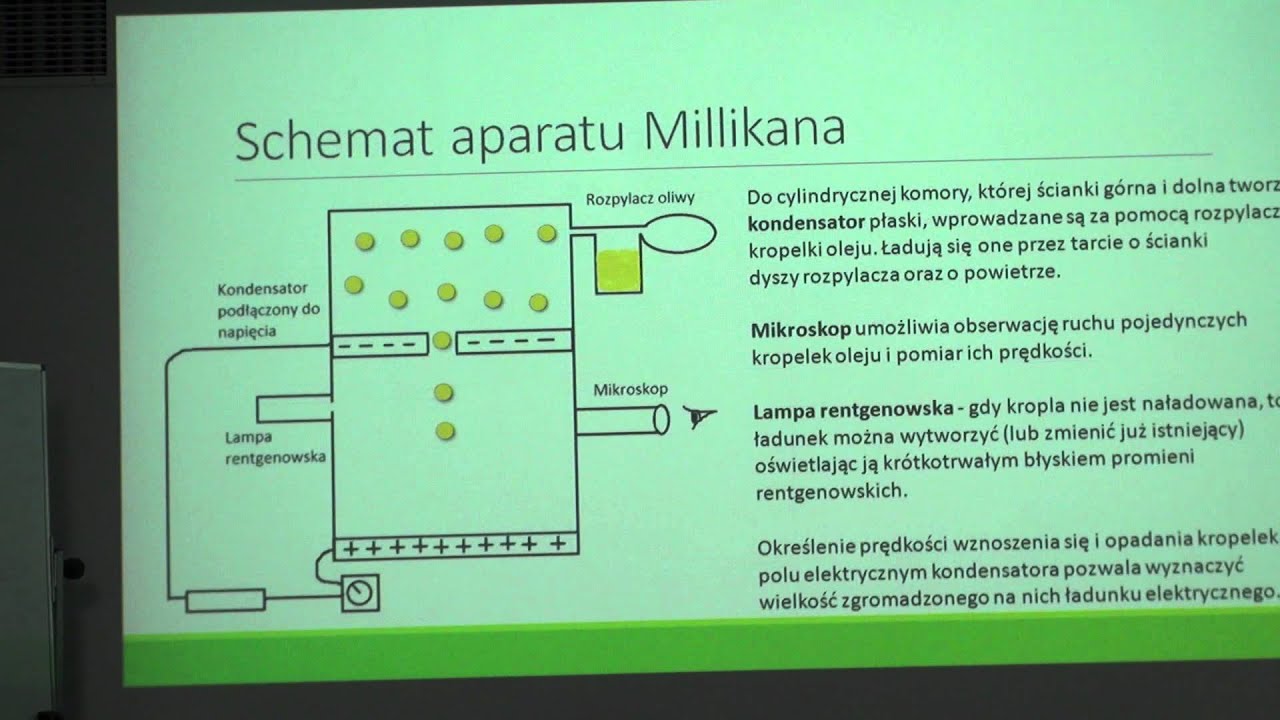
- Description of the experimental apparatus: capacitor, oil sprayer, X-ray lamp, microscope.
- Discussion of forces acting on oil droplets: gravity, electric force, buoyancy, Stokes drag.
- Derivation of the formula for droplet charge, including the balance of forces and terminal velocity.
- Presentation of Millikan's final formula and the observation of charge quantization.
- Audience criticizes the assumption of spherical droplets and the influence of air displacement, referencing alternative forces.
- Discussion about Millikan's data selection and the controversy over discarded data, compared with Kaufman's honest publishing.
- Conclusion about the significance of charge quantization and ethical considerations in experimental science.
Contribution & Novelties
The video provides an accessible yet detailed explanation of the Millikan oil-drop experiment, situating it in historical context and adding a critical perspective on the experimental methodology. It highlights both the success of measuring the elementary charge and the controversy over data selection, which is not always emphasized in standard textbooks. The novelty lies in the interactive discussion that raises nuanced points about force balance and systematic errors.
Pour aller plus loin :
- Millikan oil-drop experiment — A comprehensive overview of the experiment, its setup, and its significance.
- Elementary charge — Explanation of the concept of elementary charge and its modern value.
- Robert A. Millikan — Biography of the physicist, including his Nobel Prize and the controversies surrounding his data.
- Stokes’ law — The aerodynamic drag formula used in the derivation, relevant to understanding the force balance.
137 words
Radar Profile
The radar profile shows moderate to high scores across all dimensions, with quantity and technical level notably strong, while quality and reliability are slightly lower due to the informal discussion and lack of explicit sources. The overall balance indicates a content-rich lecture with technical depth, but with some caveats regarding rigor.