Pola cechowania
Marking fields
Keywords
Summary
190 words
Critical Evaluation
Value of the Information & Strength of the Argument
The lecture provides high educational value by connecting the abstract mathematical notions of gauge theory to physical intuition through clear examples and historical context. The argumentation is structured logically, starting from simple electromagnetic case and systematically extending to non-abelian theories, with each step motivated by physical principles such as locality and symmetry. The speaker emphasizes the conceptual breakthroughs and remaining puzzles, offering a balanced view of the subject. The strength of the argumentation lies in its pedagogical clarity and the expert framing of the ideas without oversimplification.
Scientific Rigor, Source Quality, Title Accuracy
The lecture is scientifically rigorous, given by an established researcher, and content is consistent with well-established theoretical physics. Although no explicit sources or citations are provided in the description or on screen, the speaker references the historical works of Weyl, London, Yang, Mills, and Gribov, which are clearly part of the standard literature. The title is perfectly aligned with the content, which covers both the fundamentals and the modern implications of gauge fields. The presentation is appropriate for an academic audience, though accessible to advanced students.
188 words
Title / Content Match
The title 'Pola cechowania' (Gauge fields) accurately reflects the content, as the entire lecture is devoted to the concept, history, and modern applications of gauge field theory.
Quality & Reliability
9/10
The lecture is delivered by a renowned physicist at a professional academic seminar, with a clear, historically informed presentation of gauge field theory. The technical content is accurate and well-structured, though it relies on the speaker's expertise rather than cited external sources.
Key Moments
Markers derived by PSI from the transcript: the creator did not define chapters.
- Introduction: meaning of a gauge symbol and historical motivation for gauge invariance.
- Weyl's original scale-change idea and its initial failure, followed by London's quantum mechanical reinterpretation.
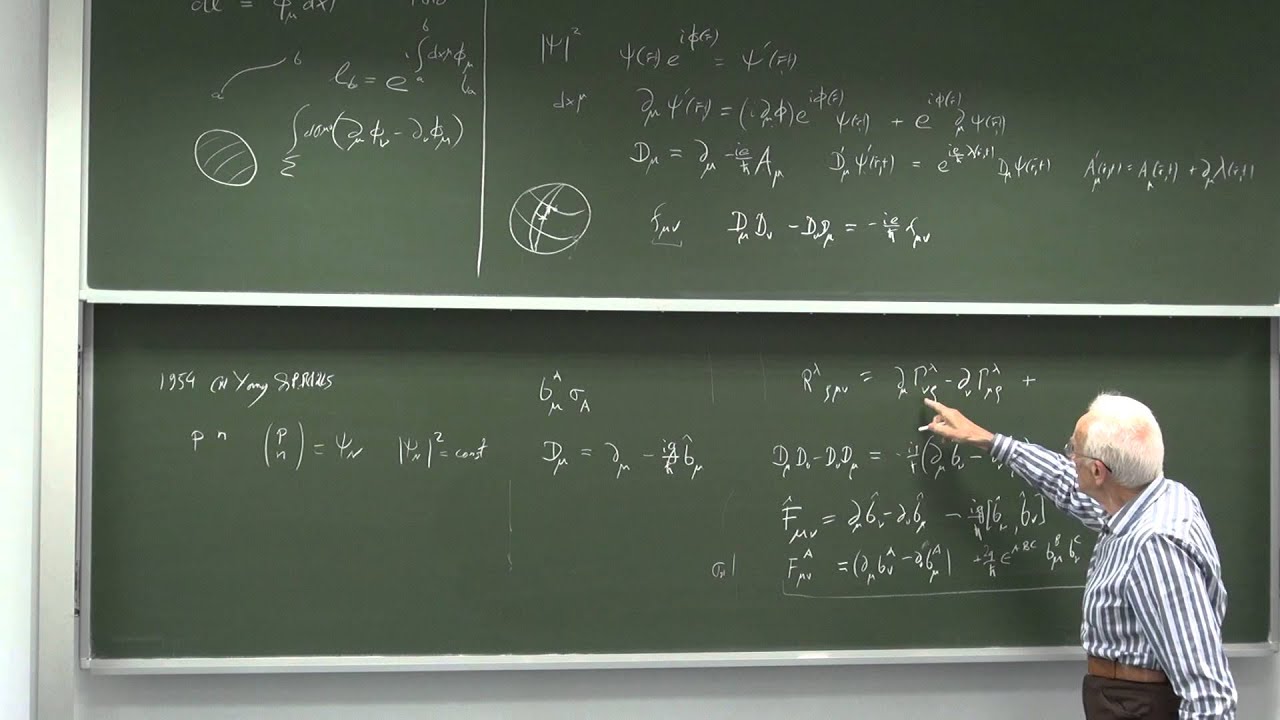
- Local phase invariance and introduction of the electromagnetic field as a compensating gauge field.
- Generalization to non-abelian gauge theories: Yang-Mills theory for isospin, with matrix-valued potentials and field strength.
- Comparison with general relativity, dynamics, and the Yang-Mills equations; later extension to QCD and the Standard Model.
- Challenges in non-abelian theories: Gribov ambiguity, and the unresolved questions about elementary particles and gauge fields.
Contribution & Novelties
This lecture offers an original didactic synthesis of gauge field theory, connecting its historical roots with modern applications. Its novelty lies in the clarity of the historical narrative—from Weyl to London to Yang-Mills—and the emphasis on conceptual continuity. The speaker personalizes the subject by sharing his own reflections on the nature of elementary particles and the tentative idea of gauge fields as emergent phenomena. The discussion of technical issues like the Gribov ambiguity is presented in an accessible manner, highlighting open problems that remain relevant.
Pour aller plus loin :
- Gauge theory (Wikipedia) — An overview of gauge theory, its mathematical formulation, and its role in modern physics.
- Yang-Mills theory (Wikipedia) — Detailed description of non-abelian gauge theories and their significance in particle physics.
- Gribov ambiguity (Wikipedia) — Explanation of the gauge fixing issue in non-abelian theories, a topic mentioned in the lecture.
143 words
Radar Profile
The radar profile shows a balanced, high-quality lecture: information quantity and quality are both near-maximal, reflecting the dense but accessible content. The technical level is high, appropriate for a professional seminar, while the reliability is strong due to the speaker's expertise. The slightly lower quantity score relative to quality suggests efficient use of time rather than unnecessary length.