Doświadczenie Davissona-Germera
Davisson-Germer experiment
Keywords
Summary
139 words
Critical Evaluation
Value of the Information & Strength of the Argument
The lecture’s value lies in its clear and thorough historical narrative, connecting the evolution of wave-particle duality to the key experiments that validated it. The speaker effectively argues for the significance of the Davisson-Germer experiment by presenting both the experimental details and the theoretical context, including the technical accident that led to the necessary crystal structure. The argumentation is logically structured, moving from foundational concepts to the experiment’s setup, results, and broader impact. The inclusion of subsequent related experiments and applications strengthens the overall thesis about the universality of matter waves.
Scientific Rigor, Source Quality, Title Accuracy
The rigor is high, as the lecture is delivered by an expert and references established scientific facts without evident errors. No explicit sources are cited within the video, but the content aligns with standard textbook accounts of wave-particle duality. The title precisely matches the content, focusing on the Davisson-Germer experiment. The presentation is technically coherent and scientifically accurate, drawing on the speaker’s expertise. Due to the absence of primary literature citations, the reliance on established knowledge is presumed, but the institutional backing adds credibility.
190 words
Title / Content Match
Title accurately reflects the lecture's focus on the Davisson-Germer experiment.
Quality & Reliability
8/10
Lecture by a physicist at a reputable Polish research institute; content aligns with established quantum physics knowledge.
Key Moments
Markers derived by PSI from the transcript: the creator did not define chapters.
- Introduction and historical context of light's nature
- Discussion of Newton's corpuscular theory and wave theory
- Introduction of de Broglie's matter wave hypothesis
- Davisson-Germer experiment setup and anomalous results
- Interpretation via crystal diffraction and confirmation of de Broglie's wavelength
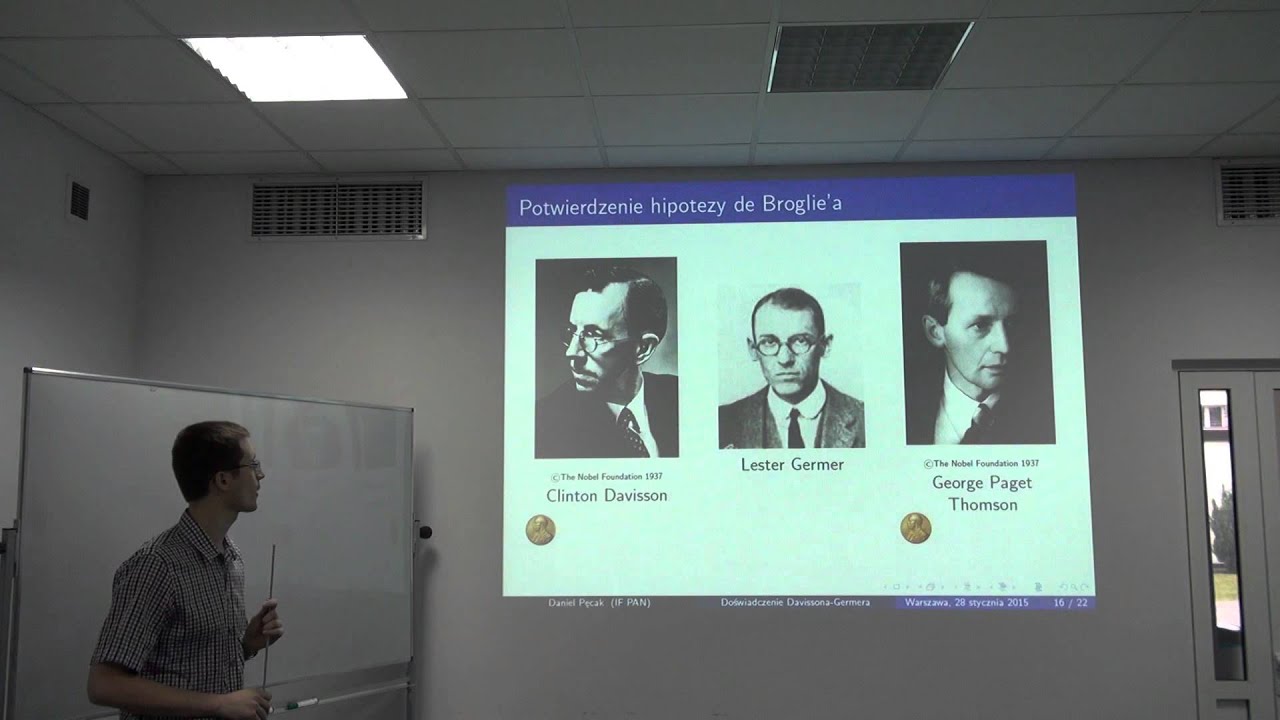
- Confirmation by George Thomson and Nobel Prize
- Applications: electron microscope and other uses
- Extensions to larger particles and atom lasers
Contribution & Novelties
The lecture provides a clear and engaging account of the Davisson-Germer experiment, emphasizing its historical importance and its role in establishing the wave nature of matter. It effectively bridges the gap between theoretical prediction and experimental confirmation, and goes on to illustrate the far-reaching consequences such as the electron microscope and matter wave interferometry. The original contribution lies in its pedagogical presentation, making complex quantum phenomena accessible to a technical audience.
Pour aller plus loin :
- Davisson-Germer experiment — The central experiment, with details and historical context.
- Matter wave — De Broglie’s hypothesis and its theoretical foundation.
- Electron diffraction — Techniques and applications of electron wave scattering.
- Bose-Einstein condensate — Illustrates wave behavior at macroscopic scale.
116 words
Radar Profile
The radar profile shows high scores in information quality, reliability, and technical level, reflecting a rigorous expert presentation. The quantity of information is also substantial, covering both the experiment and its implications. The overall assessment is strongly positive, with a minor gap in self-cited sources, but the institutional backing and internal consistency compensate.