Poszukiwania życia we Wszechświecie
The Search for Life in the Universe
Keywords
Summary
184 words
Critical Evaluation
Value of the Information & Strength of the Argument
The lecture provides valuable insight into the current state of astrobiology and the practical methods used to search for life-related molecules in space. The argumentation is solid, building from general questions about life to specific observational techniques. The speaker’s personal involvement in research projects adds authenticity and depth, as he describes real observations and their interpretations. The reasoning is clear and accessible, with appropriate caveats about negative results and the need for further study. The emphasis on spectroscopy as a tool is well justified, and the examples from his own work illustrate the challenges and achievements in the field.
Scientific Rigor, Source Quality, Title Accuracy
The speaker is a professor at the Institute of Physics of the Polish Academy of Sciences, and his talk reflects a high level of expertise. The content is consistent with established scientific knowledge in astronomy and molecular physics, though no explicit references are cited during the talk. The title ‘Searching for Life in the Universe’ matches the content well, as the lecture is entirely focused on that theme. The presentation avoids sensationalism and sticks to evidence-based reasoning, mentioning the mythological ‘face on Mars’ only to dismiss it. Overall, the scientific rigor is strong, although the lack of direct citations limits the ability to verify specific claims without external knowledge.
223 words
Title / Content Match
The title accurately reflects the content: the lecture discusses the search for life in the universe, including methods and recent findings.
Quality & Reliability
8/10
Lecture by a professor at the Polish Academy of Sciences, based on established scientific knowledge and personal research in molecular spectroscopy.
Key Moments
Markers derived by PSI from the transcript: the creator did not define chapters.
- Introduction to the search for life and the 'Pillars of Creation' image.
- Discussion of exoplanet discoveries and the prevalence of planetary systems.
- Mars exploration: Viking missions, the 'face on Mars', and evidence of water.
- Introduction to molecular spectroscopy and its role in detecting molecules in space.
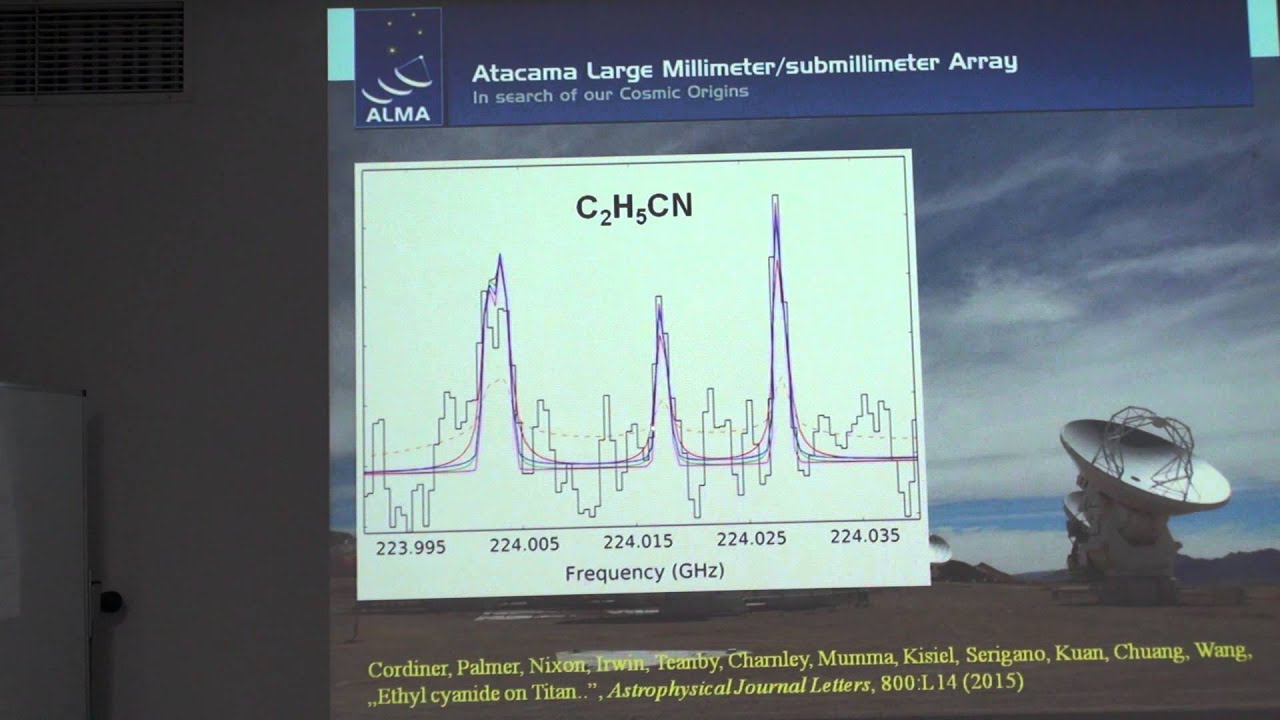
- Radio telescopes and ALMA: observation of molecules like C3H on Titan.
- Search for complex organic molecules near the galactic center and negative results.
- Concluding remarks on the status of the search for life and thanks to taxpayers.
Contribution & Novelties
The lecture offers an accessible yet detailed overview of the search for life in the universe, with a unique insider perspective on the use of molecular spectroscopy. It highlights the importance of negative results in scientific research and the ongoing efforts to identify complex molecules in space. The speaker’s own contributions, such as the identification of a new molecule on Titan, provide concrete examples of how research is conducted.
Pour aller plus loin :
- Astrobiology — Overview of the interdisciplinary study of life in the universe.
- Rotational spectroscopy — Explanation of the technique used to detect molecular transitions.
- ALMA — Details on the radio telescope array mentioned in the lecture.
- Miller–Urey experiment — Background on origin-of-life research discussed in relation to molecule formation.
123 words
Radar Profile
The profile shows high scores in quantity and quality of information, with slightly lower technical level and reliability, reflecting a well-balanced expert presentation. The strengths lie in the depth of content and scientific rigor, while the lower technical score suggests the lecture is accessible to non-specialists.