Nanocząstki tlenków domieszkowane jonami ziem rzadkich w zastosowaniach teranostycznych
Nanoparticles of oxides doped with rare earth ions in theranostic applications
Keywords
Summary
197 words
Critical Evaluation
Value of the Information & Strength of the Argument
The value of the information is high, as it presents comprehensive experimental results from a decade-long project, involving over 400 mice and other animals. The speaker systematically addresses key challenges: material selection for biocompatibility, efficient emission, selective targeting, and multi-modal imaging. The argumentation is generally sound, logical, and grounded in experimental observations. However, some claims, such as ‘100% selectivity’ for lung cancer, are likely based on a limited number of cases and may not hold in larger cohorts. The proposal that X-ray-induced photodynamic therapy could work is innovative but remains at an early stage, with no data on efficacy in vivo. The discussion of energy transfer mechanisms is scientifically plausible but not experimentally verified in detail. Overall, the talk provides a solid foundation for further research, but the overgeneralization from animal models to human applications should be tempered.
Scientific Rigor, Source Quality, Title Accuracy
The scientific rigor is reflected in the careful choice of materials based on prior safety data, the use of appropriate animal models, and the systematic evaluation of uptake and distribution. The speaker references worldwide cancer statistics and acknowledges the limitations of conventional imaging techniques. However, no peer-reviewed publications or external sources are cited in the talk, and the results are presented as personal achievements rather than being situated within the broader scientific literature. The title is fully appropriate: it accurately describes the content, which focuses on rare-earth-doped oxide nanoparticles for theranostics. The talk is a seminar presentation, so it does not undergo formal peer review, but the speaker’s expertise and the scale of the animal studies lend credibility. The lack of external citations is a minor weakness, but the depth of the presented data compensates.
288 words
Title / Content Match
The title accurately reflects the content, focusing on oxide nanoparticles doped with rare earth ions for theranostic applications.
Quality & Reliability
8/10
Presentation by a professor with extensive experience, based on experiments on animals with careful controls. However, it is a seminar talk without peer review, and some claims may be overstated (e.g., 100% selectivity).
Key Moments
Markers derived by PSI from the transcript: the creator did not define chapters.
- Motivation: global cancer incidence and the importance of early detection.
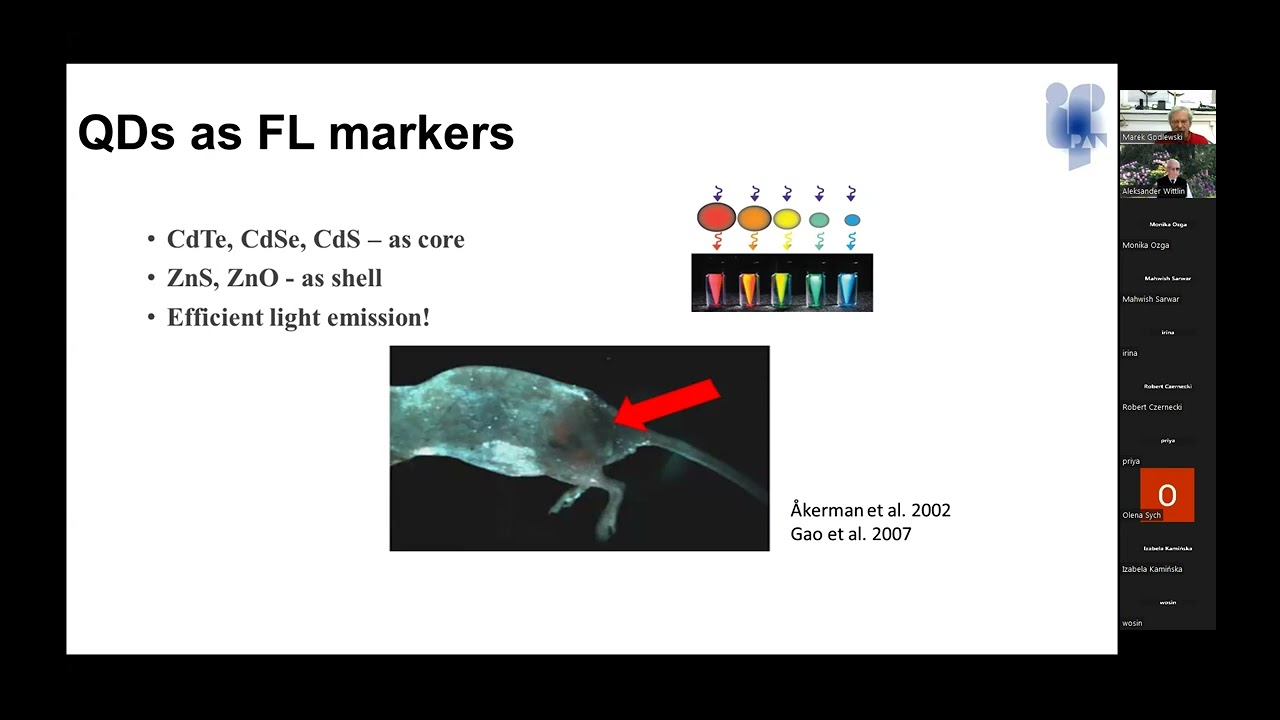
- Discussion of quantum dots and their problems (toxicity, blinking) leading to the choice of oxide nanoparticles.
- Selection of ZnO and ZrO2 for safety, and the intragastric administration method.
- Results on selective accumulation in lung cancer with 100% selectivity in mouse models.
- Use of europium-doped nanoparticles as MRI contrast agents, tested on veterinary patients.
- Proposal for X-ray-induced photodynamic therapy using nanoparticles.
- Drug delivery with ZnO nanoparticles to brain tumors via intragastric administration.
- Summary of results and future directions.
Contribution & Novelties
The original contribution is the demonstration that relatively large (50–100 nm) oxide nanoparticles, which are generally considered inert, can be used for theranostics. The development of an intragastric administration route is a notable innovation, avoiding the risks of intravenous injection. The combination of fluorescent markers and MRI contrast within the same nanoparticle platform provides a dual-modal imaging capability. The proposal to use X-rays to excite photodynamic therapy is also original, though still in early stages.
Pour aller plus loin :
- Theranostics — Overview of combined diagnostics and therapy.
- Photodynamic therapy — Background on PDT and its mechanisms.
- Magnetic resonance imaging — Principles of MRI and contrast agents.
- Rare-earth elements — Properties of rare earth ions relevant to luminescence.
118 words
Radar Profile
The radar profile shows high scores in quantity and quality of information, and moderate technical level, indicating a dense, well-presented talk with specialized content. Reliability is also high due to the speaker's expertise and the extent of animal data, but the lack of external peer-reviewed references slightly lowers the overall score.