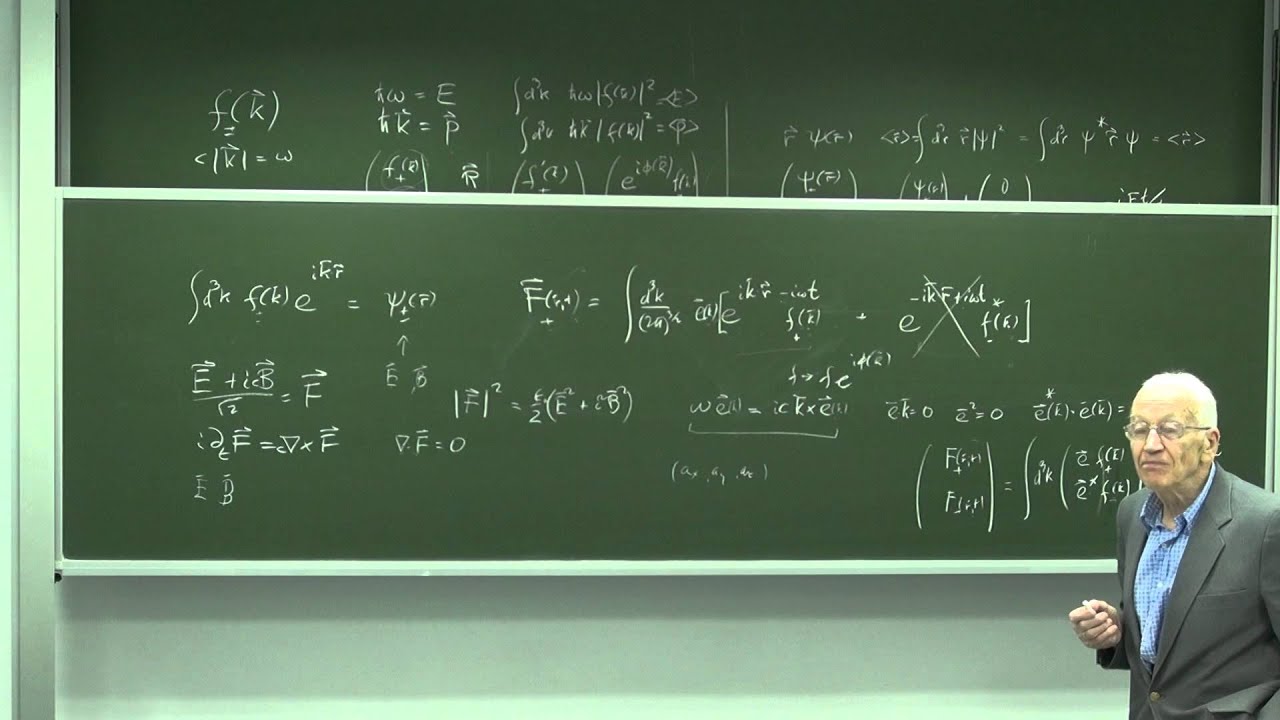
Mechanika kwantowa fotonu
Quantum mechanics of the photon
Title history
- Mechanika kwantowa fotonu — observed on 20261030-1104 UTC (YouTube)
Keywords
Summary
261 words
Critical Evaluation
Value of the Information & Strength of the Argument
The lecture delivers high-value information by clarifying common misconceptions about photons, such as the existence of a sharp energy and the nature of polarisation. The argumentation is rigorous and logically structured, systematically building from historical context to mathematical formulation. The lecturer uses explicit derivations, e.g., solving Maxwell’s equations in momentum space to determine admissible polarisation vectors, and convincingly demonstrates why a simple Fourier transform of the momentum-space wave function fails to yield a local position-space wave function. The distinction between right and left circular polarisation as distinct particles is argued clearly with reference to transformation properties. The strength of the argumentation lies in its consistent use of quantum field theory principles while remaining accessible to an audience with a physics background. The treatment of the Riemann–Silberstein vector as a complex combination of E and B is particularly illuminating, showing its role in achieving locality. Overall, the lecture provides a deep and coherent understanding of the photon’s quantum nature.
Scientific Rigor, Source Quality, Title Accuracy
The scientific rigour is exemplary: the lecturer adheres to well-established quantum mechanics and electrodynamics, and his historical account is accurate, including the anecdote about Planck’s Nobel lecture using the term ‘Lichtquant’ before ‘photon’ was coined. The sources cited are implicit but reputable—works of Planck, Einstein, Compton, and Lewis are referenced without explicit citations, and the lecturer does not make unsupported claims. The title of the video accurately indicates the subject matter, which is entirely dedicated to the quantum mechanics of the photon. The lecture is self-contained and presents a coherent narrative, with no obvious contradictions or misleading statements. The only minor point is the absence of explicit references to specific papers, but the nature of a seminar lecture makes this acceptable.
294 words
Title / Content Match
Title accurately reflects the content, which forms a comprehensive lesson on the quantum description of the photon.
Quality & Reliability
9/10
Lecture by a leading physicist, grounded in established quantum electrodynamics and Maxwell's theory, with accurate historical account and rigorous reasoning.
Key Moments
Markers derived by PSI from the transcript: the creator did not define chapters.
- Introduction: questioning the school definition of photon, arguing it is outdated because photons have finite lifetime.
- Historical background: Planck's quanta, Einstein's photoelectric effect, and the concept of light quanta.
- Compton effect confirming momentum transfer of photons; Lewis naming the photon in 1926.
- Photon wave function in momentum space: definition of energy and momentum operators, analogy with Schrödinger wave mechanics.
- Polarisation states: distinguishing right and left circular polarisation as distinct particles; comparison with electron spin.
- Problem of localisation: attempts to define position-space wave function via Fourier transform fail; introduction of the electromagnetic field vectors and the Riemann-Silberstein vector.
- Derivation of the photon wave function from Maxwell's equations, role of polarisation vectors, and final remarks on the relationship between wave function and fields.
Contribution & Novelties
The lecture provides a clear, pedagogical synthesis of the quantum description of the photon, emphasising the non-trivial aspects such as the definition of a wave function, the role of polarisation as a degree of freedom tied to helicity, and the fundamental non-locality in position space. Its originality lies in the explicit explanation of how the electromagnetic field (specifically the Riemann–Silberstein vector) emerges as the local representation of the photon state, and how the two helicity components correspond to the two independent complex functions of the field. This is particularly valuable for learners who often encounter simplified (and flawed) descriptions in textbooks.
Pour aller plus loin :
- Photon (Wikipedia) — Overview of photon properties and history.
- Wave function (Wikipedia) — Fundamental concept in quantum mechanics.
- Riemann–Silberstein vector (Wikipedia) — The complex combination of E and B used in the lecture.
- Circular polarization (Wikipedia) — Explanation of polarisation states relevant to photon helicity.
151 words
Radar Profile
The scores indicate an exceptionally high level of scientific quality and technical depth, with slightly lower quantity of information relative to the depth of explanation. The radar profile is strongly skewed towards qualitative and reliability aspects, reflecting a focused, rigorous lecture rather than a broad overview.