Odległość
Distance
Title history
- Odległość — observed on 20261026-0106 UTC (YouTube)
Keywords
Summary
133 words
Critical Evaluation
Value of the Information & Strength of the Argument
The lecture excels in presenting a logical progression of distance measurement techniques, from simple to complex, while grounding each method in historical context. The speaker’s argumentation is clear and coherent, effectively connecting the underlying physics and geometry. He emphasizes the assumptions and limitations of each method, such as the reliance on standard candles in astronomy, which adds critical depth. The frequent use of diagrams and geometrical reasoning strengthens the explanations. The focus on the evolution of the meter standard nicely frames the entire discussion, showing the interplay between practical needs and scientific precision.
Scientific Rigor, Source Quality, Title Accuracy
The scientific rigor is high: the speaker cites historical figures and experiments accurately, and the descriptions of methods like parallax and cepheid variables are technically sound. However, the lecture does not explicitly cite specific scientific papers or external sources, relying instead on well-established knowledge. The title exactly matches the content, and there are no obvious discrepancies. The presentation is appropriate for an audience with some physics background, but it avoids unnecessary jargon. The lack of citations is compensated by the speaker’s authority as a professor at a prestigious institute.
197 words
Title / Content Match
The title 'Odległość' (Distance) accurately reflects the content, which systematically covers methods of measuring distances from terrestrial to cosmic scales.
Quality & Reliability
8/10
The lecture provides a historically and scientifically accurate overview of distance measurement methods, from the meter definition to cosmological scales. The speaker, a professor, demonstrates deep expertise, though some simplifications and numerical approximations are present. The content is well-structured and reliable for educational purposes.
Key Moments
Markers derived by PSI from the transcript: the creator did not define chapters.
- Introduction: definition of measurement and the meter as a standard
- Historical introduction of the metric system in France and the original meter definition
- Evolution to the modern definition based on the speed of light
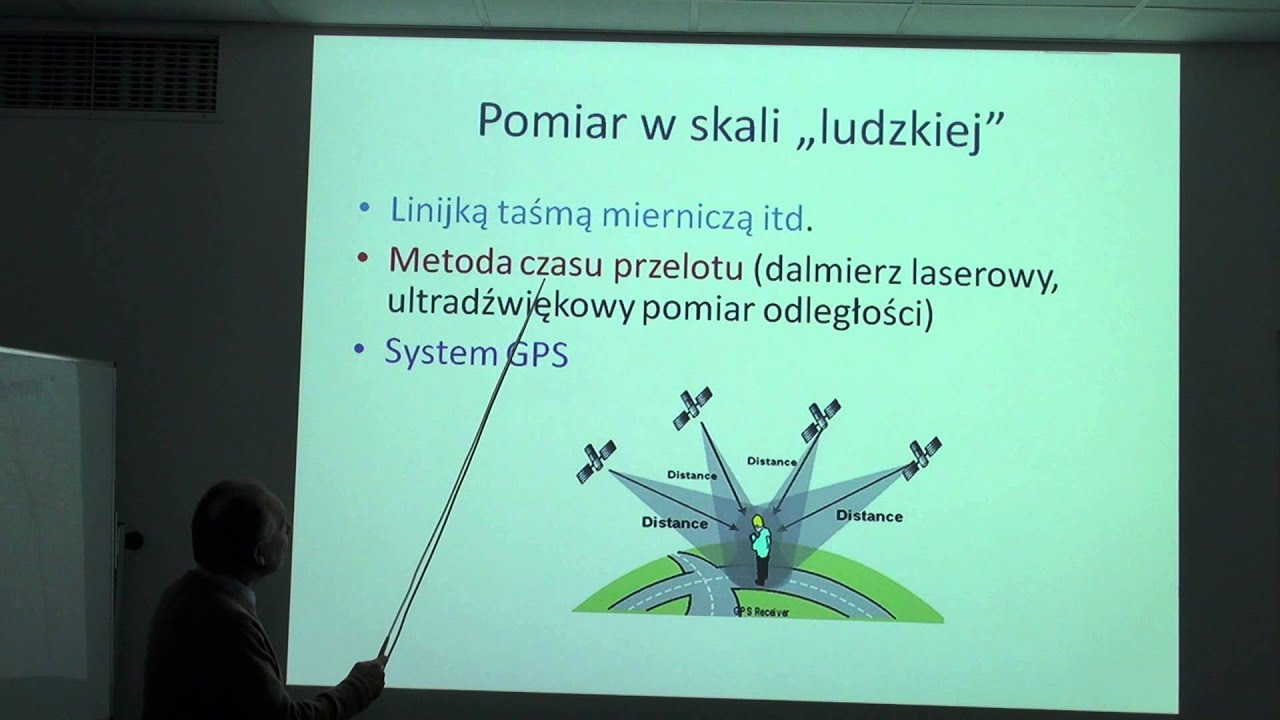
- GPS and laser distance measurement techniques for human-scale distances
- Triangulation method explained with geometric principles
- Eratosthenes' measurement of Earth's radius using shadow angles
- Measurement of the Moon's distance using ancient triangulation and modern laser retroreflectors
- Aristarchus' estimate of the Sun's distance and later Venus transit method
- Stellar parallax measurements by Bessel and the definition of parsec
- Cepheid variables as standard candles for extragalactic distances
- Type Ia supernovae as standard candles and their use in cosmology
- Redshift and Hubble's law for the most distant objects
Contribution & Novelties
The lecture provides a cohesive narrative that integrates historical and modern distance measurement techniques, highlighting the underlying logic and assumptions. It effectively bridges the gap between the definition of the meter and cosmic distance ladders. The speaker’s insights into the limitations of standard candles and the assumptions involved are valuable for understanding the uncertainty in astronomical measurements.
Pour aller plus loin :
- Eratosthenes — Directly related to the measurement of Earth’s circumference, a key example in the lecture.
- Cepheid variable — The standard candle method discussed for measuring galactic and extragalactic distances.
- Hubble’s law — Underpins the redshift-distance relationship presented in the final section of the lecture.
107 words
Radar Profile
The radar profile shows high scores across quantity, quality, technique, and reliability, indicating a well-balanced and informative lecture. The slightly lower technical level suggests it is accessible to a broad audience while still providing depth.