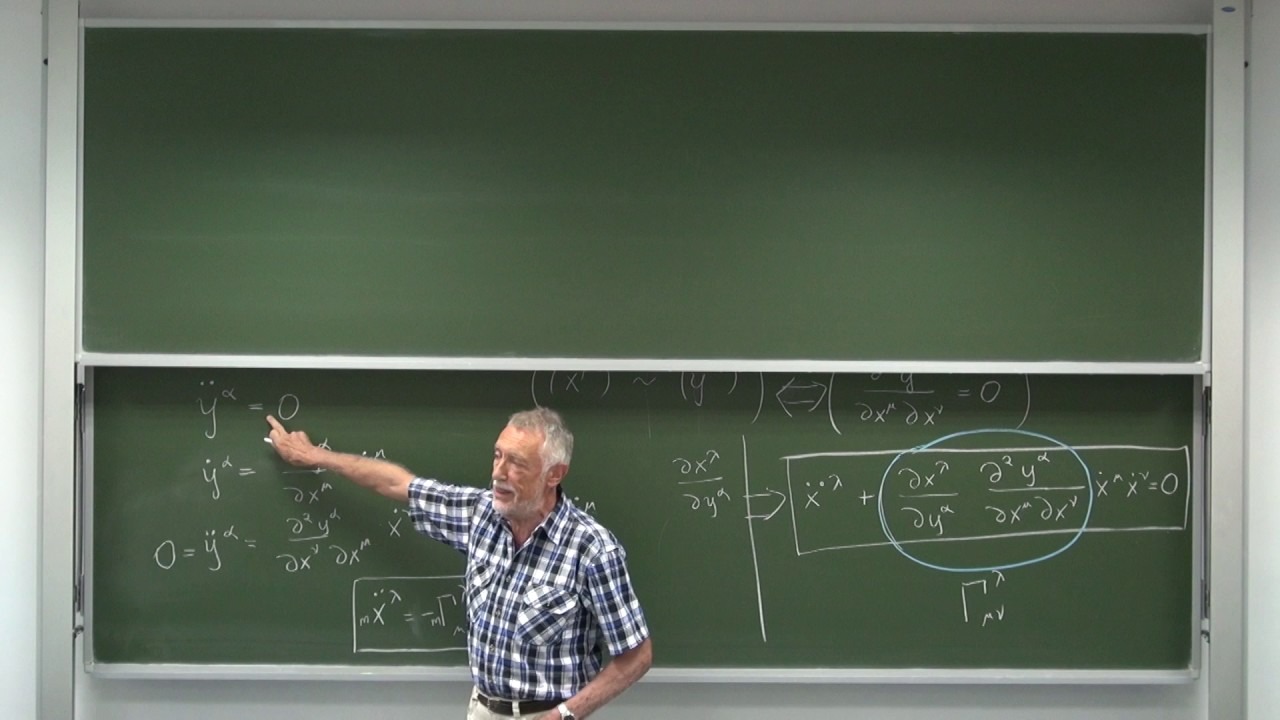
Istota grawitacji
The Essence of Gravity
Keywords
Summary
151 words
Critical Evaluation
Value of the Information & Strength of the Argument
The lecture provides high pedagogical value by offering an intuitive and geometrically motivated route to general relativity, distinct from standard textbook treatments. The argumentation is solid: the speaker builds the formalism step-by-step, from Newtonian mechanics to the principle of equivalence, and clearly explains the mathematical structures involved. He effectively uses the elevator thought experiment to justify the local nature of inertial frames, and then rigorously demonstrates how to construct a connection and curvature. The claim that the metric is unnecessary for describing particle motion is well-supported within the context of the lecture, adding conceptual novelty without contradicting established physics.
Scientific Rigor, Source Quality, Title Accuracy
The scientific rigor is exemplary: the lecturer is a professor at a prestigious institution, and the content is mathematically precise. The presentation adheres strictly to the principles of general relativity and differential geometry. No external sources are explicitly cited in the lecture, but the reasoning is internally consistent and based on well-known physics. The title-content alignment is excellent, as the talk indeed addresses the ’essence of gravity’ from a fundamental perspective. The lecture does not mention any sources, so no external references are available; however, the absence of explicit citations does not detract from the quality of the exposition.
213 words
Title / Content Match
The title accurately captures the central theme of the talk, which focuses on the fundamental nature of gravity.
Quality & Reliability
9/10
The lecture is delivered by a recognized physicist from the Institute of Physics of the Polish Academy of Sciences, offering a mathematically precise and conceptually clear exposition of gravity within general relativity, with no evident factual errors.
Key Moments
Markers derived by PSI from the transcript: the creator did not define chapters.
- Introduction and motivation: the lecturer explains his goal to present gravity in a simpler way.
- Newton's first law and the definition of inertial frames in affine space.
- Transition to non-inertial frames and derivation of connection coefficients (Christoffel symbols).
- Einstein's elevator thought experiment and the concept of local inertial frames.
- Definition of the gravitational field as a field of local reference frames and its parametrization.
- Discussion of curvature as an obstruction to a global inertial frame, and the role of curvature tensor.
- Summary and conclusions: emphasis on the affine connection as the fundamental structure for gravitation.
Contribution & Novelties
The lecture offers a fresh perspective on gravity by presenting it as a field of local inertial frames, avoiding the metric tensor for describing motion. This simplifies the conceptual understanding and highlights the affine connection as the primary structure. The approach is educational and may help students and physicists gain a deeper intuition for general relativity.
Pour aller plus loin :
- General relativity — Provides foundational background on the theory discussed.
- Affine connection — Key mathematical concept used to describe the gravitational field.
- Equivalence principle — Central to Einstein’s reasoning, as elaborated in the lecture.
95 words
Radar Profile
The radar profile shows high technicality and strong quality, indicating a dense and rigorous exposition suitable for an advanced audience. The lecture excels in technical depth and reliability, while the quantitative information is moderate due to its conceptual focus.