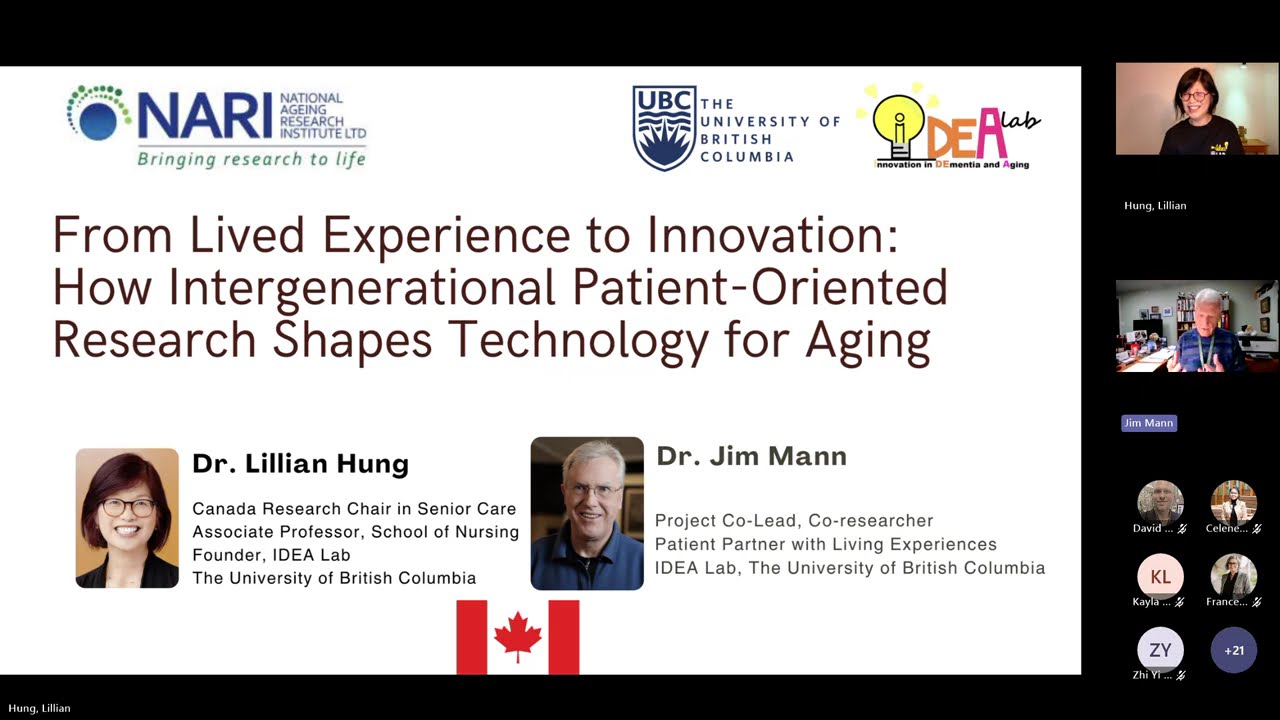
NARI Seminars in Ageing: From Lived Experience to Innovation
Keywords
Summary
146 words
Critical Evaluation
Value of the Information & Strength of the Argument
The value of this talk lies in its practical demonstration of how participatory research can be applied in aging and technology contexts. The speakers provide concrete examples of co-design with older adults, showing how lived experience shapes research questions and technology development. The argumentation is persuasive, emphasizing the importance of challenging deficit-based assumptions and the positive outcomes of engaging older adults as partners. However, the talk relies heavily on anecdotal evidence and personal stories rather than rigorous data presentation. The strength of the argumentation lies in the passionate advocacy for patient-oriented research, but it lacks in-depth methodological details or statistical evidence.
Scientific Rigor, Source Quality, Title Accuracy
The scientific rigor is moderate. The speakers mention published papers and an international study, but they do not provide specific citations or data. The sources they refer to are their own work, which is credible given their academic positions. The title accurately reflects the content, as the talk indeed focuses on moving from lived experience to innovation in aging. The presentation includes a news clip from CBC, which adds media context but also anecdotal value. Overall, the content is informative for a general audience but lacks the depth of a formal research presentation.
209 words
Title / Content Match
The title accurately captures the core message of translating lived experience into technological innovation in aging care.
Quality & Reliability
7/10
The talk is delivered by established researchers and references published work, but relies heavily on personal anecdotes and lacks detailed methodological data. The overall reliability is good for a seminar presentation, though not peer-reviewed.
Key Moments
Markers derived by PSI from the transcript: the creator did not define chapters.
- Introduction by Francis Bachelor and acknowledgments
- Introduction of the UBC IDEA Lab and patient-oriented research approach
- Discussion of tiny social robots (LOVOT) and robot cafe in hospital settings
- EVA robot with ChatGPT, resident interactions and storytelling
- Telepresence robot co-created with Jim Mann, connecting families and residents
Cited Sources
- CBC News report on social robots in seniors care — News segment included in the presentation, showing LOVOT robots with residents.
- Paper titled 'It's Always Happy to See Me' — Mentioned as a published paper on interactions with the LOVOT robot.
- First paper on LOVOT robots (mango and kiwi) — Referenced as the initial publication from the LOVOT study.
Contribution & Novelties
The novel contribution of this talk is the emphasis on co-design with older adults as equal partners in technology innovation, particularly in robotics and virtual reality. It demonstrates how participatory approaches can lead to more ethical and inclusive technologies. The speakers provide a model for intergenerational research that could be adopted in other settings.
Pour aller plus loin :
- Participatory action research - relevant to the co-design methodology.
- Social robot - background on companion robots like LOVOT.
- Virtual reality therapy - context for VR programs for older adults.
88 words
Radar Profile
The radar profile shows balanced but moderate scores across all dimensions, indicating the talk is informative and reliable but not deeply technical or data-heavy. The strongest aspect is the quality of information regarding participatory research, while the technical level is lower.