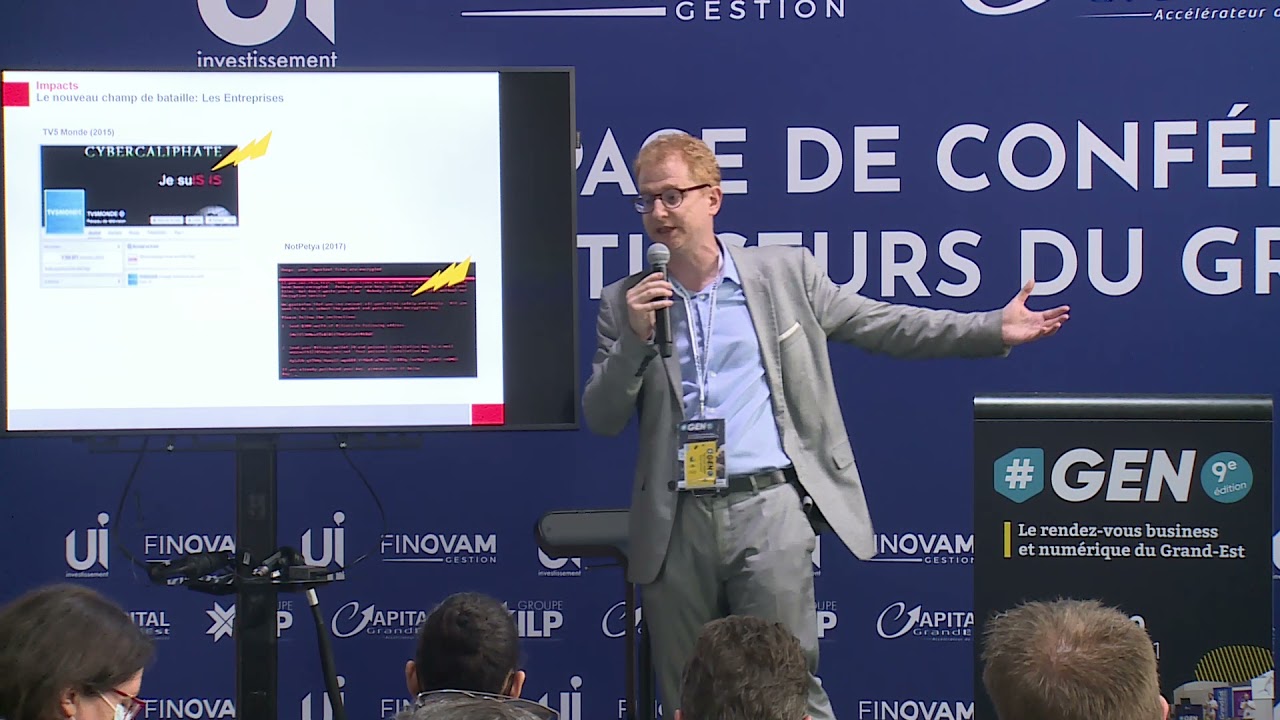
Conférence • Guy-Philippe Goldstein • La cyber-sécurité, un enjeu mondial
Conference • Guy-Philippe Goldstein • Cybersecurity, a Global Challenge
Keywords
Summary
200 words
Critical Evaluation
Value of the Information & Strength of the Argument
The lecture provides substantial value by connecting cybersecurity to geopolitical dynamics and economic resilience, a perspective often absent in technical discussions. Goldstein grounds his arguments with concrete examples, personal studies, and references to recognized bodies (ANSSI, CISA, WEF). The argumentation is coherent, progressing from the current threatscape to impacts, causes, and potential remedies. However, some claims lack precise public sources, and he occasionally relies on anecdotal evidence (e.g., the Mumbai blackout) and his own unpublished research. The reasoning is largely solid, though the breadth prevents deep technical dive, making it more suitable for a general business or policy audience.
Scientific Rigor, Source Quality, Title Accuracy
The speaker demonstrates a high level of familiarity with the domain, citing official agencies (ANSSI, CISA), research by Martin Hilbert, and his own academic and professional collaborations. The rigor is acceptable, but not all figures are traceable to specific public documents, and some numbers (e.g., 90% human factor) are presented as consensus without precise citations. The title ‘La cyber-sécurité, un enjeu mondial’ is perfectly matched to the content, which examines cybersecurity as a global geopolitical and economic challenge. No false claims or questionable sources were identified, but the absence of detailed source references in the video description limits immediate verification.
214 words
Title / Content Match
The title accurately reflects the content: the speaker addresses cybersecurity as a global challenge, covering impacts, causes, and solutions.
Quality & Reliability
8/10
The speaker is a recognized expert in cybersecurity with experience in teaching and advisory roles. He presents a wide range of concrete examples and statistics, some from his own research. However, many figures are quoted without precise sources, and some claims are anecdotal. The overall accuracy seems high, but a few numbers may be contested.
Key Moments
Markers derived by PSI from the transcript: the creator did not define chapters.
- Introduction and speaker background
- State of cyberattacks: ransomware rise, Mumbai blackout, Colonial Pipeline
- Economic impact: examples of Nortel, SolarWorld, Equifax
- Own studies on stock performance and default risk
- National security dimension and businesses as battlefields
- Causes: digital transformation and information explosion
- Business transformation and top companies in digital
- Underinvestment in security and comparison with pharmaceuticals
- Human factor as key vulnerability and concluding remarks
Cited Sources
- ANSSI (National Cybersecurity Agency of France) — Mentioned as official source for statistics on cyberattacks in France.
- CISA (Cybersecurity and Infrastructure Security Agency) — Referenced for US cybersecurity statistics and guidance.
- World Economic Forum (WEF) Global Risks Report — Speaker cites WEF surveys placing cyber risk among top global risks.
- Gordon Corera, 'Cyberspies: The Secret History of Espionage, Terrorism, and Hacking' — Speaker attributes the downfall of Nortel Networks to cyber espionage aided by Chinese hackers, citing Corera's book.
- Martin Hilbert & Priscila López, 'The World's Technological Capacity...' — Study on the exponential growth of digital information, referenced by the speaker.
Concurring Sources
- ANSSI Annual Report on Cyberattacks — Supports the claim of rising ransomware and targeted attacks on critical infrastructure.
- ENISA Threat Landscape 2021 — Corroborates the increase in cyber threats and the role of human factors.
Contribution & Novelties
The originality of this lecture lies in its integrated analysis of cybersecurity as a geopolitical and economic issue, linking state-level conflicts to corporate vulnerability. Goldstein’s own research on stock underperformance and default risk adds a concrete economic dimension often missing in public discussions. His historical perspective, tracing digital information growth, helps contextualize why cybersecurity became a priority only recently.
Pour aller plus loin :
- Zero Trust Architecture - NIST SP 800-207 — A framework leading in network security, directly relevant to organizations seeking to harden defenses.
- NIS2 Directive - European Commission — The EU’s updated cybersecurity legislation, essential for understanding regulatory obligations.
- ENISA Threat Landscape — A comprehensive annual report on cyber threats, complementing the lecture’s regional focus.
118 words
Radar Profile
The profile shows a balanced but distinct pattern: high scores in information quantity and quality, moderate technical level, and slightly lower reliability due to some unsourced claims. This suggests a lecture that is informative and well-structured but not deeply technical, relying on expert opinion rather than rigorous citation.