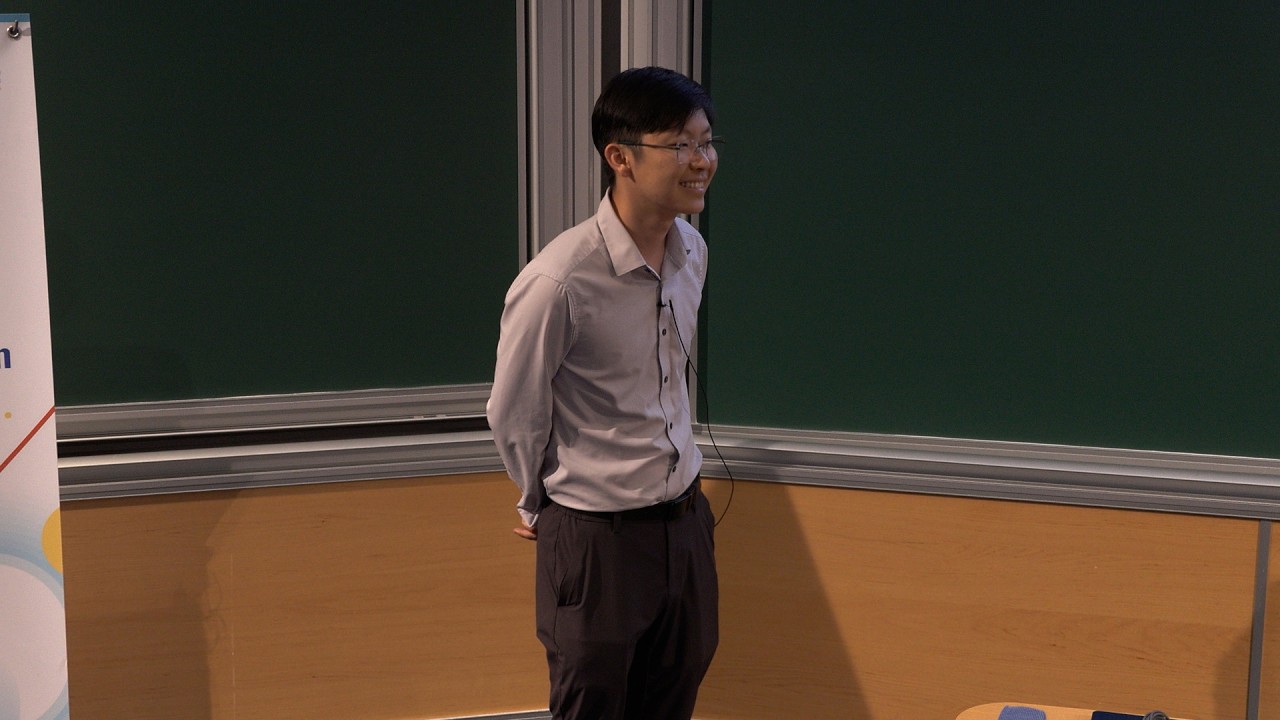
Diandian Wang - Open and closed triangulations of 3d gravity
Keywords
Summary
127 words
Critical Evaluation
Value of the Information & Strength of the Argument
The value of this work lies in offering a conceptually simpler and more local method for computing amplitudes in 3D gravity, avoiding complicated conformal blocks. The argumentation is solid, building on established mathematical structures (TQFT, triangulations) and recent results (Hartman’s work on the fixed-p basis). The presentation carefully motivates each step and addresses potential ambiguities, such as convergence issues, by referencing existing proofs for restricted cases. The use of a BCFT perspective is well argued and extends the framework to boundary configurations, which are essential for applications like entanglement entropy.
Scientific Rigor, Source Quality, Title Accuracy
The talk is rigorous, grounded in a published paper (with Daniel Jeffers) and referencing prior work by Hartman and others. The sources are credible and the presentation is self-contained enough for an expert audience. The title accurately reflects the content, focusing on open and closed triangulations in the context of 3D gravity. The description link to carmin.tv provides additional platform context. The presentation is clear, with audience questions clarifying points, indicating a high level of rigor.
181 words
Title / Content Match
The title accurately reflects the content: the talk focuses on open and closed triangulations as applied to 3d gravity.
Quality & Reliability
8/10
The talk is presented by a researcher at Harvard University and hosted by IHES. It is based on a recent paper with Daniel Jeffers, and the presentation includes technical detail and audience interaction. The content is rigorous, relying on established frameworks such as Virasoro TQFT and conformal Turaev–Viro theory, and provides a novel derivation.
Key Moments
Markers derived by PSI from the transcript: the creator did not define chapters.
- Introduction and motivation: understanding the ensemble dual of 3D gravity with triangulations.
- Review of 3D gravity results: wormhole amplitudes and the role of conformal blocks.
- Fixed-p basis and core geometry: removing asymptotic regions to focus on compact manifolds.
- Triangulation and building blocks: generalized tetrahedra and the classical 6J symbol.
- Introduction to BCFT and its role in the derivation.
- Main derivation and concluding remarks on the relation between Virasoro TQFT and conformal Turaev–Viro theory.
Cited Sources
- carmin.tv — Mentioned in the video description as a platform for scientific videos and supplementary content.
Contribution & Novelties
The talk presents a novel derivation of the relation between Virasoro TQFT and conformal Turaev–Viro theory using a BCFT perspective. This new approach avoids conformal blocks and offers a more local, triangulation-based method, potentially simplifying computations and connecting to recent developments in the field.
Pour aller plus loin :
- Virasoro algebra — Central algebraic structure used in conformal field theory and the TQFT framework.
- Turaev–Viro invariants — Topological invariants underpinning the triangulation-based formulation.
- AdS/CFT correspondence — The broader holographic duality connecting 3D gravity to 2D CFTs, relevant to the motivation.
90 words
Radar Profile
The scores indicate a highly technical but moderately quantitative presentation, with strong concentration in technical depth (niveau_technique 9) and solid information content. The fiabilite_globale of 8 reflects the rigor of the talk. The profile suggests a dense, expert-level research talk rather than a broad overview.