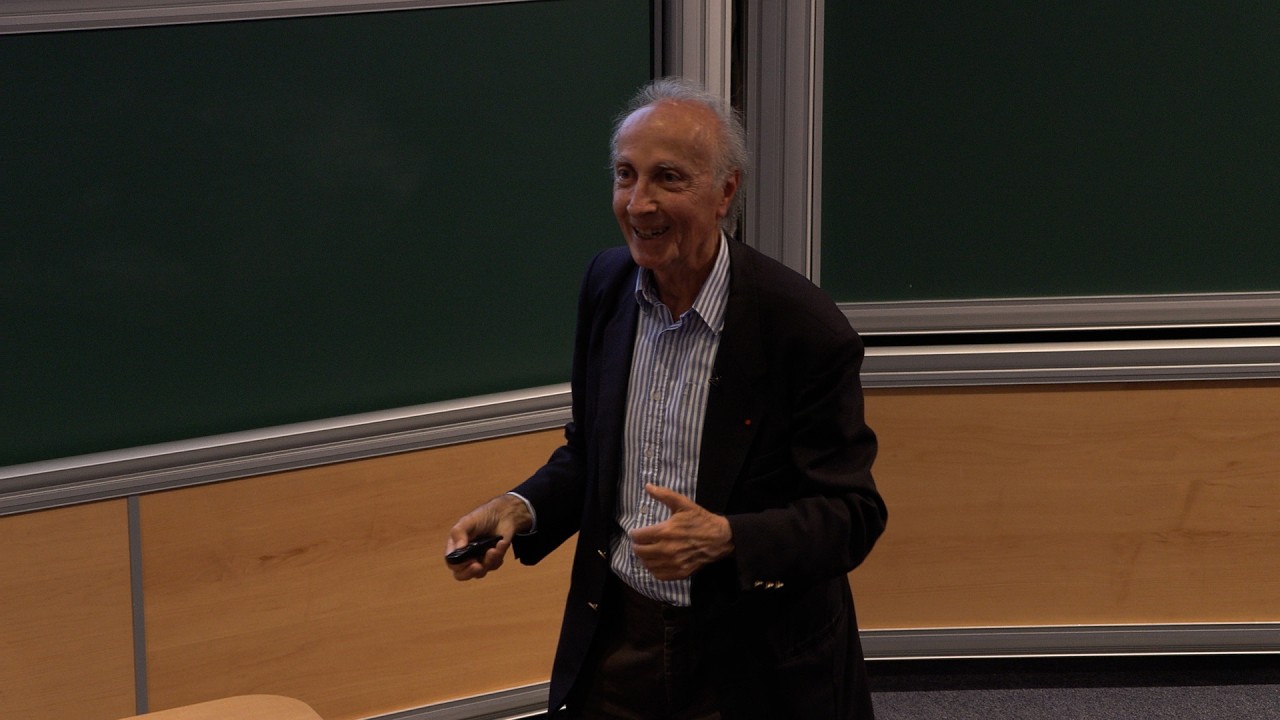
Thibault Damour - Gravitational scattering at null infinity: asymptotics, BMS symmetries, (...)
Keywords
Summary
144 words
Critical Evaluation
Value of the Information & Strength of the Argument
The talk provides a valuable synthesis of the current understanding of gravitational asymptotic structure, combining rigorous results from the post-Minkowskian formalism with conceptual insights from the BMS framework. Damour’s argumentation is systematic and clear, even when dealing with very technical material. He carefully distinguishes between proven results and open conjectures, and his reassessment of his earlier peeling-violation results shows scientific honesty. The recent exchange with Compare’s group, mentioned as ‘fresh news,’ illustrates the dynamic nature of the field. The original contributions include explicit computations of subleading terms in the metric beyond 1/r and their connection to memory effects, which are important for future gravitational-wave observations.
Scientific Rigor, Source Quality, Title Accuracy
The talk is rigorous, with explicit mathematical derivations and references to a wide body of literature, including works by Penrose, Bondi, Sachs, Christodoulou, Klainerman, and others. Damour clearly states assumptions and limitations, such as the formal nature of some expansions. The title matches the content accurately. No mention of public comments; the audience’s reaction cannot be inferred from this data.
180 words
Title / Content Match
The title accurately describes the talk's focus on gravitational scattering, asymptotics at null infinity, and BMS symmetries.
Quality & Reliability
8/10
The talk is given by a leading expert in general relativity, based on rigorous computations and referencing recent literature. The content is highly technical and appears accurate, though some results are still under debate (e.g., factor-of-2 discrepancy).
Key Moments
Markers derived by PSI from the transcript: the creator did not define chapters.
- Introduction to LIGO/Virgo detections and the notation for gravitational waveforms from coalescing binaries vs. hyperbolic encounters.
- Setup of Einstein equations in harmonic coordinates and discussion of the conformal treatment of null infinity.
- Review of the Bondi-Metzner-Sachs group, supertranslations, and the ambiguity in defining angular momentum.
- Discussion of the peeling theorem, its assumptions, and early concerns about violations.
- Formal proof of peeling in certain regimes and the role of Christodoulou-Klainerman estimates.
- Introduction to the multipolar post-Minkowskian formalism and its connection to source dynamics.
- New results on peeling violations, including terms beyond 1/r and the link to infrared structure.
- Recent controversy with Compare et al. about coefficients and the historical connection to Amati-Ciafaloni-Veneziano scattering.
Cited Sources
- Carmin.tv - video platform for mathematical sciences — Platform hosting the video, mentioned in the description.
Concurring Sources
- Christodoulou & Klainerman stability of Minkowski — Their results support the decay of curvature components, partially consistent with peeling in generic spacetimes.
Dissenting Sources
- Compare, Galatolo, V (2024) on matching all infinities — Their approach suggests a unique BMS group across all infinities and a different coefficient for peeling violation, which Damour questions based on missing terms.
Contribution & Novelties
The talk presents original results on the subleading structure of gravitational waveforms at null infinity, specifically showing how memory effects and tail terms lead to peeling violations. Damour clarifies the connection between the MPM formalism and BMS symmetries, and highlights open problems in the definition of angular momentum.
Pour aller plus loin :
- Bondi–Metzner–Sachs group — Central to the talk’s discussion of asymptotic symmetries.
- Gravitational wave — Background on the detection and waveforms discussed.
- Peeling theorem — Directly related to the violations analyzed.
- Multipolar post-Minkowskian formalism — The technical framework used for computations.
93 words
Radar Profile
The profile shows a very high level of technical depth (10/10) and quantity of information (9/10), indicating a dense expert talk. Quality and reliability are also high (8/10), reflecting the use of rigorous methods and recent references. The lower score for generality is expected for a specialized seminar.