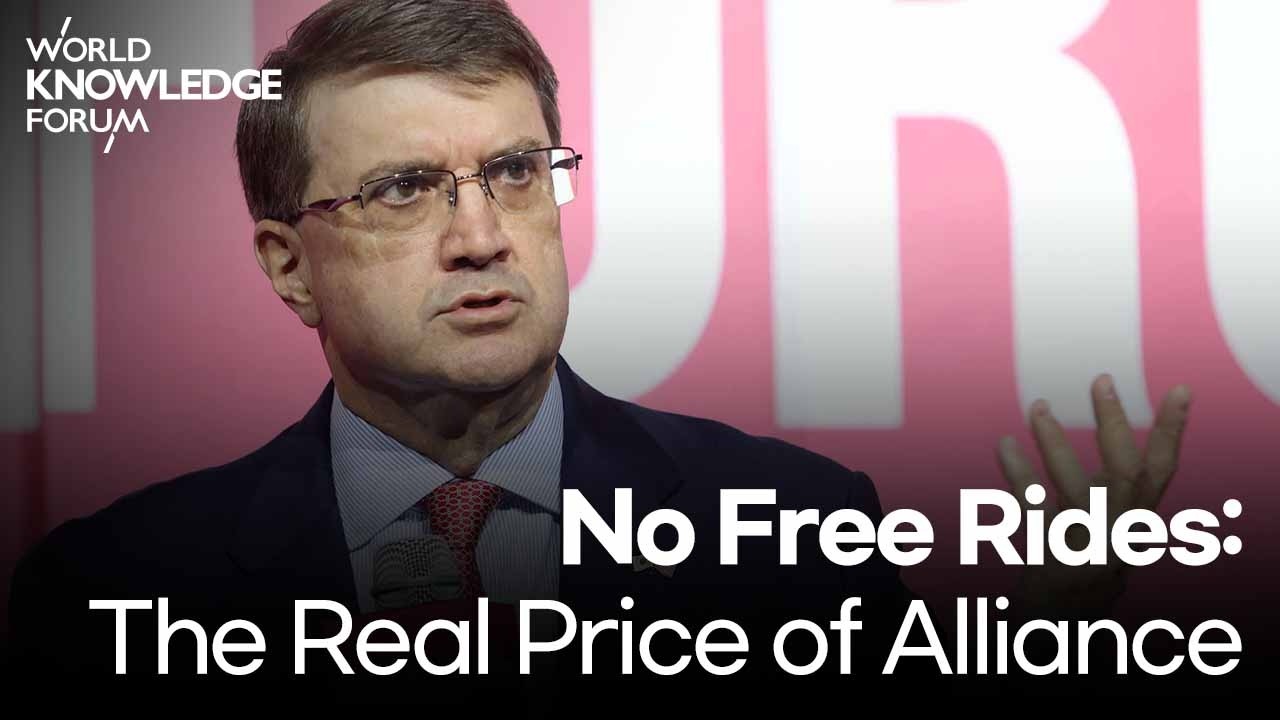
The Future of Alliances under the Second Trump Administration
Keywords
Summary
215 words
Critical Evaluation
Value of the Information & Strength of the Argument
The value of this discussion lies in the direct involvement of the panelists in the first Trump administration, providing firsthand insight into the administration’s thinking on alliances. They offer nuanced explanations of Trump’s rhetoric, distinguishing between headline-grabbing statements and the underlying policy shifts toward conditionality and burden-sharing. The argumentation is largely anecdotal, drawing on historical examples (Nixon, Eisenhower, de Gaulle) to argue that current turbulence is not unprecedented. However, the case is built on personal experience and opinion rather than systematic evidence. For instance, they claim tariffs are working because the bilateral deficit with China fell, but ignore that deficits with third countries rose, a point they attribute to transshipment without data. The discussion is persuasive for those sympathetic to the ‘America First’ stance, but it lacks counterarguments or independent verification.
Scientific Rigor, Source Quality, Title Accuracy
The panelists refer to internal documents (e.g., the National Defense Strategy) and historical events, but no specific external sources are cited, and no references or links are provided in the video description. The claims about defense spending, trade deficits, and alliance strength are not backed by statistical sources. The title precisely matches the content. The discussion is a mix of expert opinion and policy advocacy, not a scientifically rigorous analysis. The panelists’ credentials lend some credibility, but their political affiliations introduce bias. No comments or audience feedback were provided for analysis.
237 words
Title / Content Match
The title accurately reflects the content: a focused panel discussion on how the second Trump administration will restructure alliances, with emphasis on the US-ROK partnership.
Quality & Reliability
7/10
Panel of former US officials offers informed but partisan perspectives; arguments rely on experience and historical parallels rather than verifiable data.
Key Moments
Markers derived by PSI from the transcript: the creator did not define chapters.
- First question about whether the US is abandoning global leadership; Secretary Wolf begins response on conditionality.
- Secretary Wolf elaborates on the shift from alliances as ends to tools for American interests, citing NATO and WTO examples.
- Director Wii offers historical parallels, comforting the audience that US alliance rhetoric has always been turbulent but enduring.
- Discussion on South Korea's defense contribution and the gap between current and expected spending under Trump.
- Tariffs and trade deficit debate; Wolf argues tariffs are part of a decoupling strategy, with examples of transshipment via Vietnam and Taiwan.
- Concerns about AI and cybersecurity; Kim suggests US-ROK collaboration to protect AI assets, drawing on the Huawei precedent.
Contribution & Novelties
This video contributes to the discourse on American foreign policy by offering rare, candid reflections from former officials who implement ‘America First’ policies. Its originality lies in framing the Trump administration’s actions as a renegotiation of alliance terms, not an abandonment, and in stressing the rising importance of economic and technological cooperation over purely military ties. The panelists provide a rare look at how the administration views allies like South Korea as partners in naval rebuilding and AI protection.
Pour aller plus loin :
- America First (policy) — Provides background on the policy doctrine referenced throughout the video.
- United States–South Korea alliance — Directly relevant to the core discussion of the ROK-U.S. partnership.
- NATO defence spending — Context for the 2% GDP target and burden-sharing debates mentioned by the panelists.
130 words
Radar Profile
The radar profile shows high scores in information quantity and quality, reflecting a substantial and informed discussion, but lower scores in technical depth and reliability due to the opinion-heavy nature and lack of verifiable sources. The overall balance suggests a valuable expert perspective with moderate scientific rigor.