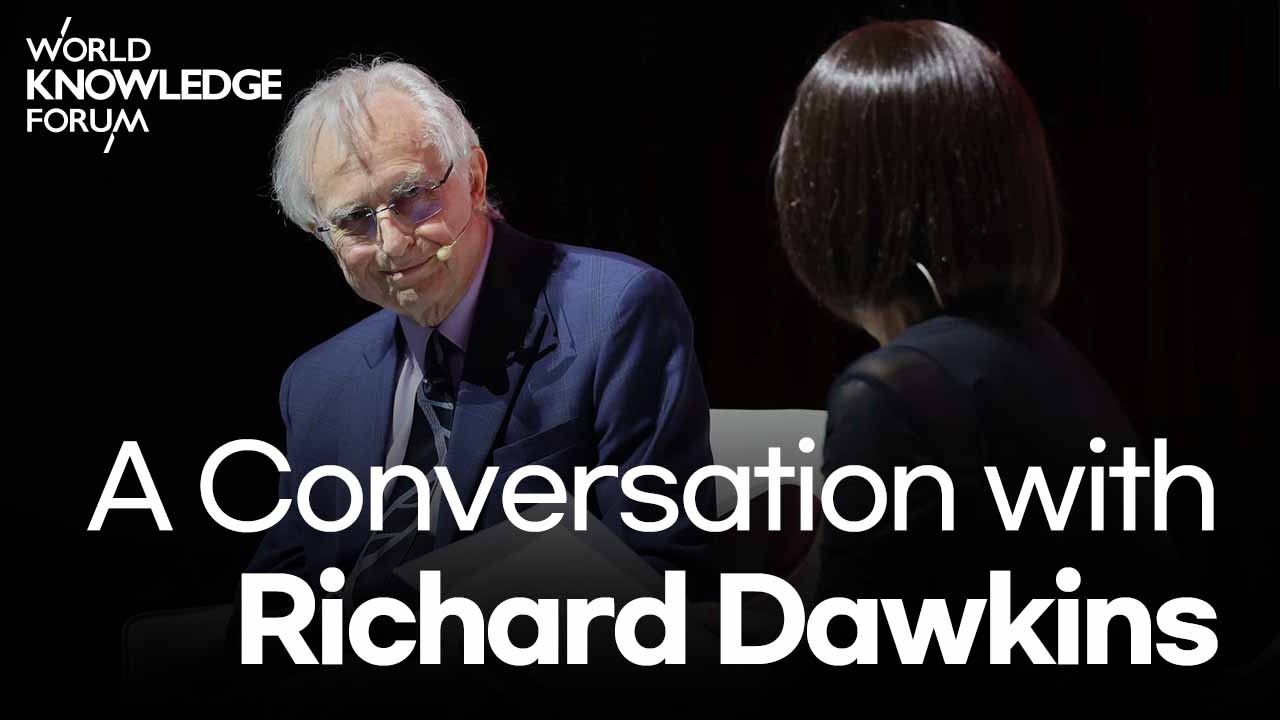
Artificial Intelligence from an Evolutionary Perspective
Keywords
Summary
160 words
Critical Evaluation
Value of the Information & Strength of the Argument
The video offers valuable insights by connecting evolutionary biology to AI, providing a novel framework for understanding consciousness and cultural evolution. Dawkins’ arguments are logically coherent and grounded in his deep knowledge of evolution. He uses concrete examples, such as his interactions with AI, to support his claims, and he addresses counterarguments about AI consciousness with pointed questions. The argumentation is persuasive on biological topics, while his AI-related speculations are presented as open questions, demonstrating intellectual humility. The dialogue adds depth by contrasting physics and biology perspectives, enriching the discussion with diverse viewpoints.
Scientific Rigor, Source Quality, Title Accuracy
Dawkins relies primarily on his own published works, such as ‘The Selfish Gene’ and ‘The God Delusion’, and on well-known scientific concepts. He does not cite specific external studies or provide references, which limits the verifiability of his more speculative claims. However, his biological explanations are authoritative and consistent with established evolutionary theory. The title matches the content precisely, as the entire discussion is framed through an evolutionary lens applied to AI. The video’s scientific rigor is high in biology, but lower in the philosophical speculation about AI consciousness, which remains an ongoing debate.
202 words
Title / Content Match
The title accurately reflects the content, as the entire conversation is framed around an evolutionary perspective on artificial intelligence.
Quality & Reliability
8/10
Richard Dawkins is a highly credible evolutionary biologist, and his explanations of biological concepts are rigorous. However, his views on AI consciousness and future scenarios are speculative, and the discussion lacks direct references to empirical studies, which tempers the reliability.
Key Moments
Markers derived by PSI from the transcript: the creator did not define chapters.
- Introduction by Professor Kim Young-Kee, presenting Richard Dawkins.
- Dawkins explains the gene as the unit of natural selection, revisiting his book 'The Selfish Gene'.
- Discussion of progress in biology, highlighting AlphaFold's protein structure prediction.
- Dawkins expands on memes and cultural evolution, noting the internet as a fertile ecosystem.
- Dawkins shares his experience with ChatGPT and Claude, arguing they pass the Turing test convincingly.
- Advice on science communication: strive to be understood, not to impress, and highlight wonder.
- Dawkins discusses his science fiction novel, the origin of life, and the RNA world hypothesis.
Cited Sources
- The Selfish Gene — Dawkins' seminal book, basis for his gene-centric view of evolution and memes.
- The God Delusion — Mentioned as another influential work by Dawkins.
- AlphaFold — AI program for protein structure prediction, cited as a major breakthrough from AI.
Contribution & Novelties
This video provides a unique synthesis of evolutionary biology and AI, offering fresh perspectives on consciousness, memes, and the future of intelligence. Dawkins’ argument that AI may already be conscious challenges dominant views and encourages reconsideration of consciousness criteria. The discussion also reframes AI as a new replicator in cultural evolution, extending his original meme concept.
Pour aller plus loin :
- Memetics — Study of memes as cultural replicators, directly relevant to Dawkins’ discussion.
- AlphaFold — The AI system whose breakthrough in protein folding is discussed in the video.
- RNA world — Hypothesis on the origin of life, mentioned as a plausible model for the first replicator.
- Turing test — The test Dawkins uses to argue for AI consciousness.
119 words
Radar Profile
The profile shows high scores for information quantity and quality, with moderate technical depth. Reliability is high due to Dawkins' authority, but the speculative elements slightly lower it. Overall, the video is a broad, insightful discussion that balances scientific rigor with philosophical exploration.