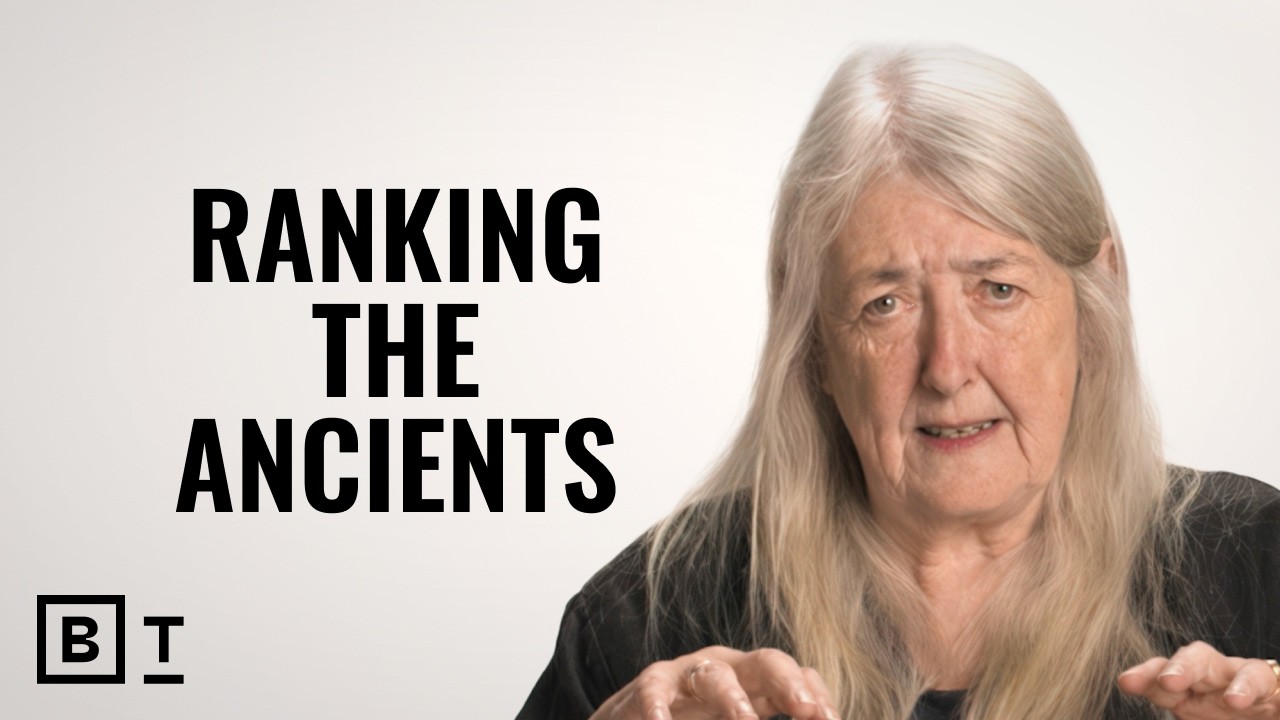
The 8 Romans who shaped the modern world | Mary Beard
Keywords
Summary
198 words
Critical Evaluation
Value of the Information & Strength of the Argument
The talk’s primary value lies in Mary Beard’s ability to distill decades of scholarship into a coherent and engaging narrative. Each of the eight choices is supported by specific historical evidence and thoughtful reasoning, often highlighting lesser-known aspects (e.g., Virgil’s ambivalence about empire, Cincinnatus as a republican role model). Beard also engages critically with her own selection process, noting the absence of women and the challenge of evaluating figures who lived millennia ago. Her argumentation is transparent and avoids dogmatism; she openly acknowledges uncertainty and the need for ‘stereoscopic vision’—simultaneously understanding the past in its own context and applying modern ethical standards. The structure is logical, moving chronologically and thematically, and it successfully encourages listeners to reflect on how history is framed and used.
Scientific Rigor, Source Quality, Title Accuracy
Beard’s scholarly rigor is evident in her careful caveats about historical sources (e.g., the scarcity of contemporary evidence for Augustus’s rule, the mythical quality of Cincinnatus) and her recommendations to listen for ‘discordant voices’ in antiquity. While no specific academic sources are cited in the description (only a generic Big Think membership link), the content itself draws on established classical scholarship and Beard’s own published works. The title accurately matches the content, and the video is consistent with its promise of ranking eight influential Romans. Although the selection is subjective, Beard clearly presents it as such, which enhances rather than detracts from its intellectual honesty.
244 words
Title / Content Match
The title accurately reflects the content: Mary Beard presents her personal ranking of 8 Romans who, in her view, have had a lasting impact on the modern world. Each figure is clearly introduced and justified.
Quality & Reliability
9/10
Mary Beard is a distinguished professor of Classics at Cambridge with 50 years of expertise. Her argumentation is nuanced, acknowledges historical uncertainty, and supports each choice with reasoned analysis. She also addresses modern ethical judgment without anachronism. The subjective ranking is clearly framed as her interpretation, and she forthrightly discusses the absence of women and the misogyny of the period, adding depth and critical self-awareness.
Key Moments
Markers derived by PSI from the transcript: the creator did not define chapters.
- Introduction: Mary Beard introduces the premise of ranking influential Romans and explains her methodological approach.
- Augustus: Beard discusses how Octavian transformed from a civil war warlord into the first emperor, founding a system of one-man rule.
- Virgil: The Aeneid as a foundational narrative of empire, capturing ambition and cost; Beard claims it has been read daily since its author's death.
- Julius Caesar: A populist disruptor who bypassed institutions but failed to create lasting structures, thus ranking third.
- Cincinnatus: The mythic farmer-dictator who returned to his plow, symbolizing service without self-aggrandizement.
- The Gracchi brothers: First explicit advocates for the poor and redistributors of wealth, introducing a coherent political program.
- Cicero: The power of rhetoric and persuasion as the bedrock of democracy; his legacy in modern political language.
- Nero: Redefining imperial power through art and culture, and the enduring caricature of 'fiddling while Rome burns'.
- Tacitus: The historian's searing exposure of autocracy and the corruption of language, paralleled to Orwell.
- Reflection on the absence of women, the role of misogyny in historical narratives, and the ethics of judging the past.
Cited Sources
- Big Think Membership — Link in the video description to Big Think's membership page, unrelated to the specific content but the only link provided.
Concurring Sources
- Wikipedia: Augustus — General historical background on Augustus's reign and establishment of the Principate, consistent with Beard's portrayal.
- Wikipedia: The Aeneid — Description of Virgil's epic and its themes, supporting Beard's claims about its influence and ambivalence.
Dissenting Sources
- Nero in popular and scholarly reinterpretation — Some modern historians argue that Nero's reputation is overly vilified by hostile sources, and that his cultural projects were more constructive than Beard implies, though she does acknowledge the difficulty of judging him. No direct source, but an ongoing academic debate.
Contribution & Novelties
The video offers a fresh, personal framework for understanding the legacies of Roman figures, blending traditional historical narrative with modern critical perspectives—particularly on power, gender, and the ethics of judgment. Beard’s emphasis on ‘stereoscopic vision’ provides a methodological tool for anyone approaching historical figures. Her choice to include Cincinnatus and Tacitus over more obvious candidates (e.g., Marcus Aurelius) challenges conventional lists and sparks thought about what ‘shaping the modern world’ truly means.
Pour aller plus loin :
- Roman Empire — Provides broad context on the historical period and institutions discussed.
- Tacitus — Offers detailed biography and analysis of his works, especially the Annals and Histories.
- Cicero — Explores his orations, political career, and enduring influence on rhetoric and Latin literature.
120 words
Radar Profile
The radar profile shows very high scores on information quality and reliability, reflecting the speaker's expertise and balanced approach. Technical level is high but accessible, while quantity of information is substantial for the duration. The overall shape indicates a scholarly yet engaging presentation.
💬 Très positif — Sur les 30 commentaires analysés, l'immense majorité exprime une admiration enthousiaste pour la clarté, la profondeur et l'érudition de Mary Beard, plusieurs commentaires ajoutant des précisions historiques ou témoignant d'une grande valeur éducative.