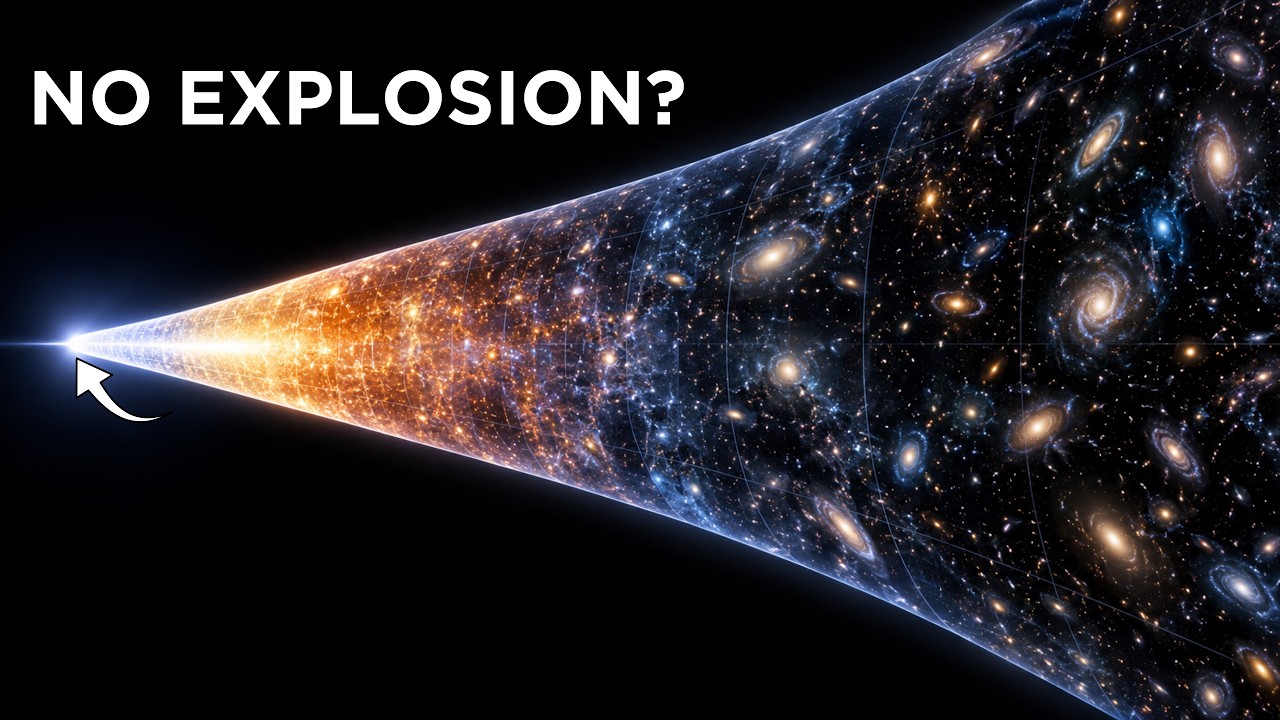
What Actually Happened During the Big Bang? | The Sleepy Scientist
Keywords
Summary
184 words
Critical Evaluation
Value of the Information & Strength of the Argument
The video provides high informational value by correcting widespread misconceptions about the Big Bang, replacing the intuitive ’explosion’ image with the more accurate description of expanding spacetime. It effectively argues its points by tracing the historical development of cosmological ideas—from Einstein’s static universe to Friedmann’s dynamic solutions, Lemaitre’s connection with observations, and the decisive discovery of the cosmic microwave background. The argumentation is solid, presenting a coherent narrative supported by established scientific evidence without oversimplifying the underlying physics. The steady-state theory is fairly presented and its refutation explained, which strengthens the credibility of the explanation. The video skillfully uses analogies and logical reasoning to make complex concepts like the absence of a center and the recession of distant galaxies understandable, while maintaining a rigorous connection to the standard model of cosmology.
Scientific Rigor, Source Quality, Title Accuracy
The scientific rigor is excellent, with content aligned with the current understanding of cosmology and numerous references to official sources like NASA, ESA, and the Nobel Prize organization. The video avoids unsupported claims and carefully distinguishes between established facts and open questions. The sources cited in the description are authoritative and directly related to the topics discussed, including NASA’s Big Bang pages, the Planck mission results, and the Nobel Prize announcement for the discovery of the cosmic microwave background. The title is perfectly appropriate, as it explicitly addresses the central theme and does not overpromise or mislead. The content matches the title: it genuinely explains what happened during the Big Bang, correcting common misconceptions along the way. There are no contradictions or dubious statements, and the presentation of historical debates is handled with impartiality and scientific nuance.
283 words
Title / Content Match
The title accurately reflects the content, which explains the nature of the Big Bang and directly addresses 'what actually happened'.
Quality & Reliability
8/10
The video relies on well-established scientific sources (NASA, ESA, Nobel Prize) and presents the standard cosmological model accurately, with clear corrections of common misconceptions.
Key Moments
Markers derived by PSI from the transcript: the creator did not define chapters.
- Introduction correcting the explosion misconception; setting up the theme.
- Explanation of cosmic expansion and why there is no center; distinction from ordinary explosions.
- Fred Hoyle and the origin of the term 'Big Bang'; presentation of the steady-state theory.
- Einstein's relativity, Friedmann's expanding solutions, and Lemaitre's primeval atom concept.
- Observational evidence: Slipher's redshifts, Hubble's distance-velocity relation, and the cosmic microwave background.
Cited Sources
- NASA Science — The Big Bang — Overview of Big Bang theory
- NASA Science — Webb Telescope & The Big Bang — Q&A about Big Bang
- NASA Science — Big Bang and the Evolution of the Universe — Details on universe evolution
- NASA Science — Edwin Hubble and the Expanding Universe — Hubble's discovery and expansion
- NASA Science — Universe Overview and Big Bang Nucleosynthesis — Universe overview and nucleosynthesis
- European Space Agency — Planck and the Cosmic Microwave Background — Planck mission results on CMB
- NASA Science — Measuring the Big Bang with the Cosmic Background Explorer — COBE satellite measurements
- Nobel Prize — Arno Penzias and Robert Wilson’s Discovery of the Cosmic Microwave Background — Nobel Prize for CMB discovery
- University of Cambridge — The Fred Hoyle Collection — Fred Hoyle's background
- Particle Data Group — Big Bang Nucleosynthesis — Technical review of BBN
External References
Contribution & Novelties
The video’s original contribution lies in its clear, accessible correction of the widespread misconception that the Big Bang was an explosion in empty space. It systematically dismantles this image by explaining cosmic expansion as an evolution of spacetime geometry, using historical context and observational evidence. It also highlights the often-overlooked roles of Slipher, Lemaitre, and Friedmann, and notes the ironic origin of the term ‘Big Bang’ from a scientific skeptic. This episode adds value for learners by connecting fundamental concepts in a relaxed format, making cosmology approachable without oversimplifying.
Pour aller plus loin :
- Big Bang - Wikipedia — Comprehensive overview of the theory.
- Hubble’s law - Wikipedia — Explanation of the distance-velocity relationship.
- Cosmic microwave background - Wikipedia — Details on the relic radiation.
- Steady-state model - Wikipedia — The alternative theory proposed by Hoyle and others.
- Cosmic inflation - Wikipedia — The early rapid expansion phase mentioned in the video.
152 words
Radar Profile
The scores show a high quantity and quality of information with excellent reliability, while the technical level is moderate, indicating a piece that is both informative and accessible. The radar profile suggests a strong emphasis on solid, well-sourced content with a slightly lower technical depth, suitable for a general audience.