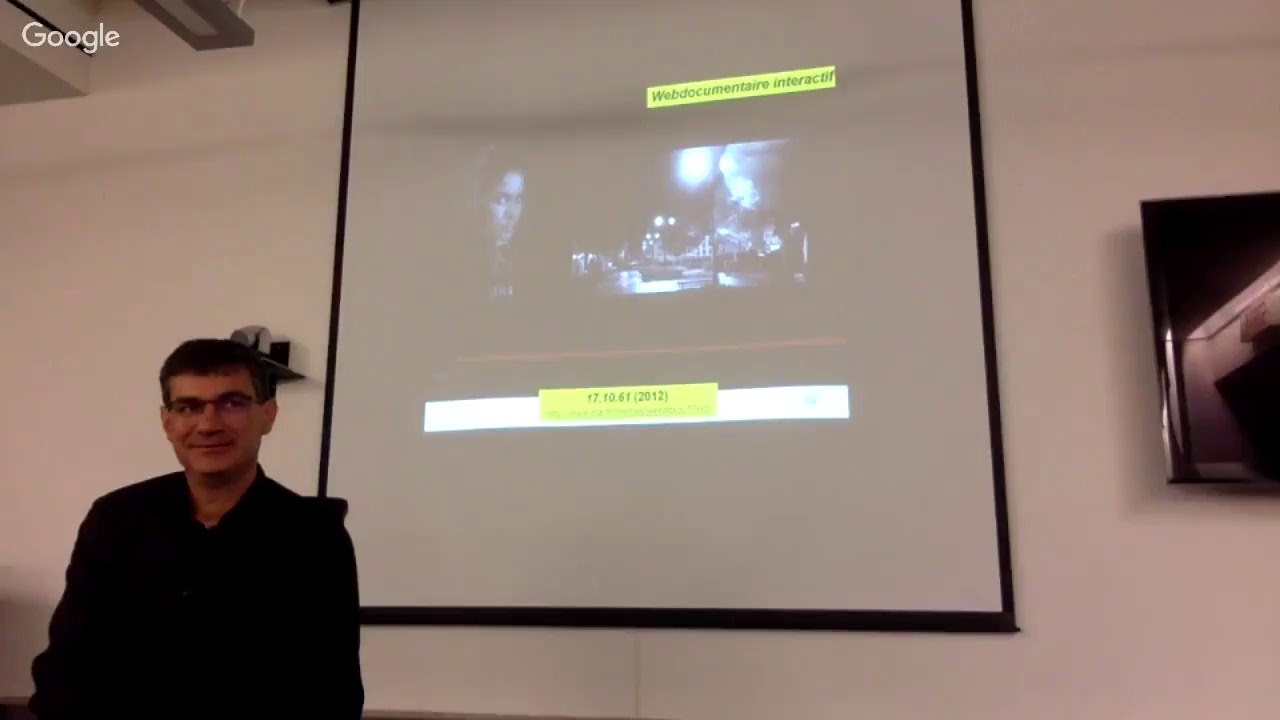
Conférence de Serge Bouchardon : Les récits interactifs : enjeux et perspectives
Conference by Serge Bouchardon: Interactive narratives: issues and perspectives
Keywords
Summary
188 words
Critical Evaluation
Value of the Information & Strength of the Argument
The value of this lecture lies in its rich blend of theoretical rigor and practical illustration. Bouchardon’s argument is well-structured: he first presents a concrete example, then builds a typology, and finally critiques the underlying concepts. His argumentation is solid and nuanced, avoiding simplistic dichotomies between continuity and rupture. He effectively demonstrates that interactive narratives can question fundamental categories of storytelling. He also acknowledges the limits and explores the paradoxes of delegating narrative authority to the reader. The use of numerous examples, from classical hypertexts to his own creations, grounds the discussion and makes abstract points tangible. However, the lecture occasionally leans on personal authority and specific works without extensive empirical evidence, and some claims about social changes remain speculative.
Scientific Rigor, Source Quality, Title Accuracy
Bouchardon draws on a well-established corpus of digital literature, citing key works such as Marc Saporta’s ‘Composition No. 1’, Calvino’s ‘If on a winter’s night a traveler’, and contemporary creations like ‘Les Nouvelles de la Colonie’. He also references theoretical concepts from scholars like Bruno Bachimont. The sources are relevant and appropriate for the topic, and his presentation of them is accurate. The title is fully adequate, as the lecture systematically covers both ’enjeux’ (challenges) and ‘perspectives’ (outlooks). The quality of sources is high, though the lecture relies more on qualitative analysis and personal creation than on systematic reviews. No discrepancies between title and content were observed.
242 words
Title / Content Match
The title accurately reflects the content, which explores the challenges and perspectives of interactive narratives through theoretical reflection and concrete examples.
Quality & Reliability
8/10
The speaker is a recognized professor and researcher in digital literature, combining theoretical expertise with practical creation. The lecture is structured, well-illustrated, and builds on established concepts and works, though it reflects personal opinions and specific examples rather than systematic empirical evidence.
Key Moments
Markers derived by PSI from the transcript: the creator did not define chapters.
- Introduction and presentation of 'Déprise' (2010), an interactive work demonstrating how gestures contribute to meaning.
- Typology of interactive narratives: hypertextual, kinetic, generative, and collective forms, with examples.
- Historical precursors: from Marc Saporta's combinatorial novel to Calvino's reader involvement.
- Discussion of the continuum from analogue to digital supports and the concept of 'limit passage' according to Bruno Bachimont.
- Examination of narratological categories: closure, linearity, and the role of the narrator in interactive works.
- Exploration of the tension between narrative and interactivity, and the shift from chronology to cartography.
- Comparison with video games and the concept of 'playable story'; questioning whether interactive works remain narratives.
- Concluding perspectives on societal changes and new temporalities that may influence future narrative forms.
Cited Sources
- Déprise (2010) — Interactive narrative created by Serge Bouchardon, presented as an example of kinetic and interactive narration.
- Littérature numérique: le récit interactif (2009) — Bouchardon's book proposing a typology of interactive narratives, cited during the lecture.
- Les Nouvelles de la Colonie — A fictional universe on social networks, cited as an example of collective interactive narrative.
- Composition No. 1 (1962) — Marc Saporta's combinatorial novel, mentioned as a pre-digital precursor of reader participation.
- If on a winter's night a traveler (1979) — Italo Calvino's novel, referenced for its playful treatment of the reader-narrator relationship.
Contribution & Novelties
This conference brings a fresh perspective by combining practical creation and theoretical analysis, demonstrating that interactive narratives can serve a heuristic function, questioning fundamental narratological concepts. Bouchardon’s typology and his reflections on the ’limit passage’ of digital media offer valuable insights for researchers and creators alike. The lecture succeeds in showing that digital interactivity is both a legacy and a radical transformation of narrative practices.
Pour aller plus loin :
- Ergodic literature — A related concept by Espen Aarseth that explores the nontrivial effort required by readers in certain fictions.
- Interactive fiction — Software-based narrative experiences that often involve text input and branching stories.
- Hypertext — The underlying structure of early digital narratives, relevant to Bouchardon’s discussion of hypertextual récits.
120 words
Radar Profile
The radar profile shows high scores in quantity and quality of information, indicating a well-filled and substantively rich lecture. The technical level is moderate, suitable for an academic audience, while reliability is strong due to the speaker's expertise. The relatively lower 'niveau_technique' suggests that the content is accessible beyond a narrow technical specialty.