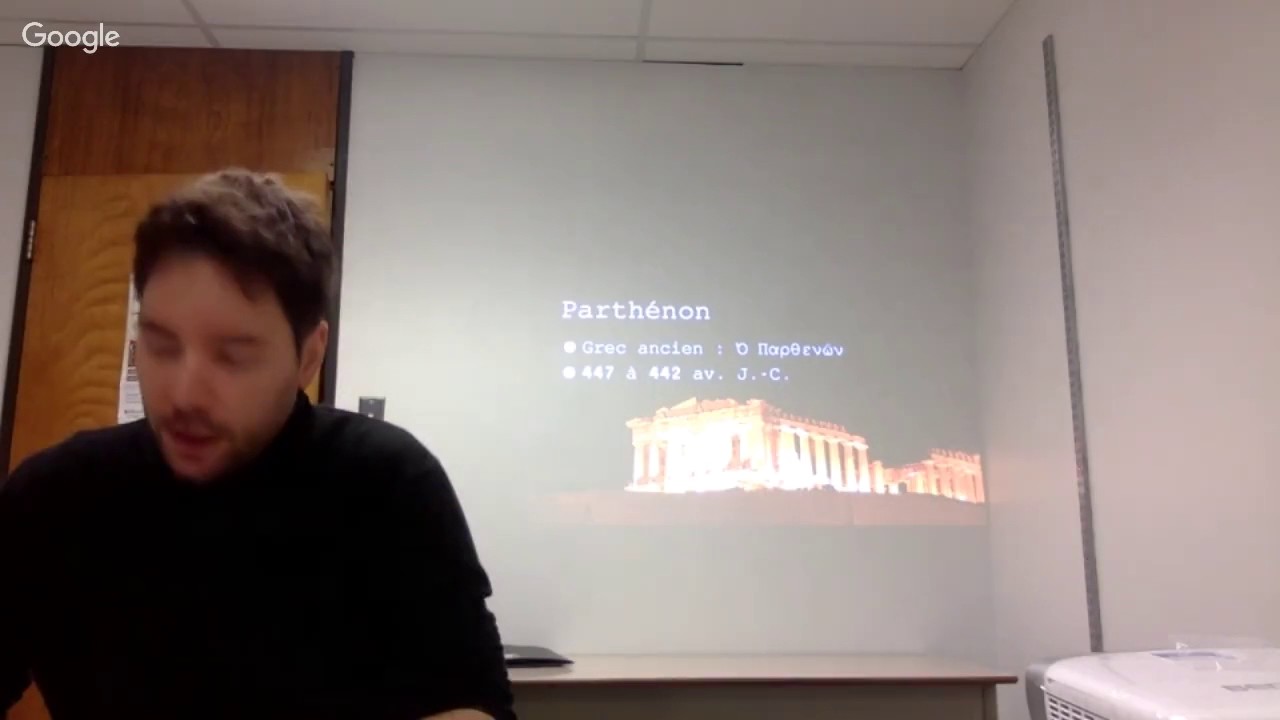
Littérature et culture numérique, colloque étudiant Part3
Literature and digital culture, student symposium Part3
Keywords
Summary
155 words
Critical Evaluation
Value of the Information & Strength of the Argument
The presentations offer valuable insights into the evolution of mimesis in contemporary art and digital tools. Dukanic’s analysis is rooted in close reading of Aristotle and theatrical practice, demonstrating a solid argumentative structure. Sauret’s conceptual clarification of ‘model’ is particularly useful, linking philosophical tradition with current computational approaches. The speakers support their claims with references to primary texts and specific examples, although some arguments rely on theoretical assumptions that are not fully unpacked. The Q&A sessions add depth, allowing for counterpoints and refinements. Overall, the information is substantive and well-argued, though not groundbreaking.
Scientific Rigor, Source Quality, Title Accuracy
The scientific rigor is moderate. Presenters cite canonical sources like Aristotle’s works and refer to contemporary artists and scholars (e.g., Romeo Castellucci, Jean-Guy Meunier), but there is no systematic source verification or peer-review process. The adéquation between title and content is strong: the symposium clearly addresses literature and digital culture, with each presentation exploring relevant theoretical and practical dimensions. However, the reliance on personal interpretation and the lack of broader scholarly context limit the overall rigor.
184 words
Title / Content Match
The title accurately reflects the content: a student colloquium on digital literature and culture, featuring three research presentations that match the scope.
Quality & Reliability
6/10
Presentations by graduate students are intellectually serious and well-structured, but audio quality issues and lack of directly verifiable sources lower overall confidence.
Key Moments
Markers derived by PSI from the transcript: the creator did not define chapters.
- Filip Dukanic begins his presentation on mimesis and Castellucci's 'Les métopes du Parthénon'.
- Nicolas Sauret starts his talk on modeling reality, distinguishing descriptive and predictive models.
- Mélissa Golebiewski presents on video, mimesis, and direct effects in Gosselin's adaptation of Bolaño's '2666'.
Cited Sources
- Aristotle's Poetics — Referenced by Filip Dukanic to discuss the origins and definitions of mimesis.
- Aristotle's Politics — Mentioned in relation to the role of imitation in human education and society.
- Romeo Castellucci's 'Les métopes du Parthénon' — Analyzed as a contemporary performance that challenges traditional mimetic representation.
- Jean-Guy Meunier's article on computational models — Cited by Nicolas Sauret to develop the notion of model in humanities computing.
Concurring Sources
- Aristotle's Poetics — Consistent with the discussions of mimesis as a foundational aesthetic concept.
- Contemporary performance theory — Supports the idea that performance can challenge mimetic conventions.
Contribution & Novelties
The symposium contributes original analyses of how classical concepts like mimesis and dynamis can be reinterpreted in the context of digital culture and contemporary performance. It bridges theoretical discourse with practical examples, offering a multi-perspective view on the evolving role of representation. The discussion on models as generative tools rather than mere copies is particularly insightful.
Pour aller plus loin :
- Mimesis (Wikipedia) — Provides background on the concept as developed by Plato and Aristotle.
- Poetics (Aristotle) — Primary source for understanding poetic mimesis and its principles.
- Romeo Castellucci (Wikipedia) — Overview of the works and performance aesthetics of the director discussed in the first presentation.
- Digital humanities (Wikipedia) — Relevant to the methodological underpinnings of Nicolas Sauret’s talk.
119 words
Radar Profile
The radar profile shows a moderate balance across information quantity, quality, technical level, and reliability. The low reliability score drags down the overall assessment, reflecting the lack of verifiable sources and the informal, student-based context. Technical depth is adequate for a specialized audience, but the breadth could be wider.