De l'épistémologie de la mesure à celle de la donnée, conférence de Bruno Bachimont
From the epistemology of measurement to that of data, conference by Bruno Bachimont
Keywords
Summary
163 words
Critical Evaluation
Value of the Information & Strength of the Argument
The talk provides substantial intellectual value by systematically deconstructing the hype around Big Data while acknowledging its potential. Bachimont builds a structured argument, starting from the technological phenomenon (collection, processing, visualization) and moving to deeper epistemological questions. He uses concrete cases, such as the Google Flu Trends incident, to show how correlation does not imply causation, and he revisits philosophical traditions (nominalism, phenomenotechnics) to frame the shift. The argumentation is solid and well-grounded in the literature, though it remains at a conceptual level without providing empirical validation of its own. The speaker is careful to distinguish between the promise and the actual practice of data science, making the talk both informative and critical.
Scientific Rigor, Source Quality, Title Accuracy
Bachimont cites several well-known sources: the Google Flu Trends article in Nature, Chris Anderson’s ‘The End of Theory’ in Wired, and Jim Gray’s ‘The Fourth Paradigm’ book. These references are accurately used to illustrate the current discourse on Big Data. The title is perfectly aligned with the content, as the lecture specifically contrasts the epistemology of measurement (classical science) with that of data (contemporary Big Data). However, some claims are presented without deep sourcing, and the talk is more of an expert synthesis than a rigorous scientific review. The quality of the sources invoked is high, but their treatment remains at a descriptive level, without critical evaluation of all methodological aspects.
239 words
Title / Content Match
The title accurately reflects the content: the lecture explores the epistemological shift from measurement-based science to data-driven knowledge in the context of Big Data.
Quality & Reliability
8/10
The lecture is given by a recognized professor in computer science and epistemology, and it references published works and philosophical concepts. The argumentation is coherent and well-illustrated with concrete examples, such as Google Flu Trends. However, it remains an opinion-based talk rather than a peer-reviewed study, and some claims are broad generalizations.
Key Moments
Markers derived by PSI from the transcript: the creator did not define chapters.
- Introduction and presentation of Bruno Bachimont by the hosts; announcement of the lecture's theme.
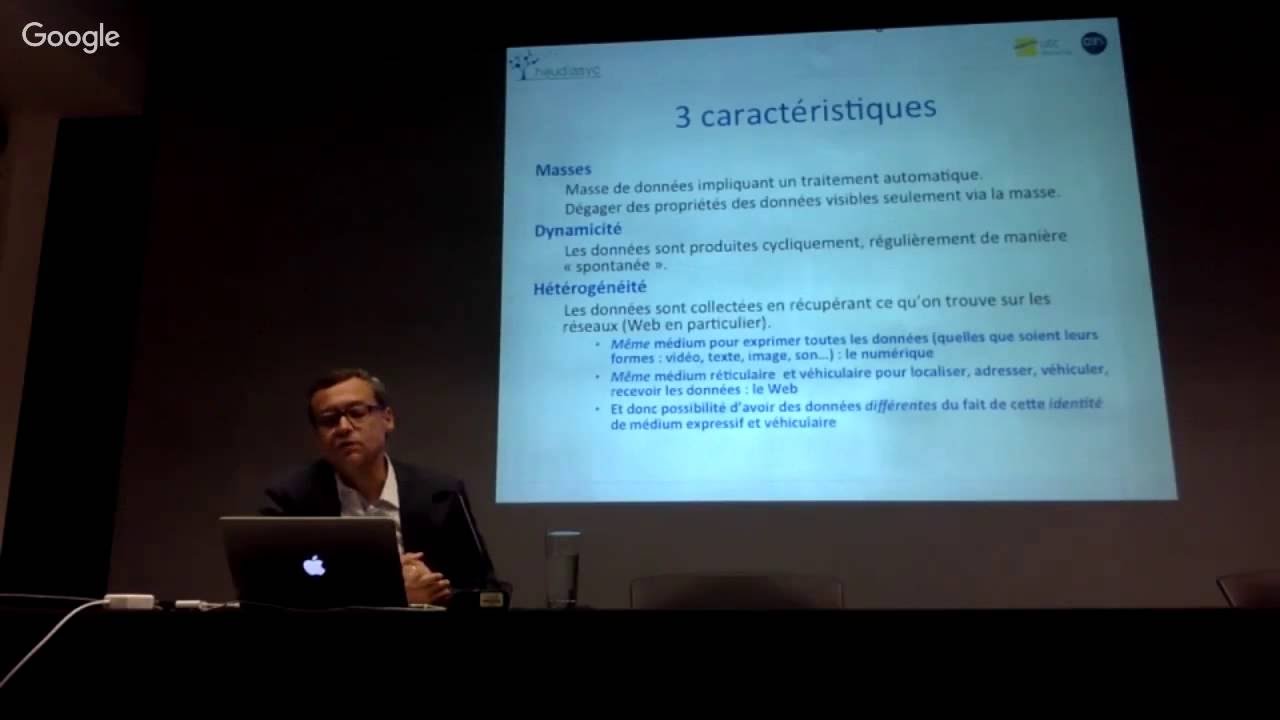
- Definition of Big Data through three characteristics: mass, dynamicity, and heterogeneity.
- Discussion of the 4Vs (volume, velocity, variety, veracity) and the idea that meaning emerges from the mass of data.
- Example of Google Flu Trends: correlation between search queries and flu epidemics; critique of the method.
- Examination of radical positions: Chris Anderson's 'end of theory' and the 'fourth paradigm' of Jim Gray.
- Introduction of the nominalist paradigm for the social realm, drawing on Bachelard and the notion of phenomenotechnics.
- Concluding remarks on the need for a new epistemology and anthropology in the age of data.
Cited Sources
- Detecting influenza epidemics using search engine query data — Referenced as the Google Flu Trends study, illustrating the predictive power and limitations of big data.
- The End of Theory: The Data Deluge Makes the Scientific Method Obsolete — Cited as an example of radical empiricism championed by Chris Anderson.
- The Fourth Paradigm: Data-Intensive Scientific Discovery — Mentioned in relation to Jim Gray's vision of a new scientific paradigm driven by data.
- Cultural Analytics — Referenced as a methodological approach proposed by Lev Manovich for studying culture through data.
Contribution & Novelties
The lecture’s original contribution lies in framing Big Data as a paradigm shift that mirrors the historical transition from language to measurement in natural sciences, now applied to social phenomena. Bachimont introduces the notion of a ’nominalist paradigm’ for the social realm, arguing that data, like measurements, constitute a new form of representation that requires new epistemological tools. He also highlights the paradox of intelligence: while data offer unprecedented access to complexity, they simultaneously obscure understanding through opaque algorithmic processes, reviving the Platonic paradox of knowledge. This perspective enriches the debate on digital humanities and data science.
Pour aller plus loin :
- Big data — Provides background on the technical and social aspects of Big Data.
- Nominalism — Historical philosophical doctrine relevant to Bachimont’s argument.
- Phenomenotechnics — Concept from Bachelard used in the lecture.
- Fourth Paradigm — Introduction to Jim Gray’s framework.
142 words
Radar Profile
The profile shows high scores in information quantity and reliability, with slightly lower technical depth. This suggests a well-informed and reliable lecture that is conceptually rich but not overly technical, making it accessible to a broad audience.