Aesthetic perspectives / Perspectives esthétiques #1
Keywords
Summary
163 words
Critical Evaluation
Value of the Information & Strength of the Argument
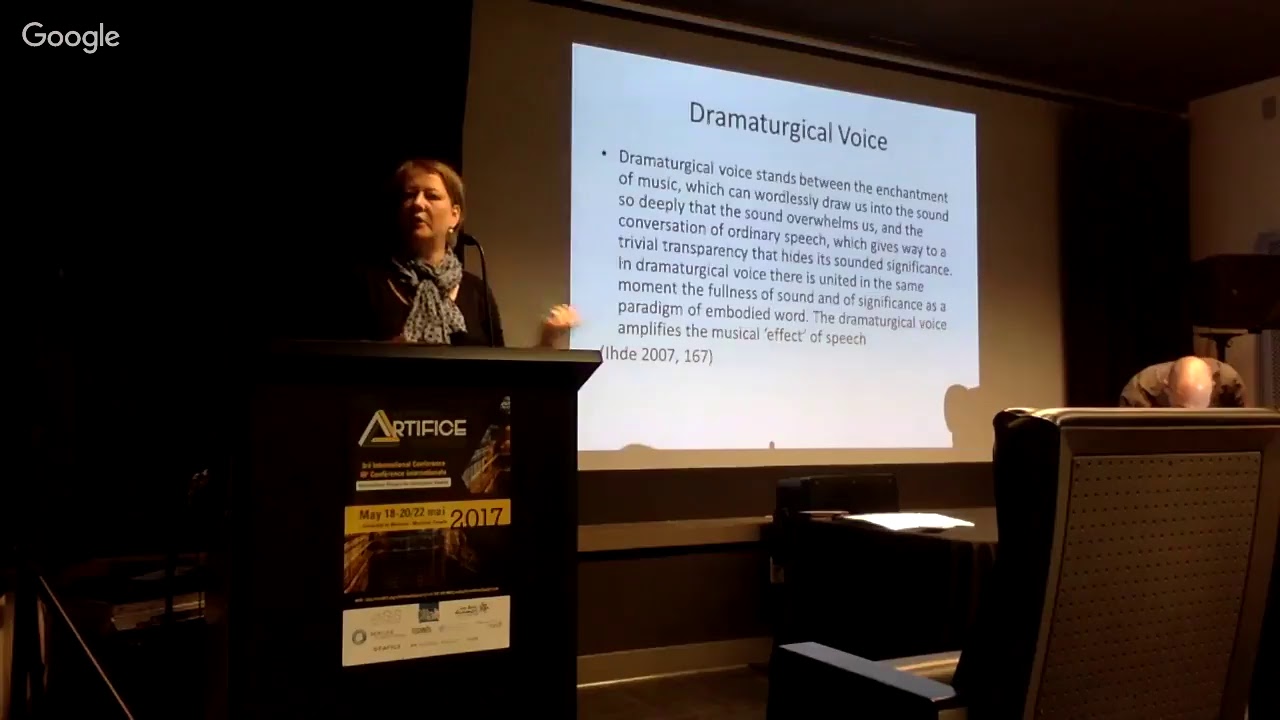
The value of the information lies in the practical insights shared from 15 years of experience in creating mixed reality theatre. Joris Weijdom provides a concrete case study that illustrates the complexities of interdisciplinary collaboration and the need for iterative prototyping. His argument for a ’technical dramaturge’ role is compelling, as it addresses a genuine gap in current production processes. Birgitte Stougaard Pedersen’s presentation is more theoretical but equally valuable, as she challenges simplistic notions of authenticity in digital media by focusing on the auditory experience of audiobooks. The argumentation is generally solid, grounded in practice or established theory, though the first presenter explicitly acknowledges using terms naively due to his practice-based background. The discussion also adds value by connecting historical examples (Wagner) to contemporary issues.
Scientific Rigor, Source Quality, Title Accuracy
The rigor is moderate: the speakers refer to academic concepts (Milgram’s continuum, post-phenomenology) and cite a publication by the first speaker, but they do not provide detailed source citations. The title ‘Aesthetic perspectives’ adequately captures the range of topics presented. The session is part of an academic colloquium, suggesting a baseline of scholarly integrity, but the lack of formal references in the video reduces the overall rigor. The audience discussion is relevant and contributes to the depth.
218 words
Title / Content Match
The title is broad but accurate, covering multiple aesthetic perspectives on mixed reality and voice in performance.
Quality & Reliability
7/10
The presentation offers practice-based insights from a technical dramaturge and a researcher on voice, with references to academic concepts (Milgram's continuum, post-phenomenology) but lacks rigorous citations. The format is a colloquium talk with limited formal verification.
Key Moments
Markers derived by PSI from the transcript: the creator did not define chapters.
- Introduction and start of Joris Weijdom's presentation
- Weijdom introduces his practice-based research and studio approach
- Presentation of the 'Well Data' project: 60 audience members, VR, and opera
- Discussion of prototyping and iterative design in mixed reality theatre
- Proposal for the profession of 'technical dramaturge'
- Q&A session with audience questions (including reference to Wagner)
- Start of Birgitte Stougaard Pedersen's presentation on voice and audiobooks
- Discussion of authenticity effects in digital voice
- Audio clip from audiobook read by Roxana Ortega
- Conclusion and further discussion
Cited Sources
- Authentic Artifice conference website — Official conference site for the International Society for Intermedial Studies colloquium where this presentation took place.
Concurring Sources
- Authentic Artifice conference website — The conference program likely lists abstracts of these presentations, confirming the topics.
Contribution & Novelties
The video provides rare insight into the practical challenges of creating mixed reality theatre from the perspective of a technical dramaturge, introducing a novel role that bridges art and technology. It also offers a nuanced analysis of voice authenticity in audiobooks, moving beyond simple dichotomies.
Pour aller plus loin :
- Milgram’s Reality-Virtuality Continuum — Foundational concept for thinking about mixed reality.
- Postphenomenology — Theoretical framework used in the voice analysis.
- International Society for Intermedial Studies — Background on the conference’s academic context.
82 words
Radar Profile
The radar profile shows moderate scores across all axes, with slightly higher on information quantity and technical level, reflecting a practice-based but conceptually grounded discussion. Lower quality information score suggests occasional vagueness in citations.