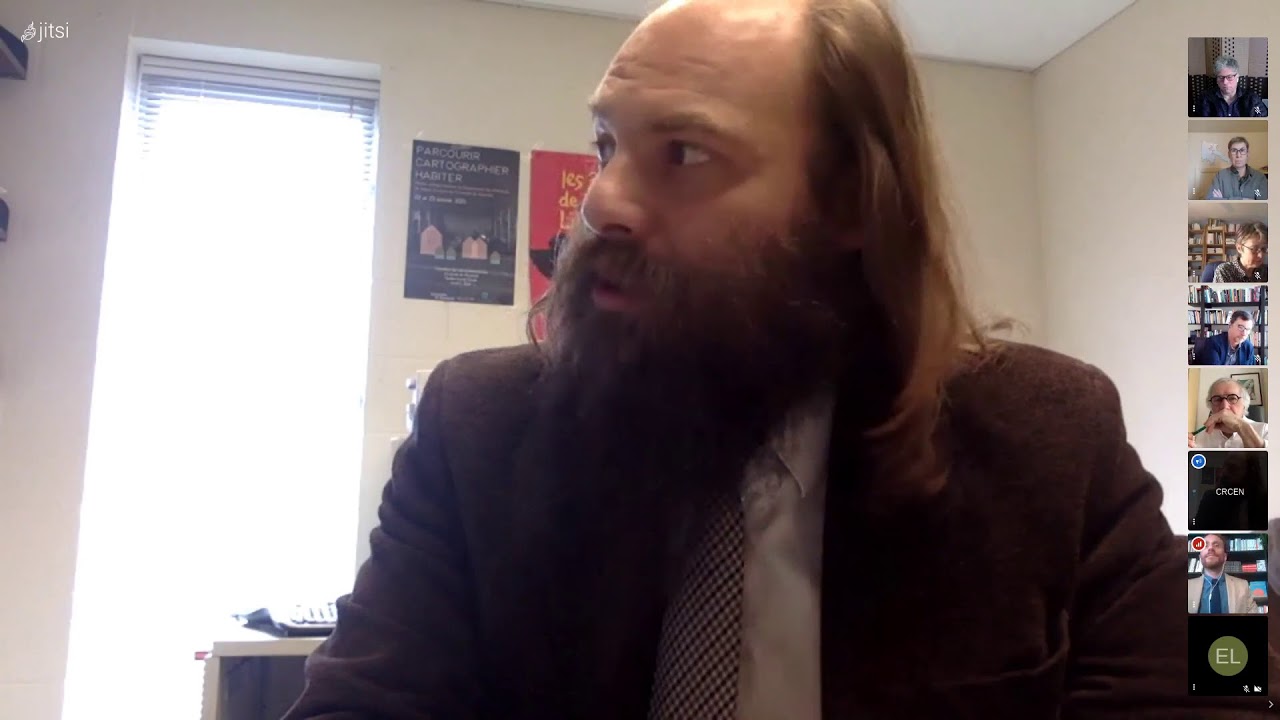
Diffusion en direct de Chaire de recherche sur les écritures numériques
Live broadcast of the Research Chair in Digital Writing
Keywords
Summary
145 words
Critical Evaluation
Value of the Information & Strength of the Argument
The information value lies in the original theoretical contribution to digital humanities, specifically the reframing of geolocation as a spatial form and the introduction of two novel concepts (‘plans-type’ and ‘oligopict’). The argumentation is systematically built, moving from historical spatial theories to contemporary digital practices, and is supported by concrete case studies. The candidate engages critically with Lefebvre’s limitations and extends the discourse through feminist and alternative perspectives, though acknowledges gaps in these areas. The reasoning is coherent and demonstrates a strong grasp of multidisciplinary sources, although some claims could benefit from more empirical evidence.
Scientific Rigor, Source Quality, Title Accuracy
The scientific rigor is high given the academic context of a thesis defense. The candidate cites canonical thinkers (Foucault, Lefebvre, Bachelard, Debord, Lynch, de Certeau, Haraway) and contemporary scholars like Vitali-Rosati, weaving them into a cohesive theoretical framework. The sources are academically sound but not independently verifiable from the video description, which is empty. The title accurately reflects the institutional origin of the content, and the video aligns with the given title. The defense format itself provides a measure of quality, with jury feedback reinforcing the credibility. No external corroboration or contradictions were found, as no other sources were referenced for comparison.
212 words
Title / Content Match
The title accurately describes the live broadcast of a research chair event, which the defense is, reflecting the institutional framing of the content.
Quality & Reliability
8/10
The video presents a doctoral thesis defense, indicating academic rigor and structured argumentation. However, as a live stream, the content is unedited and lacks verifiable citations in the description; the reliability of sources is inferred from the academic context rather than direct verification.
Key Moments
Markers derived by PSI from the transcript: the creator did not define chapters.
- Introduction and technical setup for the thesis defense
- Marcus begins his thesis presentation on space and digital literature
- Discussion of the spatial turn and introduction of key concepts (topology, geolocation)
- Presentation of case studies (Dérives, Fabien Girard) and proposal of the concepts 'plans-type' and 'oligopict'
- Jury questions and feedback, including feminist and cross-cultural perspectives
Cited Sources
- Michel Foucault - Des espaces autres — Mentioned in the thesis presentation as a foundational reference for the topology of space
- Henri Lefebvre - La production de l'espace — Cited for the tripartite model of spatial production
- Gaston Bachelard - Poétique de l'espace — Referenced for the ontological consistency of spatial imaginaries
- Guy Debord - Situationnisme — Mentioned for the social dimension of spatial imaginaries
- Marcello Vitali-Rosati - Editorialisation — Key theoretical influence for understanding the digital as a spatial practice
Contribution & Novelties
The original contribution of this thesis lies in the formulation of two novel concepts—‘plans-type’ and ‘oligopict’—which provide a framework for understanding geolocation not merely as a technological tool but as a culturally significant aesthetic practice. The application of these concepts to case studies demonstrates a creative synthesis of philosophical, geographical, and digital humanities perspectives, offering a fresh lens on the hybridization of physical and digital spaces.
Pour aller plus loin :
- Geolocation (Wikipedia) — Provides basic context on the technology and its applications.
- Spatial turn (Wikipedia) — Offers an overview of the intellectual movement that underpins the thesis.
- Digital humanities (Wikipedia) — Situates the interdisciplinary field to which this research belongs.
111 words
Radar Profile
The radar profile shows strong scores in quality, technical level, and reliability, all at 8, indicating a robust academic content. The quantity of information is slightly lower at 7, likely due to the limited transcript excerpt and the extensive content of a full defense. Overall, the video demonstrates high scholarly merit.