Grupo de Estudio | Intensivo de Primavera - Introducción a la Psicología CAPÍTULO 2
Study Group | Spring Intensive - Introduction to Psychology CHAPTER 2
Keywords
Summary
123 words
Critical Evaluation
Value of the Information & Strength of the Argument
The information is valuable for revision, as it condenses the textbook material into manageable points and highlights typical exam questions. However, the argumentation relies primarily on the authority of the textbook and the presenters’ own experience, not on critical evaluation or multiple sources. The reasoning is generally coherent but sometimes oversimplifies complex theories (e.g. reducing Kant to a mere synthesis of Plato and Aristotle). Still, the systematic organization by discipline and the emphasis on exam tricks can be genuinely useful for students.
Scientific Rigor, Source Quality, Title Accuracy
The scientific rigour is moderate. The presenters consistently refer to the course manual (by Kosakov) and align with its content, but they do not cite external references or studies. The title accurately describes the session’s purpose. The content is internally consistent, though occasional approximations (e.g. classifying the Pygmalion effect as a form of ideology) might mislead if taken too literally. The reliance on exam-centred tips rather than deep academic analysis limits its depth, but as a supplementary review tool it is adequate.
179 words
Title / Content Match
The title accurately reflects the content: a study group session focused on chapter 2 of the introduction to psychology course.
Quality & Reliability
6/10
The video provides a structured revision of chapter 2 with explicit test-oriented explanations, but it is a non-expert peer-led session (though apparently well-informed by the textbook). Concepts are simplified and occasionally approximate (e.g. the four forms of ideology), and no external sources beyond the course manual are referenced.
Key Moments
Markers derived by PSI from the transcript: the creator did not define chapters.
- Welcome and overview of the spring intensive schedule, plan for chapters, and study group logistics.
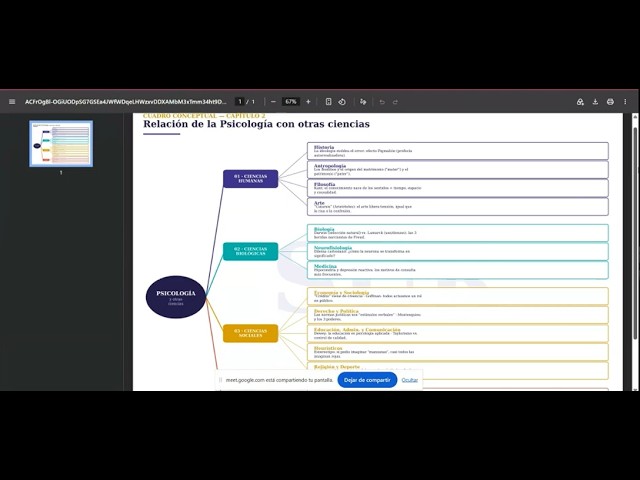
- Participants work on a multiple-choice quiz; the hosts provide a conceptual map of disciplines related to psychology.
- Discussion on psychology and history, focusing on historiography, ideology, and the Pygmalion effect.
- Philosophy section: empiricism vs rationalism, the synthetic role of Kant, distinctions between existential, analytic, and mind philosophy.
- Psychology and art: role of art, catharsis, and connection to emotional identification.
- Biological sciences: Lamarck vs Darwin, the three narcissistic wounds, and mention of Freud.
- Social sciences: economics, sociology (Goffman), law (Montesquieu, conduct of norms), and final recommendations.
Cited Sources
- WhatsApp group for the study session — Link shared in the video description for students to join the study group and access materials.
Concurring Sources
- Pygmalion effect - Wikipedia — Aligned with the video's mention of the concept in relation to expectations influencing behavior.
- Theory of mind - Wikipedia — Relevant to the video's clarification that theory of mind differs from philosophy of mind.
- Lamarckism - Wikipedia — Supports the discussion on evolutionary theories presented in the biology section.
Contribution & Novelties
The video offers an original, condensed review of chapter 2, tailored to exam preparation, with an accessible breakdown of complex philosophical and historical concepts, and practical test-taking tips. This peer-led approach can help students integrate textbook content more effectively.
Pour aller plus loin :
- Pygmalion effect — pertinent to understanding the psychological phenomenon mentioned in the video.
- Theory of mind — helps distinguish from philosophy of mind, as emphasized in the video.
- Lamarckism — relates to the biology section on evolutionary ideas.
- Philosophy of mind — provides a broader academic background to the video’s treatment of the mind-brain problem.
99 words
Radar Profile
The radar profile suggests a balanced but modest performance: information quantity is decent, but quality and technical depth remain moderate, and overall reliability is average. This indicates a useful but not exhaustive educational resource.