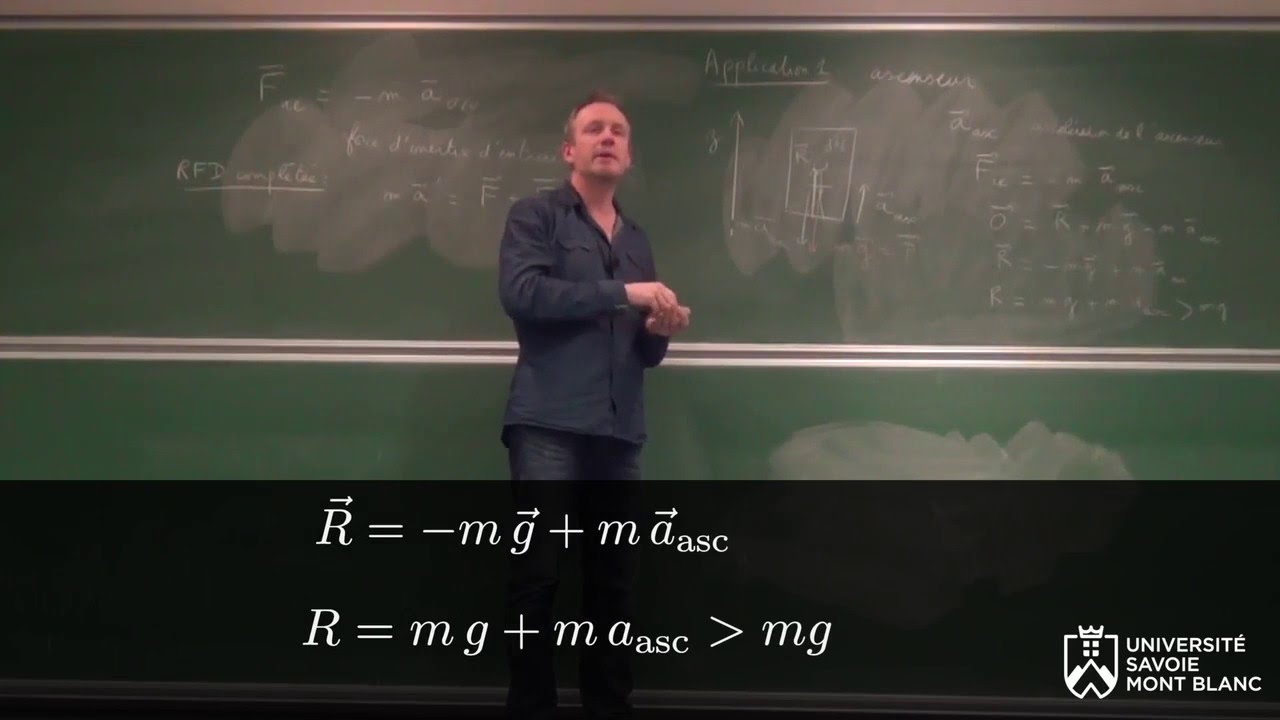
Mécanique, semestre 2, cours 5 : référentiels en translation
Mechanics, Semester 2, Lecture 5: Translational Reference Frames
Keywords
Summary
103 words
Critical Evaluation
Value of the Information & Strength of the Argument
The lecture provides a solid theoretical foundation for understanding inertial forces in translational non-inertial frames. The argumentation is rigorous: the professor starts from the composition of accelerations, derives the inertial force term, and then applies it to physical situations. He carefully addresses common misconceptions, such as the perception of weight in an elevator. The examples are well chosen and illustrate the physics clearly. The reasoning is logical and step-by-step, making it easy to follow for students.
Scientific Rigor, Source Quality, Title Accuracy
The lecture is based on standard physics textbook material and the professor’s own presentation. No external sources are cited within the video, but the description provides links to the course materials and related courses. The content aligns with standard university curriculum. The title is accurate, though it mentions ‘référentiels en translation’ which is precisely what is covered. The lecture does not claim to present original research but rather to explain established physics.
163 words
Title / Content Match
The title accurately reflects the content: the lecture focuses on reference frames in pure translation and the associated inertial forces.
Quality & Reliability
8/10
The lecture is delivered by a physics professor with clear mathematical derivations, standard pedagogical examples, and alignment with established physics education. The content is reliable and accurate, though it does not introduce new research.
Key Moments
Markers derived by PSI from the transcript: the creator did not define chapters.
- Introduction and recap of previous lecture on changing reference frames.
- Statement of the problem: mechanics in non-Galilean frames, focusing on pure translation.
- Derivation of the inertial force (force of inertia) from the composition of accelerations.
- Application to an accelerating elevator: calculation of the reaction force and discussion of perceived weight.
- Example of a freely falling frame leading to weightlessness and its physical interpretation.
- Application to an accelerating airplane and summary of inertial forces in translational frames.
Cited Sources
- Mécanique du point - Phys 111 — Course page for the mechanics course where updated video lectures are available.
- Introduction à la relativité restreinte — Related course that discusses reference frames in the context of special relativity.
Contribution & Novelties
The lecture offers a clear and systematic introduction to inertial forces in translational non-inertial frames, with a strong focus on physical intuition. It does not present original research but is valuable for its pedagogical quality. For further exploration, the following concepts are relevant: fictitious forces, the equivalence principle, and weightlessness.
Pour aller plus loin :
- Fictitious force — Covers the general concept of fictitious forces, including inertial forces in accelerating frames.
- Equivalence principle — Relates to the equality of gravitational and inertial mass, explaining why weightlessness occurs in free fall.
- Weightlessness — Discusses the condition of apparent weightlessness, relevant to the free-fall example.
103 words
Radar Profile
The radar profile shows balanced scores across quality, quantity, and technical level, indicating a consistent and reliable educational resource. The high reliability and technical scores reflect the rigorous derivation and clear explanations.