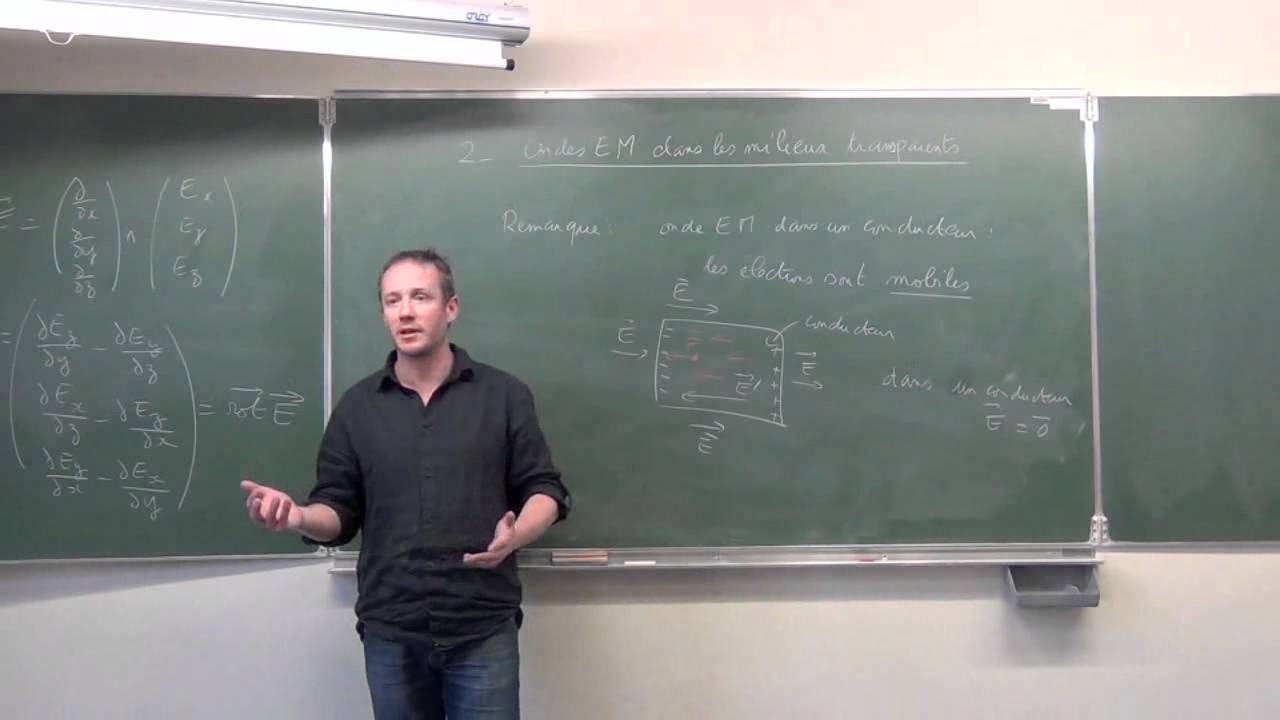
Optique ondulatoire - cours 1
Wave optics - lesson 1
Keywords
Summary
197 words
Critical Evaluation
Value of the Information & Strength of the Argument
The value of the information lies in a clear and methodical derivation of the wave equation from Maxwell’s equations, explicitly connecting fundamental electromagnetic theory to the nature of light. The argumentation is solid: each mathematical step is explained, and the instructor emphasizes the logical sequence, including the use of the vacuum condition, vector calculus identities, and the combination of equations. The interpretation of the speed of light as derived from electrostatic and magnetostatic constants is compelling and historically significant. The lecture successfully bridges basic electromagnetism and wave phenomena, providing a strong foundation for subsequent optics topics.
Scientific Rigor, Source Quality, Title Accuracy
The scientific rigor is high: the derivation follows standard textbook procedures, and the instructor takes care to justify each mathematical manipulation. The sources cited come from the video description, which links to a series of university physics courses and the official site of the University of Savoie. These are authoritative institutional sources. The title/content adequacy is perfect: the video indeed covers the first part of a wave optics course, starting with necessary electromagnetism recalls. There is no misleading information or unsupported claims.
193 words
Title / Content Match
The title accurately reflects the content: this is the first lecture of a wave optics course, combining an electromagnetism refresher with the derivation of wave propagation from Maxwell's equations.
Quality & Reliability
8/10
The lecture, given by a university professor, presents a rigorous derivation of the wave equation from Maxwell's equations, with clear explanations and appropriate technical depth for advanced undergraduate students. The content is accurate and well-structured.
Key Moments
Markers derived by PSI from the transcript: the creator did not define chapters.
- Introduction to the course structure and outline of topics.
- Discussion of electric and magnetic fields, forces on charges, and the concept of a field.
- Writing down Maxwell's equations in both divergence-curl and nabla notation.
- Derivation of the wave equation for the electric field from Maxwell's equations in vacuum.
- Identification of the wave speed as c=1/√(ε₀μ₀) and its comparison to the speed of light.
- Explanation of why a compass needle does not move under visible light due to the high frequency.
Cited Sources
- Cours de thermodynamique L2 — Description link to a related university course.
- Cours d'électromagnétisme — Description link to a related university course.
- Cours d'introduction à la relativité générale — Description link to a related university course.
- Cours d'optique ondulatoire — Description link to the current course series.
- Histoire des sciences, histoires de la lumière — Description link to a related university course.
- Introduction à la relativité restreinte — Description link to a related university course.
- Mécanique du point - PHYS 111 — Description link to a related university course.
- Optique géométrique - PHYS 112 — Description link to a related university course.
- Site de physique de l'université de Savoie — Description link to the university physics department page.
Contribution & Novelties
This video provides its own educational value by offering a clear, step-by-step derivation of the wave equation from Maxwell’s equations in a live lecture format. It frames the connection between electromagnetism and optics in a didactic manner, making it accessible to advanced undergraduates. The historical note about Maxwell’s identification of light as an electromagnetic wave is a valuable addition.
Pour aller plus loin :
- Maxwell’s equations — Core equations discussed in the lecture.
- Wave equation — The general form of the equation derived for the electric field.
- Speed of light — The physical constant linked to ε₀ and μ₀.
- Electromagnetic radiation — The broader concept of light as an electromagnetic wave.
111 words
Radar Profile
The radar profile shows high scores across all dimensions, with quantity, quality, technical level, and reliability all around 8/10. This reflects a well-structured and rigorous physics lecture that offers substantial information at an advanced undergraduate level, with reliable sourcing from a university professor.