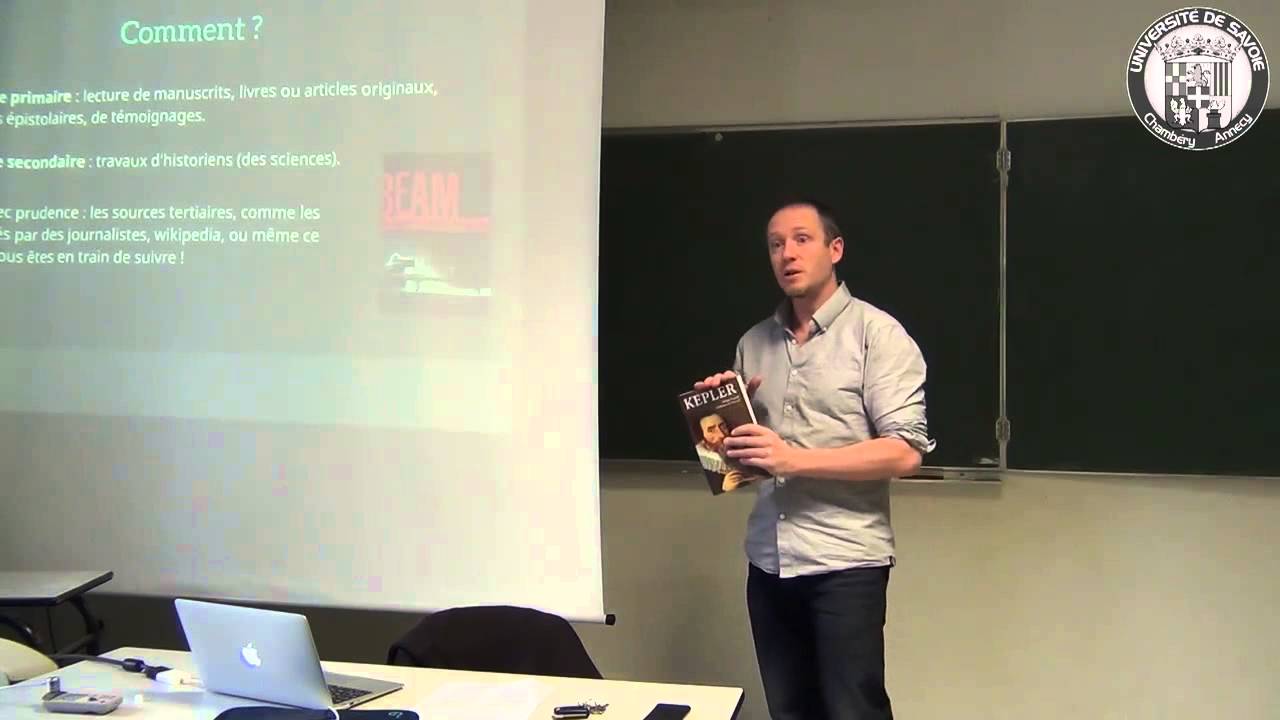
histoire des sciences - cours 1 : introduction
history of science - lesson 1: introduction
Keywords
Summary
191 words
Critical Evaluation
Value of the Information & Strength of the Argument
The video provides a solid conceptual foundation for understanding the history of science as a discipline. Taillet’s argumentation is clear and methodical: he presents multiple definitions of science, examines their implications, and uses concrete examples (Kepler’s refraction law, Rømer’s speed-of-light measurement) to illustrate why historical accuracy matters. He effectively demonstrates that history is not merely a collection of dates and anecdotes but a complex analysis of how ideas emerge and transform within specific social and intellectual contexts. The distinction between primary, secondary, and tertiary sources is particularly valuable, as it equips viewers with a practical toolkit for independent exploration. The argument persuades through careful reasoning rather than dogmatic claims, acknowledging his own limitations as a physicist rather than a trained historian. This honesty strengthens, rather than weakens, the credibility of the presentation.
Scientific Rigor, Source Quality, Title Accuracy
The scientific rigor is high for an introductory lecture: Taillet explicitly cites classic works (Kuhn, Wagner) and mentions an American Journal of Physics article on Rømer, indicating provenance for his claims. He avoids overgeneralization and openly cautions against text‑book simplifications, using the Kepler example to demonstrate how errors propagate. The title ‘histoire des sciences – cours 1 : introduction’ precisely matches the content, which is a first overview of the course’s approach and methodology. The lecture is well-structured, progressing from general definitions to practical methodological advice, and closes with a preview of future case studies (Kepler, laser history). While not a deep academic treatise, it fulfills its introductory role with intellectual honesty and appropriate referencing.
262 words
Title / Content Match
The title accurately reflects the content: this is the first lecture of a course on history of science, providing an introduction to the field.
Quality & Reliability
8/10
Lecture given by a physics professor with academic background; discusses methodological issues in history of science, cites classic works (Kuhn, etc.) and emphasizes critical approach to sources. Some simplifications expected in introductory lecture.
Key Moments
Markers derived by PSI from the transcript: the creator did not define chapters.
- Introduction of the course structure: focus on history of light as a pretext to explore general history of science.
- Explanation of the 'fractal' nature of historical depth—zooming in reveals endless complexity.
- Discussion on various definitions of science from Pierre Wagner's anthology.
- Thomas Kuhn's quote about the importance of history and its potential to transform the image of science.
- Critique of textbook anecdotes: the erroneous attribution of Kepler's refraction law to illustrate typical historical distortions.
- Methodological discussion on primary, secondary, and tertiary sources, and the role of interpretation.
- Examples of how different historians can interpret the same event differently (e.g., French Revolution analyses).
- Introduction of Kepler as a case study for upcoming lectures, with a note on primary literature difficulty.
Cited Sources
- Videos Université Grenoble Alpes - Formation — General page for the lecturer's physics courses at Université de Savoie.
- Histoire des sciences : histoire(s) de la lumière — Dedicated page for this course series, containing the full lectures.
- The Structure of Scientific Revolutions — Classic work by Thomas Kuhn, quoted in the lecture to illustrate the role of history.
- Les philosophes et la science — Anthology edited by Pierre Wagner, source of the first quoted definition of science.
- Article on Rømer's measurement of the speed of light (American Journal of Physics) — Mentioned as a source for historical details on Rømer's work; no specific reference given.
Contribution & Novelties
This lecture contributes an accessible, critical introduction to the discipline of history of science, emphasizing methodological pitfalls (e.g., reliance on secondary sources, interpretive bias) and advocating a fractal approach to historical exploration. It goes beyond simple chronology by integrating philosophy and concrete examples, making it a valuable primer for students and enthusiasts.
Pour aller plus loin :
- History of science (Wikipedia) — Overview of the field and its development.
- The Structure of Scientific Revolutions (Wikipedia) — Central work on paradigm shifts, cited in the lecture.
- Ole Rømer (Wikipedia) — Details on Rømer’s measurement of the speed of light, a key example discussed.
- Johannes Kepler (Wikipedia) — The case study for upcoming lectures.
112 words
Radar Profile
The radar profile shows a notably high score on information quality and global reliability (8/10 each), reflecting the lecturer's academic credibility and clear citing of sources. Quantity of information is moderate (6/10), consistent with an introductory, non-exhaustive lecture. Technical level is low (4/10) as expected for a methodological introduction rather than a detailed scientific exposition.