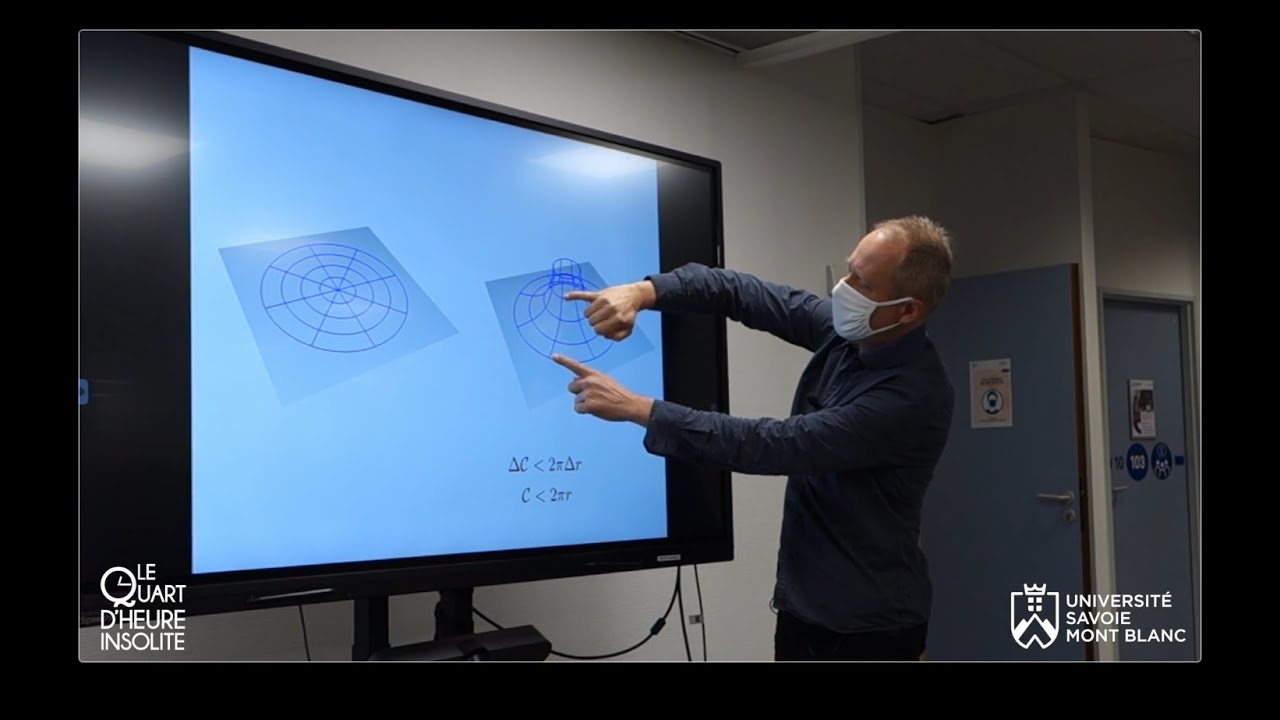
Quart d'Heure Insolite #24 : Dessine-moi un trou noir !
Quarter of an Hour Unusual #24: Draw me a black hole!
Keywords
Summary
152 words
Critical Evaluation
Value of the Information & Strength of the Argument
The video’s value lies in its clear, rigorous correction of widespread misconceptions about spacetime curvature. Taillet builds his argument step by step, using relatable analogies (spider, penguin, bubble gum) to explain intrinsic curvature without requiring a higher-dimensional view. He effectively demonstrates how common illustrations mislead by showing extrinsic curvature (a sheet with a ball) instead of intrinsic geometry. The argumentation is solid: he starts with an accurate statement of general relativity, identifies errors in typical depictions, and systematically replaces them with correct mental models. He also addresses potential misunderstandings, such as the difference between a cone and a sphere. The talk is intellectually honest, acknowledging what cannot be visualized (4D) and encouraging further study. However, some analogies are stretched (e.g., the bubble gum) and might confuse, yet overall the logical flow is strong.
Scientific Rigor, Source Quality, Title Accuracy
The scientific rigor is high: Taillet, a university researcher, presents the physics correctly and avoids oversimplification. He critiques specific illustrations from popular books, notably mentioning Carlo Rovelli’s work (though he clarifies that the criticism is not about the quality of the book). He provides a precise definition of intrinsic curvature and demonstrates it through geometric experiments. The sources used are his own library examples and a reference to Rovelli’s book; he also mentions the illustrator Clément Fabre. The title ‘Draw me a black hole!’ accurately reflects the content: it invites the audience to consider how black holes are depicted. The talk stays on-topic and fulfills its promise, making the adéquation strong. There is no notable discrepancy between the title and the content.
270 words
Title / Content Match
The title matches the content effectively: the talk addresses common representations of black holes and corrects them via spacetime curvature, as promised.
Quality & Reliability
9/10
The speaker is a physicist and professor, the content is well-structured and based on correct physics, with clear explanations and analogies. The critique of common illustrations is scientifically accurate and the pedagogical approach is sound.
Key Moments
Markers derived by PSI from the transcript: the creator did not define chapters.
- Introduction to the 'Quart d'Heure Insolite' series and topic of black hole illustrations.
- Presentation of common textbook illustrations of spacetime curvature, including a sheet with a ball.
- Introduction of the spider analogy to explain intrinsic curvature without leaving the surface.
- Demonstration with paper and a cone showing extrinsic vs. intrinsic curvature.
- Explanation of parallel transport with penguins on a sphere to detect curvature.
- Sphere and bubble gum analogy illustrating how circumference vs. radius behaves on curved surfaces.
- Transposition to 3D space and discussion of whether our universe could be curved.
- Note about a typo in a slide (Flamm vs. Flam) and conclusion.
Cited Sources
- Par-delà le visible: la réalité du monde physique et la gravité quantique — Referenced as an example of a popular science book that uses a misleading illustration of spacetime curvature, though the book itself is praised.
Contribution & Novelties
The video’s original contribution is a systematic critique of common black hole illustrations, replacing them with a correct conceptual framework for intrinsic curvature. It provides accessible analogies (spider web, penguin transport) that allow laypeople to grasp general relativity’s core idea without mathematical formalism. The emphasis on distinguishing extrinsic from intrinsic curvature is a valuable educational tool.
Pour aller plus loin :
- Intrinsic curvature — Key concept distinguishing curvature from embedding in higher dimensions.
- Parallel transport — Technique used to detect curvature via vector displacement.
- General relativity — The theory describing gravity as spacetime curvature.
- Carlo Rovelli — Author of the discussed book, known for loop quantum gravity.
107 words
Radar Profile
The radar profile shows high scores in quality and reliability, with slightly lower technical level reflecting the accessible presentation. The quantity of information is moderate but sufficient for the pedagogical goal. Overall, the video excels in clarity and accuracy.