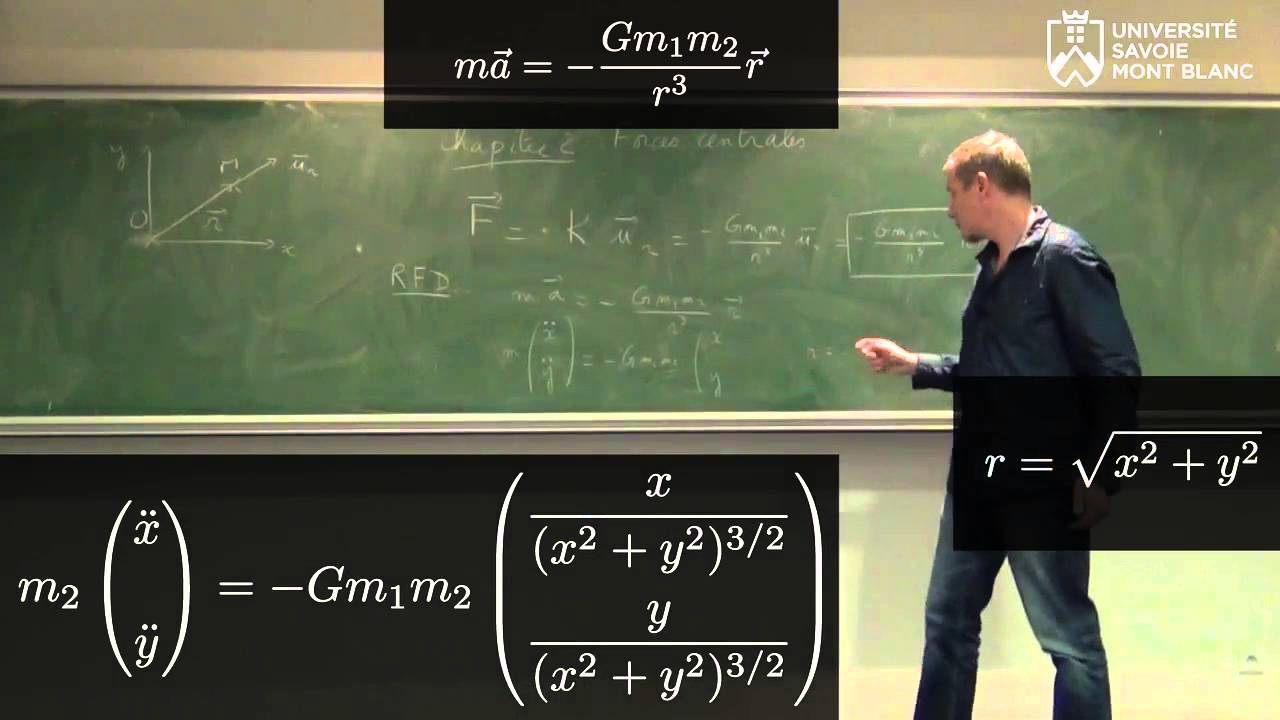
Mécanique, semestre 2, cours 2 : coordonnées polaires
Mechanics, semester 2, course 2: polar coordinates
Keywords
Summary
146 words
Critical Evaluation
Value of the Information & Strength of the Argument
The value of the information lies in its clear pedagogical treatment of a fundamental topic in mechanics. The instructor justifies the use of polar coordinates by showing the intractability of Cartesian equations for central forces, thus motivating the new approach. The argumentation is solid: each step is derived from first principles, with explicit use of chain rules and product rules, and the physical interpretation of each mathematical result is clearly stated. The lecture successfully bridges mathematical formalism and physical intuition, making it highly instructive for students.
Scientific Rigor, Source Quality, Title Accuracy
The lecture demonstrates high scientific rigor: definitions are precise, derivations are complete, and the reasoning is logically coherent. No external references are cited within the video, but the description provides links to the university’s podcast platform for related courses, indicating the material is part of an institutional curriculum. The title ‘Coordinates polaires’ accurately reflects the main topic, and the lecture delivers exactly what is promised. The teaching style includes pauses for student questions, enhancing clarity.
176 words
Title / Content Match
The title accurately reflects the content: the lesson focuses on introducing and using polar coordinates in mechanics, as well as central forces.
Quality & Reliability
9/10
The lecture is given by a physics professor, uses rigorous derivations and clear pedagogical structure. No external sources are cited beyond course materials available from the university, but the content is standard classical mechanics with high educational reliability.
Key Moments
Markers derived by PSI from the transcript: the creator did not define chapters.
- Introduction to central forces and motivation for new coordinates
- Expression of gravitational force as a central force
- Cartesian equations of motion and their complexity
- Introduction of polar and cylindrical coordinates
- Definition of radial and orthoradial unit vectors u_r and u_θ
- Derivation of the time derivative of u_r
- Expression of velocity in polar coordinates
- Beginning of acceleration derivation
Cited Sources
- Mécanique du point (PHYS-111) - podcast — Referenced in the description as the current version of this course.
- Cours de thermodynamique L2 — Listed in description as a related course.
- Cours d'électromagnétisme — Listed in description as a related course.
- Cours d'introduction à la relativité générale — Listed in description as a related course.
- Cours d'optique ondulatoire — Listed in description as a related course.
- Histoire de la cosmologie — Listed in description as a related course.
- Histoire des sciences : histoires de la lumière — Listed in description as a related course.
- Introduction à la relativité restreinte — Listed in description as a related course.
- Optique géométrique (PHYS-112) — Listed in description as a related course.
- Site de la formation en physique à l'université Savoie — Provided in description for further information.
Contribution & Novelties
The lecture provides a clear didactic transition from Cartesian to polar coordinates in classical mechanics, emphasizing why the latter simplifies central force problems. It systematically derives the expressions for velocity and acceleration, highlighting the crucial difference from Cartesian basis vectors. The originality lies in the pedagogical approach, making the often-tricky concept of non-inertial basis vectors accessible to undergraduate students.
Pour aller plus loin :
- Polar coordinate system — Overview of polar coordinates and their mathematical properties.
- Central force — Definition and properties of central forces, with examples.
- Gravitational two-body problem — Application of polar coordinates to planetary motion and the derivation of orbits.
- Equations of motion — General context of kinematic equations this lecture builds upon.
116 words
Radar Profile
The radar profile shows high scores across all dimensions, with the weakest being technical level (8) compared to other 9s, indicating a very solid but not maximally advanced treatment suitable for its target audience.