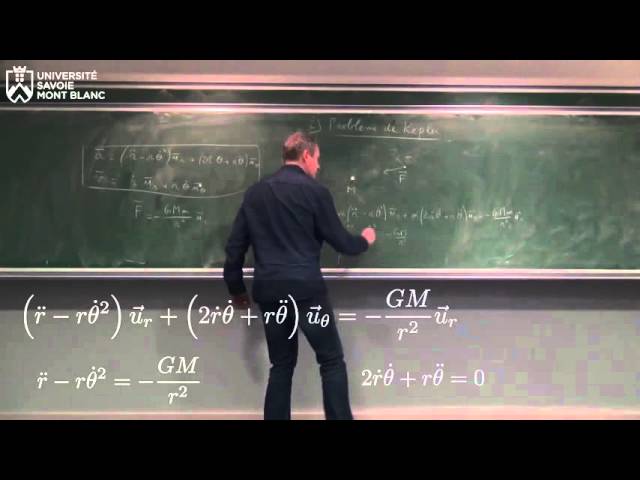
Mécanique, semestre 2, cours 3 : problème de Kepler
Mechanics, Semester 2, Lecture 3: Kepler's Problem
Keywords
Summary
150 words
Critical Evaluation
Value of the Information & Strength of the Argument
The video provides a high pedagogical value through its step-by-step derivation of the Kepler problem, making complex gravitational dynamics accessible to students. The argumentation is rigorous and follows standard textbook methodology, relying on Newton’s laws, conservation of angular momentum, and conservation of energy. The lecturer carefully explains each mathematical step, including derivative and integration techniques, which strengthens the logical continuity. The physical interpretations, such as the universality of free fall and the meaning of the areal constant, enrich the understanding. The reasoning is sound and coherent throughout, with no logical gaps detected.
Scientific Rigor, Source Quality, Title Accuracy
The scientific rigor is excellent: the derivation is canonical and follows the work of Newton and Kepler. The lecture does not cite external sources directly, but the description provides links to updated course materials and other physics courses, which serve as references. The title accurately reflects the content: it is a mechanics course lesson dedicated to the Kepler problem. The video is well-structured and the explanations are precise, though the technical level is intended for undergraduate students. Overall, the rigor is appropriate for an academic setting, and the title is in perfect alignment with the presented material.
204 words
Title / Content Match
The title accurately describes the content: a lesson on the Kepler problem in a mechanics course.
Quality & Reliability
8/10
The lecture is given by a professor, rigorous derivation of Kepler's laws from Newtonian gravity, based on standard physics. The video is a full course with clear steps.
Key Moments
Markers derived by PSI from the transcript: the creator did not define chapters.
- Presentation of the Kepler problem and simplifying assumptions (fixed central mass).
- Derivation of equations of motion in polar coordinates and simplification by mass.
- Conservation of angular momentum and definition of the constant C (constant of areas).
- Integration of the radial equation and interpretation in terms of total energy.
- Change of variable to u = 1/r and simplification of the differential equation.
- Solving the differential equation and deriving conic section trajectories, leading to Kepler's laws.
Cited Sources
- Podcast Grenet - Course version — Updated version of this mechanics course and other physics courses.
- Podcast Grenet - Other courses — Link to other physics courses at Université de Savoie.
- Podcast Grenet - History of physics — Link to history of physics courses.
- Podcast Grenet - Introductory courses — Link to introductory physics courses.
- Podcast Grenet - Optics — Link to optics courses.
- SFA University of Savoie — Information about physics programs at Université de Savoie.
Contribution & Novelties
The video offers a clear pedagogical derivation of Kepler’s laws from Newtonian gravity, with careful explanations of each mathematical step. Its originality lies in the didactic approach: the lecturer explicitly connects conservation laws (angular momentum, energy) to the solution of the differential equation, and uses the substitution u = 1/r to simplify the problem into a harmonic oscillator. This method is standard but presented with great clarity, making it a valuable resource for students. For the scientifically curious, the discussion of central forces and orbital mechanics can be deepened with basic references.
Pour aller plus loin :
- Kepler’s laws of planetary motion — Historical and mathematical context of the three laws.
- Classical central-force problem — Detailed derivation of central force motion, including the use of the reciprocal substitution.
- Two-body problem — Generalization when both masses move, relevant for real celestial mechanics.
141 words
Radar Profile
The radar profile shows very high scores in quantitative content and technical level, with slightly lower but still solid reliability and quality. This reflects a dense, advanced university lecture, excellent for its educational purpose.