Mécanique, semestre 2, cours 1 : moments de force
Mechanics, semester 2, lesson 1: moments of force
Keywords
Summary
122 words
Critical Evaluation
Value of the Information & Strength of the Argument
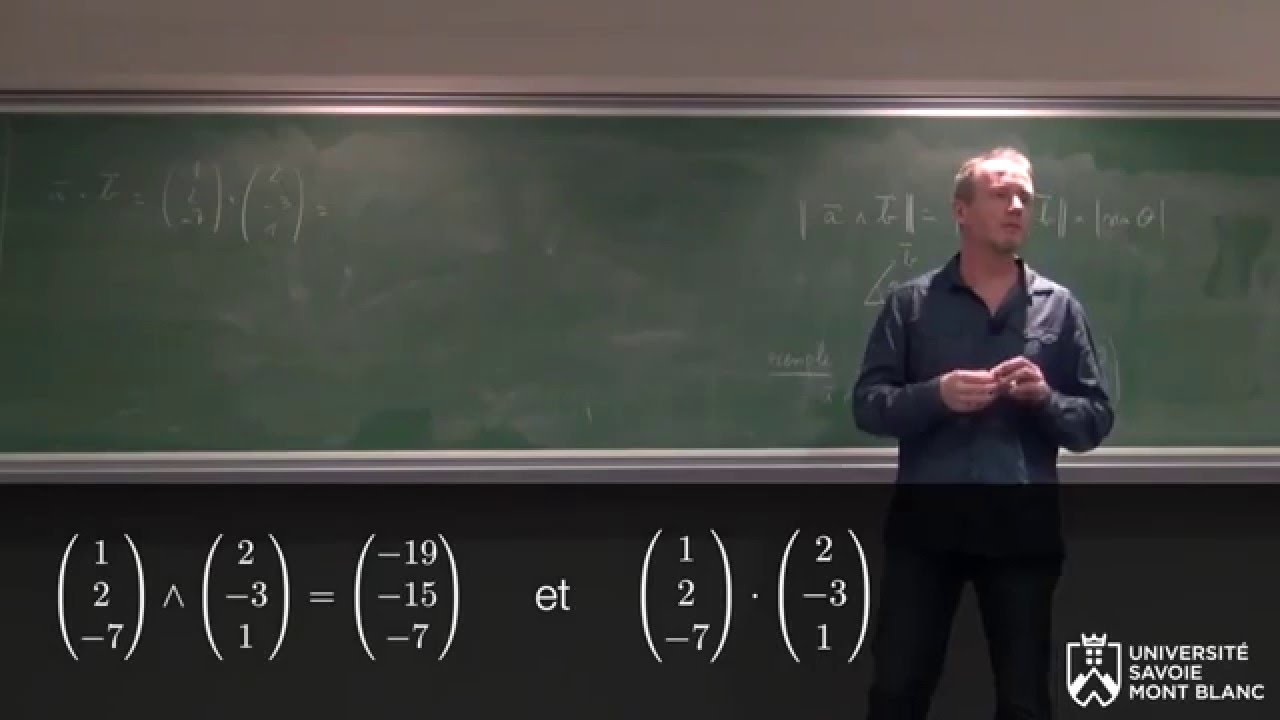
The primary value of this lecture lies in its meticulous pedagogical construction, building from a known law (F=ma) to a novel concept via a formal derivation. The argumentation is logically sequenced: it first demonstrates the inadequacy of force alone to explain rotational motion, then introduces the cross product as the necessary tool, and finally derives the moment of force and angular momentum theorem. The lecturer takes care to justify each step, including a worked example to clarify the algebraic structure. The geometrical interpretation of torque as the magnitude rF sin θ is clearly explained, providing intuition. The presentation is rigorous and methodical, typical of good introductory university teaching.
Scientific Rigor, Source Quality, Title Accuracy
The scientific rigor is high for an undergraduate lecture: all definitions are precise, the derivation of the angular momentum theorem is complete, and the properties of the cross product are explicitly stated and used. No specific external sources are cited within the video itself, but the description provides links to complementary course materials and the faculty website, indicating institutional backing. The title accurately reflects the content, as the entire session is devoted to moments of force and preparatory notions. The video is self-contained and follows standard textbook treatments of classical mechanics.
214 words
Title / Content Match
The title accurately describes the content: a first course session on moments of force within a semester 2 mechanics course.
Quality & Reliability
9/10
The lecture is given by a university physics professor and covers established concepts in classical mechanics (cross product, moment of force, angular momentum). The presentation is rigorous, with derivations and worked examples. No controversial claims are made.
Key Moments
Markers derived by PSI from the transcript: the creator did not define chapters.
- Introduction: course overview, motivation for studying moments of force, and outline of the semester.
- Recall of the cross product: definition, properties, and geometrical interpretation.
- Definition of angular momentum for a point mass and derivation of its derivative.
- Introduction of the moment of force and statement of the angular momentum theorem.
- Geometrical interpretation of the moment of force, projecting the force line of action.
Cited Sources
- Updated course videos (Mécanique du point) — The description provides a link to the most recent version of the course videos, including the one discussed.
- Physics faculty at Université Savoie Mont Blanc — Link to the physics program at the university for further context.
- Other courses by the same instructor — Example of another course provided in the description, indicating a series.
Concurring Sources
- Torque (Wikipedia) — Confirms the definition and properties of moment of force as presented in the lecture.
- Angular momentum (Wikipedia) — Discusses the conservation of angular momentum, consistent with the theorem presented.
External References
Contribution & Novelties
This video’s contribution is primarily pedagogical rather than research-oriented. It offers a clear, step-by-step introduction to the moment of force, a fundamental concept in mechanics, with careful attention to mathematical detail and student comprehension. The lecturer’s approach of leading students from the known (Newton’s second law) to the new (torque and angular momentum) is an effective teaching method. The choice to start with a review of the cross product is practical for reinforcing prerequisite knowledge.
Pour aller plus loin :
- Torque — Directly extends the concept of moment of force to rigid-body rotations.
- Angular momentum — A conserved quantity in many physical systems, related to the lecture’s discussion.
- Cross product — The mathematical operation underpinning all definitions in the lesson.
120 words
Radar Profile
The radar profile shows high scores in information quality and reliability (9 each), a strong rating of 9 for overall reliability, with slightly lower but still solid scores for quantity (8) and technical level (7). This indicates a well-balanced lecture that provides substantial content without overwhelming complexity, suitable for undergraduate students.